

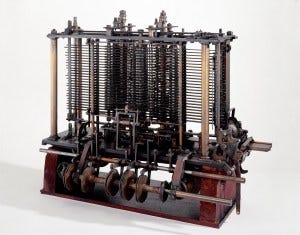
Charles Babbage’s Analytical Engine – at least, the portion he did manage to build. Ada Lovelace published the first ‘computer programme’ for it.
Science Museum London. Photo via Wikimedia Commons.
‘Once you learn to read, you will be forever free.’
Frederick Douglass
What do Leonardo da Vinci, Benjamin Franklin and Mary Wollestonecraft have in common?
What about Ada Lovelace and Jimi Hendrix?
For most people, learning happens at school. The traditional method can hamper innovation, though. If we fill everyone’s heads with the same ideas, can we really expect creative and original thoughts to pop out?
Autodidacts are people who teach themselves. Mostly. They might have had some schooling and found teachers along the way, but their knowledge is unique. Their way of thinking about the world is unlike anyone else’s.
Becoming responsible for your own education is not a simple process. There are false starts and dead ends. Hours spent on something you just don’t get.
But for autodidacts, the difficulty of the process is its strength. You can learn things other people can’t – or won’t. Because the journey is unpredictable, so are the results.
Teaching yourself
Given the choice, many autodidacts may have chosen the conventional learning route.
They did things differently because they had to.
They were excluded because, like Ada Lovelace and Mary Wollestonecraft, they were women, like Michael Faraday and Andrew Carnegie, they were too poor to receive an education, like Leonardo da Vinci, they were born out of wedlock, or Frederick Douglass and Jimi Hendrix, their skin was the wrong colour.
Their unconventional routes to knowledge gave them the tools to change the world. Michael Faraday’s discoveries changed our understanding of electricity and magnetism. Mary Wollstonecraft’s work laid the foundations for women’s rights movements. Frederick Douglass became a legendary speaker and pioneering abolitionist.
For many autodidacts, being outside the mainstream meant they could challenge convention. They didn’t need to follow the rules their peers were taught.
Many of these figures seem to have little in common. It’s hard to imagine two revolutionaries more different than Frederick Douglass, the social reformer, and Michael Faraday, the physicist. But, like many other autodidacts, they read obsessively.
Faraday, when he was an apprentice bookbinder, read every book he bound, taking meticulous notes in the process. As a slave, Frederick Douglass wasn’t allowed to learn to read and write, so he taught himself and later escaped. The urge to discover more through books stayed with him for life.
Superficially, the stories of Jimi Hendrix – born into poverty in Seattle in 1942 – and Ada Lovelace – the nineteenth-century English aristocrat – have little to connect them. They had different goals, faced different challenges and overcame these in different ways.
Like many autodidacts, however, their path to greatness hides lessons that we can all learn from. Their stories show the lengths you have to go to change the way the world thinks.
Lesson 1: The barriers you face can become your greatest strengths
So, you want to become a rock guitarist?
You want to change the face of rock and roll music forever.
You want your name and face to become synonymous with the instrument.
Where do you start?
A guitar, obviously. You’ll need lessons. Only then can you begin to dream.
Often, it’s our conventional assumptions that can hold us back. And our constraints can provide an opportunity to change the way things are done.
Jimi Hendrix didn’t have an easy start in life. He struggled at school and spent hours under the teacher’s desk as punishment for talking to friends.
Outside school, he was writing his own poetry so complex his cousin had to read each line again and again to understand it.
His parents were alcoholics and often fought. They separated when Hendrix was nine and his mother died when he was fifteen. His father refused to take him to the funeral, offering him a shot of whisky instead, as that was how men dealt with loss.
There was never a spare cent when Hendrix was growing up, so Hendrix had to help his father out removing rubbish from people’s houses. One day he came across a ukulele in an old woman’s house.
The ukulele only had one string.
He asked the woman if he could keep it.
He began to teach himself music while listening to the radio. It was rare to hear black musicians, so he played along to Elvis and Buddy Holly on his single-stringed ukulele.
A year later, he got his first acoustic guitar for $5. This was all he could afford. It was a right-handed guitar, and Hendrix was left-handed, so he restrung it and played it upside-down.
This contributed to his unique sound, but it also had symbolic significance. Even when he could afford a left-handed guitar, he continued playing a right-handed one upside down – it reinforced his image as someone who upturned convention.
According to music professor Jeanne Bamberger, many musical prodigies face a ‘midlife crisis’ during adolescence following a childhood undergoing an intense and often externally dictated practice regime. During this teenage period of self-discovery, they question what makes them special. They begin to wonder how they can do the things they’ve always taken for granted. It’s a period that can make or break their musical careers.
As an autodidact, Hendrix didn’t face this crisis. He was just getting started.
His journey almost ended, though, before it really began.
Lesson 2: Steal, borrow, appropriate – it’s all a learning experience
When Hendrix was nineteen, he was caught riding in a stolen car.
It wasn’t the first time.
He was given a choice – army or jail. He joined the 101st Airborne Division but was discharged a year later for his lack of focus. He didn’t want to be a soldier; he just wanted to play guitar.
It wasn’t a wasted experience. Hendrix was intensely attached to sounds. He absorbed them in the same way others might revel in a meal at a Michelin-starred restaurant.
He realised he wanted to make his guitar sound like the horn in the swing bands he’d heard on his father’s records, or like the wind rushing past his ears as he plunged towards the earth as a paratrooper.
But as a black musician during a time of segregation, he struggled to get gigs. Later, he talked about the hell of sleeping outside between tenements, rats running across his chest. At times, he was reduced to eating orange peel and tomato paste.
It would have been easy for Hendrix to give up. Try rejoining the army – or go back to stealing cars.
Instead, when he was given a gig, he wasn’t going to waste the opportunity. He made sure he was noticed.
He created the most electrifying live performance possible.
When he saw something he liked, Hendrix incorporated it into his repertoire. In Seattle, he saw a guy playing guitar with his teeth. Hendrix copied him. And learnt to play his guitar behind his head for good measure.
His live act gained a reputation; soon, the crowds began to get out of control. When an audience in Munich invaded the stage, Hendrix fled. He smashed his guitar in the process. The crowd went wild. Hendrix incorporated the guitar destruction into his act.
Lesson 3: Learn from everyone
Everything he heard or saw became a lesson for Hendrix. He wasn’t limited by genre. ‘I just hate to be in one corner,’ he said. He learnt the blues and rock and roll but also listened to Bob Dylan and classical music.
He covered other people’s songs, imbuing them with a manic energy. He experimented with distortion and feedback, incorporating the newly invented wah-wah pedal that makes songs like Voodoo Child so distinctive.
If Hendrix had been properly trained, the jazz musician Miles Davis noted, it would have affected the way he expressed himself. Had he ‘known all that other stuff,’ he might have played a different way.
It was the challenges he faced that allowed Hendrix to reinvent rock music.
But challenge can come in many forms. The way we overcome them defines who we are and what we can achieve.
Lesson 4: Choose the right teacher
It’s almost impossible to imagine an upbringing more different to Jimi Hendrix’s than that of Ada Lovelace.
Her father was the poet Lord Byron. He had been expecting a ‘glorious boy’ and was disappointed when he didn’t get one. Ada’s parents separated a month after she was born. Byron left England, never to return.
Ada’s mother was terrified that Ada might inherit Lord Byron’s madness. She later said of Ada, ‘I am told she is clever — I hope not; and, above all, I hope she is not poetical.’
To keep her away from the ‘poetical’, Ada was forced to follow a strict educational curriculum tailored to the mathematical and the logical. When Ada was six, her mother found out that geography was her favourite lesson. Lady Byron sacked Ada’s tutor and replaced the geography lessons with arithmetic.
When her mother thought she wasn’t working hard enough, Ada was put into solitary confinement, made to lie motionless and to write letters of apology.
Still, Ada was lucky to get any education.
Universities and scientific institutions were closed to women, but her connections gave her access to some of the greatest minds in the country.
She began corresponding with Augustus De Morgan, the first professor of mathematics at the University of London. De Morgan was impressed by her intellect. Had she been a young man about to go to Cambridge, De Morgan thought, the powers Ada possessed could have made her a mathematician of ‘first-rate eminence’.
He told Ada’s mother that Ada could reach the boundaries of mathematical knowledge – and even push beyond them.
Another tutor, Mary Somerville, the first person in history to be described as a ‘scientist’, had even more influence over Ada’s story – and the story of the computer.
Lesson 5: Cross boundaries
Somerville introduced Ada, aged seventeen, to the inventor Charles Babbage. Babbage was working on a calculation machine for the British government, the Analytical Engine.
It was one of the most ambitious projects of its era, a mass of wheels and cogs. The Analytical Engine possessed many of the elements of a modern computer. It could be ‘programmed’ with punch cards. It could print an output. The position of its wheels formed its memory. The processor was ‘the mill’, a set of gears and cogs which could perform arithmetic.
It was too far ahead of its time. Babbage built parts and prototypes but never completed the machine.
His friend Ada, however, recognised the machine’s power. It was Ada who published the first programme for it, the first algorithm – the conversion of mechanical computing functions into logic.
Babbage saw the Analytical Engine as a powerful calculator. Ada thought it had more potential. If sounds could be turned into computing language, she thought, ‘the engine might compose elaborate and scientific pieces of music of any degree of complexity or extent.’
She also warned that the Analytical Engine could not produce original thought. While it could calculate, ‘it has no power of anticipating any analytical revelations or truths’.
A century after Ada’s publication, Alan Turing took issue with ‘Lady Lovelace’s objection’, arguing that machines could produce original results we couldn’t have predicted.
It is a debate that still rages today, with discussions about the capabilities of AI.
Ada’s passion was mathematics, but that alone wasn’t enough for her. She often expressed her thoughts through poetic rather than dry scientific language and brought her imagination to whatever she was studying. This allowed her to see the potential for the Analytical Engine – and, by extension, modern computers – before even its inventor could.
Lesson 6: You don’t need exams or grades
Ada had tutors, who helped drive her towards the boundaries of mathematics – and beyond, into the theory of computing, a world that had not previously existed.
Hendrix created his own curriculum. He played a single-string ukulele because that was all he had. He learned the songs of Elvis and Buddy Holly because that was what they played on the radio. He borrowed from the acts he saw on stage – mainly black musicians – because those were the ones he was allowed in to see.
It wasn’t organised. It didn’t have milestones or grades. Progress would have been frustratingly hard to measure. But Hendrix was driven along by a need to learn and play, something so deep it was impossible to put into words.
Lesson 7: Whatever you choose to do, work hard at it
There is no shortcut to greatness. Hendrix’s appetite for playing the guitar was voracious. He regularly spent eight to ten hours a day practising. Sometimes, he even went to sleep holding his guitar.
Later, in the studio, he insisted on hundreds of takes. The records had to match the sound in his head.
Ada Lovelace was recognised as a great mathematician at 18 and it was around this time she became interested in the Analytical Engine. She didn’t write her groundbreaking notes on the machine for another decade, though. In between, she wasn’t idle; she was always seeking new ways to learn.
Lesson 8: Find your calling
Jimi Hendrix and Ada Lovelace died young. Who knows what they could have achieved if Hendrix had lived past twenty-seven and Ada past thirty-six.
It’s testament to their achievements, though, that we still remember them. Even in the short time they had, they made their mark on the world. They did this, in part, by following their heart.
In elementary school, Hendrix clung to a broom, holding it like it was a guitar. He went everywhere with it. He was so attached to it that the school’s social worker got involved. She wrote to the school insisting that unless they bought him a guitar, he might suffer permanent psychological damage.
The school authorities weren’t convinced.
Later, he promoted himself to a cigar box with an elastic band across it before finding the single-stringed ukulele.
Ada’s combination of obsessive, self-led learning and imagination was evident from a young age. Aged twelve, she decided she wanted to fly. She constructed wings, testing out every material she could find. Like Leonardo da Vinci, she made a careful study of birds’ wings and anatomy. She even wrote a book, Flyology, showing her findings.
Jimi Hendrix and Ada Lovelace didn’t start off as geniuses. They became one through a combination of determination, imitation, innovation, and taking every opportunity to learn.
By following the way of the autodidact – finding mentors, combining ideas and focusing on learning rather than exams or grades – you can take responsibility for your own education.
This way, you can build a body of knowledge that is as unique that of Ada Lovelace or Jimi Hendrix.
Sources:
On Jimi Hendrix:
Morrissey, A.-M. (2001) Beyond the image: The giftedness of Jimi Hendrix. Roeper Review, 24(1), 5–11
van der Bliek, R. (2007) The Hendrix chord: Blues, flexible pitch relationships, and self‑standing harmony. Popular Music, 26(2), 343–364.
Waksman, S. (1999). Black sound, black body: Jimi Hendrix, the electric guitar, and the meanings of blackness. Popular Music and Society, 23(1), 75-113
Whiteley, S. (1990) Progressive rock and psychedelic coding in the work of Jimi Hendrix. Popular Music, 9(1), 37–60
On Ada Lovelace:
Hollings, C., Martin, U., & Rice, A. (2017) The early mathematical education of Ada Lovelace. BSHM Bulletin: Journal of the British Society for the History of Mathematics, 32(3), 221–234
Hollings, C., Martin, U., & Rice, A. (2017). The Lovelace–De Morgan mathematical correspondence: A critical re-appraisal. Historia Mathematica, 44(3), 202-231
University of St Andrews. MacTutor History of Mathematics Archive: Quotations from Ada Lovelace. Available at: https://mathshistory.st-andrews.ac.uk/Biographies/Lovelace/quotations/
Other sources:
Bamberger, J. (1982). Growing up prodigies: The midlife crisis. New Directions for Child and Adolescent Development, 1982(17), 61-77
The post Educate Yourself appeared first on Get Curious.