

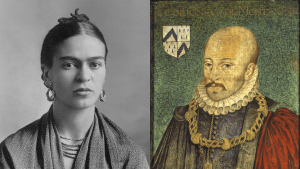
Frida Kahlo (L) by Guillermo Kahlo (1932) and Montaigne (R) by Daniel Dumonstier (c. 1588)
‘I would rather be an expert on me than on Cicero’
Montaigne
An eventful bus ride
Age six, Frida Kahlo contracted polio. The standard medical treatment at the time was rest and isolation.
It wouldn’t be the only time in her short life she would be confined to her home.
Her father, an architectural photographer, watched the loneliness eating little Frida up. He taught her how to develop and retouch photos. The techniques she learnt – the tiny brushstrokes, how to take care of her equipment – stayed with her for life.
She returned to school, marked forever by her disease. One leg was shorter than the other, and her peers mocked her for it. Art was a source of comfort to her. She became an apprentice to her father’s friend, an engraver, to help her family out, although she never considered a career as an artist.
A high-achieving, if rebellious student, she was only one of a handful of girls admitted to the prestigious National Preparatory School in Mexico City. She was planning to study medicine when the accident happened.
Kahlo was returning home from school with her boyfriend, Alejandro Gómez Arias, when she realised she’d left her umbrella behind. They got off the bus and went back for it. The next bus that came along was so crowded they only just managed to squeeze on.
Gómez Arias later described the incident:
The tram with two wagons approached the bus slowly. It slammed into the middle of the vehicle. The bus had a strange flexibility. It twisted and didn’t break … As soon as the bus reached its maximum flexibility, it cracked into thousands of pieces
When Kahlo came to, her friends were helping her up, which wasn’t an easy job: she had been impaled by an iron handrail, ‘the way a sword pierces a bull,’ as she would later describe it. The handrail had pierced her abdomen. Her spine was broken in three places, her leg in eleven and her uterus had been punctured.
The first weeks passed in a blur of surgery and blood transfusions. She wrote to Gómez Arias about how she knew she should be lucky to be alive, but she hated spending so much time in the ‘piggy filthy hospital’.
Afterwards, she spent months at home in a plaster cast that extended from her collarbone to her pelvis. She couldn’t even get out of bed. Returning to school was unthinkable.
Although her body was immobile, her mind was as active as ever. She needed an outlet for her racing thoughts. She had a special easel made so she could paint in bed and had a mirror placed next to her so she could see herself.
‘I paint myself because I am often alone and I am the subject I know best,’ she later wrote.
This was the moment her curiosity turned inwards.
Brains in vats
It was the French philosopher René Descartes who first separated the mind from the body. In a series of radical thought experiments, he questioned the very nature of reality. How can we know that the external world isn’t the creation of an ‘evil demon’?
The move inspired countless sci-fi books and movies like The Matrix. We might be brains in a vat, for all we know. Our sensory information could be the product of an artificial intelligence, uploaded directly into our brains.
‘I think, therefore I am,’ Descartes concluded – all we can be certain of is that we are a series of connected thoughts.
Descartes gave the mind a life of its own. The body was relegated to something we can’t truly know, something ‘out there’ in the world and therefore of secondary importance to the mind.
Providing the body works, we often give it little thought. A much later philosopher, Martin Heidegger, said that we treat tools as ‘ready-to-hand’ – we don’t notice the hammer, only the nail we’re trying to drive into the wall. The hammer is an extension of our arm. It is only when the hammer breaks that we see it once again as a tool.
It can be the same for the body.
A calm retirement
Four years before Descartes was born, and two hundred miles to the south, another philosopher lay dying, a philosopher who had been unafraid of exploring his own body to the fullest.
In 1571, aged 38, Montaigne – or Michel Eyquem, Seigneur de Montaigne, to give him his full title – retired from public life. The first half of his life had been eventful enough. He had toured Europe, been a courtier to King Charles IX, and served as Mayor of Bordeaux.
He had also lost many of those he loved, including his best friend and his brother. In all, he would go on to lose five of his six children.
Montaigne had experienced his own brush with death, too. Two years before, he had been thrown from his horse and lay ‘dead, stretched on my back, my face all bruised and skinned’. He claimed that this experience – and the days that followed, which he spent inert in bed – cured him of his fear of death.
Montaigne took up residence in the round library in one of his chateau’s towers and began to write. He had no doubt about what his primary focus would be. ‘I myself am the subject of my book,’ he wrote. ‘Were I a good pupil there is enough, I find, in my own experience to make me wise.’
He wrote about what he had seen on his travels, about how customs in one region seemed alien in another town, just down the road. He read about discoveries in the new world, where some people went around naked, and beauty standards were at odds with those in the world Montaigne knew firsthand.
Montaigne was not content with received wisdom or lazy generalisations. ‘Only fools have made up their minds and are certain,’ he wrote, then quoted Dante: ‘For doubting pleases me as much as knowledge’.
Full of people who are full of themselves
Despite the urging of the Delphi oracle to the people of Greece centuries before, Montaigne didn’t think anyone really knew themselves. Most people already assumed they were experts on themselves – their thoughts, their bodies, their likes, dislikes, strengths and irrationalities. There was little left to discover.
In the most personal way possible, Montaigne set out to prove them wrong.
He did this through meticulous notetaking and following the slow meandering of his thoughts. But most of all, he did it through careful observation. ‘We tell ourselves all that we chiefly need: let us listen to it.’
As his biographer Sarah Bakewell has put it, Montaigne invented the kind of writing we’re all used to reading online: ‘The twenty-first century is full of people who are full of themselves’.
Some of Montaigne’s thoughts apply to the social media oversharer: ‘Many things that I would not care to tell any individual man I tell to the public.’ But Montaigne did not need to worry about constant feedback and immediate judgement. He was able to present a full picture of himself, his faults and failures, his flatulence and impotence, without worrying about creating a social media storm.
‘If my design had been to seek the favour of the world,’ Montaigne wrote, ‘I would have decked myself out better.’
Often, the things that people find most embarrassing are the most interesting things about them.
Montaigne’s unselfconscious approach meant that others could recognise themselves in what he wrote. If he had tried to fit in, or presented an airbrushed self-portrait to the world, his work would not have endured. Like Kahlo, it was what made him different that drove his creativity.
Anxiety and doom scrolling
Had Frida Kahlo lived a hundred years later and suffered her horrendous accident in 2025, her life may have turned out differently. Confined to a bed today, she may have lain day after day with only her phone for comfort, scrolling through photos of friends celebrating the end of exams, taking gap years and starting university. Friends beginning their own medical studies where hers had been cut short before they even began.
For psychiatrist Judson Brewer, anxiety builds when our responses fail to address our underlying feelings. He explains it as a series of triggers and responses, which develop into a cycle.
To take one example:
Trigger: Feeling anxious in bed after an accident; worrying about missing out
Behaviour: Scrolling
Reward: Distraction from anxiety
The only way to escape, according to Brewer, is to offer our minds something better than the reward they’re currently getting. Whether it’s smoking to relieve stress or eating to cope with anxiety, we need to get curious about our habits.
When we begin to concentrate and notice the sensations, the behaviour is rarely as satisfying as we imagine it to be. The endless pizza slices soon become bland; cigarettes have an unpleasant taste and leave the throat feeling raw. As Montaigne wrote, ‘pleasures are to be avoided, if greater pains be the consequence’.
Our brains reevaluate the compulsive cycle. When we observe our own behaviour, we can see that the way we comfort ourselves sometimes isn’t as rewarding as imagine.
Then we can start to look for a replacement.
Chewing sweets instead of cigarettes isn’t a long-term solution, though, argues Brewer. Our behaviour is still compulsive. The replacement behaviour still isn’t great for us. And we haven’t tackled the cause – the stress or anxiety.
Instead, we need to become curious about our feelings. How does it feel when the stress builds? What happens to our bodies when we’re feeling anxious? During his time as a junior doctor, Brewer began to get panic attacks. While he couldn’t stop these, he was able to use meditation techniques he’d learnt to ride them out. A sense of helplessness would have exacerbated the issue. Instead, Brewer noted what was happening to his body. Over time, the attacks became less frequent before stopping completely.
Curiosity can replace our compulsive behaviour. We can begin to enjoy this exploration of our feelings and sensations, just as Montaigne dedicated himself to understanding his own experiences. It becomes a way to address the greatest challenges that life can throw our way.
One person who took this to the extreme was Frida Kahlo.
I paint my own reality
As she recovered from the accident, Kahlo toyed with the idea of becoming an artist. She joined the Mexican Communist Party, through which she got to know Diego Rivera, the great painter of murals. They married and toured the world together. Rivera was a champion of Kahlo’s work, but his frequent affairs left her feeling lonelier than ever.
Her health was also a constant issue. Although she became pregnant numerous times, she didn’t carry any to term. Throughout, she never tried to dull her feelings or shy away from her experiences. After one miscarriage, she painted Henry Ford Hospital, depicting herself naked in a pool of blood on a hospital bed, tethered by an umbilical cord to the foetus that she had lost preterm.
Painting gave her experiences meaning. Even – especially – the painful ones.
Through the final years of her life, while Kahlo continued to push the boundaries of art, she also fought for the rights of those whose voices were not heard. She spoke out against sexism and racism. She advocated for the inclusion of artwork by women and people of colour in exhibitions and often painted herself in traditional Mexican dress.
Kahlo described Rivera as ‘eternally curious,’ but she could equally have applied this to herself. Her curiosity about her experiences ran in parallel with a constant questioning of the structure of society – its assumptions and inequalities.
She didn’t let anything – or anyone – else define her. Her accidents didn’t define her, and she wouldn’t let society either. When her right leg had to be amputated above the knee, she wrote in her diary, ‘Feet, what do I need you for when I have wings to fly?’
Don’t build a wall around your suffering
It would be easy to imagine her simply as the tragic figure shown in Henry Ford Hospital, but that wouldn’t be the complete story. ‘It is not worthwhile to leave this world without having had a little fun in life,’ she wrote.
Throughout her illness, Kahlo was still the life and soul of the party. She loved singing Mexican ballads, her Tehuana costumes brought colour wherever she went and her friends noted that she could drink her guests under the table.
Her home, the Casa Azul, became the embodiment of her personality, with its cobalt-blue walls and bright, tiled kitchen, shelves covered with ancient Aztec artefacts and garden full of animals, including monkeys, parrots and even a deer.
Like Montaigne four centuries earlier, Kahlo found comfort in self-expression rather than compulsive or addictive behaviour. ‘Don’t build a wall around your suffering,’ she apparently warned: ‘It may devour you from the inside.’
Social media encourages us to present a façade to the world. We often celebrate those who seem to have it all worked out. Whose skin is free of wrinkles. Whose family life is devoid of tragedy and complications. Who do not have physical or mental health issues.
These are not people we can learn from, though. They are not the people whose stories will last.
Instead, it is the artwork of Frida Kahlo, who expressed herself despite – and through – her illness, that is among some of the most highly valued in the world.
It is within the words of Montaigne, determined to discover and confront his flaws, that generation after generation have found comfort and meaning.
‘Painting completed my life,’ Kahlo wrote. ‘I lost three children and a series of other things that would have fulfilled my horrible life. My painting took the place of all of this.’
Frida Kahlo showed herself, unfiltered.
Her curiosity about herself and her place in the world showed what it means to be human.
Sources
On Montaigne
Sarah Bakewell (2011) How to Live: Or A Life of Montaigne in One Question and Twenty Attempts at an Answer
Alain de Botton (2000) The Consolations of Philosophy
Montaigne’s Essays (I’ve used Penguin’s 2004 edition)
On Frida Kahlo
BBC (2023) Becoming Frida Kahlo
Alicja Zelazko / Encyclopaedia Britannica (2025) Frida Kahlo https://www.britannica.com/biography/Frida-Kahlo
Museo Frida Kahlo (2025) https://www.museofridakahlo.org.mx
Other sources
Judson Brewer (2022) Unwinding Anxiety (Also, see his 2016 TED talk, ‘A Simple Way to Break a Bad Habit’)
“Portrait of Michel de Montaigne” — Condé Museum — Public domain. Source: Wikimedia Commons, File: Montaigne_1578.jpg.
“Frida Kahlo, by Guillermo Kahlo” — Public domain. Source: Wikimedia Commons, File: Frida_Kahlo,_by_Guillermo_Kahlo.jpg.
Composite image created by GetCurious.Blog; images cropped and combined from the originals.
The post Get curious about yourself appeared first on Get Curious.