

Things weren’t easy for Isaac Newton growing up. His father died before he was born and his mother got remarried and moved out when Newton was three. He lived in the family home with his grandmother, but it wasn’t a happy time. He was lonely and felt abandoned. Once, he confessed to threatening to burn down his stepfather’s home, with his stepfather and mother inside.
When his stepfather died, Newton’s mother moved back to the family home with Newton’s three stepsisters. Newton was sent to board in a town eight miles away. He was bullied at school. As an escape, he found projects to immerse himself in. He built sundials and performed astronomical calculations. He built a water wheel and watched the water flow along the stream, sometimes moving effortlessly, sometimes swirling chaotically.
Newton was destined to take up farming, the family business, but showed little aptitude for it. His head was too full of ideas. He failed to repair the farm’s fences and allowed the pigs to trespass onto his neighbour’s land – and soon found himself in court.
But fate intervened in Newton’s favour. His schoolmaster saw his potential. Together with Newton’s uncle, who had studied at Cambridge before joining the clergy, they arranged for Newton to be sent to his uncle’s old college, Trinity.
My best friend is the truth
Even at Cambridge Newton was at the bottom of the pecking order. His mother, now a wealthy widow, chose to give Newton only a tiny allowance. To pay his way, he had to work as a servant for the richer students. He wasn’t allowed to dine with his peers at high table, but once the other students had finished eating, he could finish off their leftovers.
To those around him, there was little sign he was marked out for greatness, but in his notebooks, something extraordinary was happening.
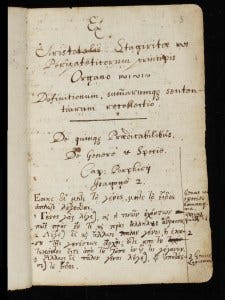
Isaac Newton’s handwritten notes on Aristotle’s Organon.
Image from Cambridge Digital Library via Wikimedia Commons
Ever since the fall of the Roman Empire, most scholars had spent their energy arguing about what the ancients wrote. Whatever Plato and Aristotle were ignorant of wasn’t worth knowing. Recently, people had started to doubt these limits – and Newton was one of them.
A section of his university notebook was titled quaestiones quaedam philosophicae – certain philosophical questions. This was reserved for his thoughts on whatever he was studying – Descartes, Galileo and Hobbes. He took careful notes and analysed ideas he came across with a critical eye. At the top of the section he wrote a motto: Amicus Plato amicus Aristoteles magis amica veritas
Plato is my friend, Aristotle is my friend, but my best friend is the truth.
It echoed the motto of the Royal Society, founded in London the year before Newton started at Cambridge. (Newton would later become its president.)
Nullius in verba.
Take nobody’s word for it.
Newton’s ability to doubt became his superpower. He let himself be guided by nature and, in the process, transformed our understanding of the universe.
After three years at Cambridge, Newton was awarded a scholarship, releasing him from valet duties for his fellow students. His notebook also showed signs of his prowess in mathematics: it contained theories nobody had seen before.
But just as things were beginning to improve, the plague arrived. Colleges shut down. Newton had to return home.
The world’s paramount mathematician
It would have been easy for him to despair. His relationship with his mother and stepsisters was difficult at best. His newfound independence was gone. Worse, so was his access to the lectures and books that inspired him.
He could have asked himself: Why me? Why now?
Instead, he asked different questions. Strange questions.
What is light made of?
Where does colour come from?
Why does an apple fall downwards – never sideways or upwards?
What makes a cannonball continue through the air after it’s been fired?
What is space made of? How long does it go on for?
Can you break time down into tiny parts, like you can break matter down into atoms?
Some of these questions had never been asked before.
He didn’t just ask questions, he also pursued the answers relentlessly. He turned the front room of the family home into one of the world’s most advanced optics laboratories. He filled a precious notebook – passed down by his stepfather – with page after page with calculations.
By the time he returned to Cambridge almost two years later he had become, according to his biographer James Gleick, ‘the world’s paramount mathematician’.
Doubt everything
Doubt, as a starting point, was not a new idea. The Sceptics of ancient Greece had made it the foundation of their philosophy. If you’re considering an argument, they said, keep piling up the evidence for each side. Soon, you’ll see that both are equally strong – or equally weak. No question can be answered with any certainty.
That’s one way to prevent you making a fool of yourself by jumping to conclusions, but it’s hardly a constructive way to make new discoveries.
Newton had a different method of doubting. It was a way of creating knowledge, not simply of dismissing other people’s ideas. His combination of perceptive questions with meticulous observation and thorough mathematics allowed him to create laws that have lasted for centuries.
Later in life, Newton became obsessed with alchemy. Chemistry was only just emerging from alchemy’s shadow, and Newton brought a rigour the discipline had never seen before. He sniffed and tasted every new chemical, every new vapour (filling his body with toxic mercury in the process). But he also brought precision to his measurements, carefully weighing and recording everything he did.
Newton didn’t doubt everything, but his standards of proof were much higher than those who had gone before. He was issuing a challenge for his rivals to up their game.
The plague over, Newton returned to Cambridge and continued his work. Years passed and he turned from student to professor. He barely left his rooms. The only thing he published was a geography textbook (lecturing on the subject was part of his remit as mathematics professor).
Then a friend, astronomer Edmund Halley, arrived with news. Newton’s great rival Robert Hooke, Curator of Experiments at the Royal Society, was going to publish his own theory of gravity. Newton knew from his correspondence with Hooke that Hooke’s ideas were much less developed than his own, but there was no way Newton could let Hooke get there first.
Newton worked relentlessly to make his ideas publishable. Previously, he had been a recluse. Now, it was as if his human, embodied life, disappeared entirely. He ate little, and when he did, took meals standing up. On the rare occasions he wandered out of his rooms, he looked confused and retreated quickly.
In 1687, the Philosophiæ Naturalis Principia Mathematica – the Principia – was published, providing the foundation for modern physics to this day.
Cognitive Misers
In 1984, psychologists Susan Fiske and Shelley Taylor introduced the term cognitive miser in their book Social Cognition. Just as a miser is someone who carefully guards their money, a cognitive miser is someone reluctant to use their precious cognitive resources. They often end up taking mental shortcuts and are happy to accept what they’re told. The theory explains why we rely on stereotypes rather than seeing people as individuals, why we can be scammed by an offer that sounds too good to be true and why we reason based on the evidence in front of us rather than doing our own research.
It suits us all to be cognitive misers at times. When we’re buying a car, we accept the dealer’s promises about its safety record, about the car’s mileage and details of previous owners. When our kids tell us how their day has gone, we don’t cross-reference their account with their friends and teacher.
There is a lot that we just have to accept. Life’s too short to question everything. But sometimes, we take others’ word for it when we should challenge them.
Newton could have accepted Aristotle’s idea that things won’t move unless they’re being pushed. But then he wouldn’t have come up with his laws of motion. He could have accepted the idea that a prism contains the spectrum of colours and gives them to white light as it passes through. He could have accepted the mathematics of the day without building calculus. It would have saved him a lot of time and mental energy. But it would also have prevented him being remembered as a genius for publishing the Principia.
Instead, he never stopped questioning.
At least, he never stopped questioning where maths and science were concerned. Just like all of us, though, there were some things Newton didn’t question.
When other scientists came up with similar theories, his instinct was to attack their methods and claim credit himself. He could have questioned this instinct. He could have expended effort getting to know more about the scientists and their views. This approach might have ended up in the kinds of collaborations that produce theories we’re still using today. But until his death, Newton wasted his time and energy trying to prove them wrong, and that he had got there first, sometimes to the point of faking a paper trail to prove it.
Later in life, as Master of the Royal Mint, he vigorously pursued counterfeiters – to the gallows, where possible. He could have questioned whether forgery should be worthy of capital punishment. Others did. He could have questioned the value of human life. But he chose to make an example out of those who tried to rival him in creating currency.
When to ask a question
The metaphor of the cognitive miser hides important differences between spending and reasoning. While money is finite and depreciates in value over time unless invested, our cognitive resources are elastic. The less we use them, the rustier they get.
In some ways, the analogy of the brain as a muscle is a more accurate one. We should be testing and straining our brain to build its strength, while making sure we rest it in between. Questioning, too, is a skill. The more we do it, the better we get at it.
We should all ask more questions, especially about the things that matter.
Nullius in verba.
Take nobody’s word for it.
We should question politicians’ promises. We should question the topics they bring up: Why do you think this is the most important issue? Why are you using this metaphor? What view of the world are you bringing?
We can question processes at work. We can look at the way we do things and ask why. Often, you’ll find people’s only explanation is that things have always been done this way. They might not like you asking but you probably can’t make any fundamental changes in the workplace without questioning the status quo (and upsetting a few cognitive misers in the progress).
We can question aspects of life that seem set in stone. Civil rights movements wouldn’t have happened unless someone had doubted the superiority of one group or one way of life over all others.
Sometimes, we have a duty to question.
Sure, we’re all cognitive misers from time to time, and that’s ok. We’d go crazy otherwise. But, like Newton, we need to work out which are the important questions to ask. Which questions might just change the world.
And we shouldn’t settle for the first thing that comes along, the first thing that sounds about right. Instead, we should demand to see the method. Question the process. And stop not just when we’re close or we have something that will sound plausible in a report but when we arrive at the correct answer.
Like Newton said, Plato is my friend, Aristotle is my friend, but my best friend is the truth.
Sources
Susan Fiske and Shelley Taylor (1984) Social Cognition
James Gleick (2003) Isaac Newton
The post Take Nobody’s Word For It appeared first on Get Curious.