
The Call to Adventure
A Guide for Thrill Seekers, Respectable Ladies and Reluctant Travellers

Header image: Marianne North, View of the Village of Tosari, Java (1876), public domain
In Victorian England, women did not become adventurers. They certainly didn’t become solo travellers, not if they were from respectable families.
Marianne North didn’t care for convention. She didn’t care for her own safety. She didn’t care what other people thought.
What she did care about was exotic plants.
A vice takes hold
Originally, Marianne North wanted to be a singer. She had a problem: ‘a most provoking habit of nervousness; when told to stand up and show off, the room seemed to go round, and I could not keep myself from shaking all over’.
So she developed another passion. Two, in fact: plants and oil painting. To North, painting was a vice like whisky, ‘almost impossible to leave off once it gets possession’, as Milbry Polk quotes in Robin Hanbury-Tenison’s The Great Explorers.
Marianne North was born into privilege. She didn’t have much formal education but was surrounded by inspiring figures during her childhood. These included Sir William Hooker, pioneering botanist and director of Kew Gardens, who sparked North’s love of plants.
After her mother died, North promised to look after her father. Which she did her way – on a series of road trips they took together to Europe and the Holy Land. North’s sketchbook was never far from her hand.
On one trip, her father fell ill. At home in Hastings, days after North turned thirty-nine, her father died.
North was devastated.
It was unthinkable, at that time, for a woman to travel without a chaperone. But North disdained convention. She called marriage ‘a terrible experiment.’ She hated the idea of simply being someone’s wife.
She wanted freedom.
The pleasure of recognition
It has become easy, in the twenty-first century, to travel to faraway places in comfort.
A new city, a different continent, another culture. Experiences that should give us a new perspective on life simply become another box, ticked.
As journalist and literary critic António Guerreiro puts it, we travel for ‘the pleasure of recognition and not the curiosity of discovery’.
This is a polite way of saying we travel to take photos.
Or, at least, to inhabit those photos that haunt our dreams. The photos we used to gaze at in the glossy travel agency magazines and that now comprise Instagram.
There is no unknown, no ambiguity. The only risk is that the hotel might not match up to the Tripadvisor description.
What kind of curious are you?
Risk taking excites me
I prefer spontaneous adventure to planning
When I have free time, I like to do things that are a little scary
Agree? You might score highly on the thrill-seeking dimension of curiosity.
For Todd Kashdan and his colleagues, curiosity isn’t a single trait. It can be split along five dimensions:
Joyous Exploration — delight in learning for its own sake.
Deprivation Sensitivity — a restless need to close knowledge gaps.
Stress Tolerance — comfort with uncertainty.
Social Curiosity — interest in other people (overt asking vs covert observing).
Thrill Seeking — a desire to explore through novelty or risk-taking.
People who score higher in stress tolerance, for example, are more extraverted. Joyous explorers are more open to new experiences. The socially curious – unsurprisingly – are more likely to gossip. (Want to know where you rate? Try this quiz I put together – just for fun – and get more info about the five dimensions).
It’s easy to feel that adventure should be for the thrill seekers, or those who are fully stress tolerant. But that’s an excuse we use – it’s too big. I don’t know where to start. I haven’t got the time, or the experience, or the money to do that.
We can turn those excuses on their head. Rather than thinking of adventure as something that exists ‘out there’, we can build adventure into our daily lives.
Embrace the inconvenience
We don’t have to start with the epic travel, writes explorer Belinda Kirk in Adventure Mind. A change to routine, a new environment, the chance to rely on our wits over modern technology – small changes can be our starting point.
And adventure brings a whole host of benefits, Kirk argues. As well as improving our mental health, it builds new skills and helps us use our brain in a way that the modern office doesn’t allow us to.
Adventure might involve following a map rather than a SatNav, cooking our own food on a burner stove in the great outdoors (and probably under a drizzle) rather than mustering the courage to risk the street food stall.
This is adventure as journey rather than destination.
Insta-travel is about where you end up. It’s about what it looks like from the outside.
In adventure travel, the inconvenience becomes the story: getting lost, being cold, wet, tired. The kind of things we spend our lives avoiding become part of the story.
Challenging yourself by getting outdoors can be transformational, Kirk writes in Adventure Mind.
You’re in a new environment, which focuses your mind on your immediate surroundings, not on the email you still haven’t answered.
Paradoxically, it is novelty of the situation, and the cognitive demands it places on you, that frees your mind:
Before you leave on the adventure, you have a million and one things to do, but as soon as you set foot on the plane, sit on the seat of your bike or turn away from your car with a full backpack, life immediately becomes much simpler. And nagging feelings dissipate and are replaced by something much more exciting: the challenge, the unknown.
One fingerhold from death
The stages of Joseph Campbell’s Hero’s Journey are so well known that they have become a cliché – and it’s easy to apply them to our lives. We wait for the call to adventure – for someone to tell us it’s time. Someone to tap us on the shoulder and hand us the itinerary and map with the route already marked out.
It’s easy, too, to think of adventure as for someone else. A different kind of person.
We look at people who do extraordinary things and assume they must all be like Alex Honnold.
Honnold climbed one of the tallest rock faces in the world without ropes or harness. The friction between his chalked fingertips and the tiniest protrusion of rock was all that separated him from death.
A few years later, he climbed one of the world’s tallest skyscrapers, again without safety equipment.
There is a scene in the 2018 film Free Solo in which Honnold is put into an MRI machine. He is shown images that would terrify a normal person. His amygdala barely lights up. He needs these terrifying experiences to feel alive, in the same way someone might feel a thrill while giving a PowerPoint presentation at work which they’ve only practised a couple of times.
To most people, adventure is both more mundane and more extraordinary than it is for Honnold. Mundane, because few people are going to make an Oscar-winning film about it. Extraordinary because it requires us to overcome what our amygdala is telling us. (Run!)
It’s more like Bilbo Baggins in The Hobbit, who lived a quiet life in The Shire, and was respected by his neighbours because he never had any adventures or did anything unexpected. Until one day he ran off after a group of dwarfs in such a hurry he forgot his hat and walking stick.
And it’s more like Marianne North, who lived a proper life in polite society until, at the age of forty, she began a series of solo adventures that would last for the rest of her life.
Snakes, fever and enormous boulders
Marianne North had a very particular idea about what she wanted to escape to.
She was driven by ‘the dream of going to some tropical country to paint its peculiar vegetation on the spot in natural abundant luxuriance.’
Nowadays, heading off to the tropics and posting snaps of some of the weird flowers on a group chat doesn’t sound that revolutionary. What Marianne North did, though, challenged the way people saw plants.
Traditional Victorian botanical art was often a lifeless affair. A sprig was laid out and painted with watercolours.
North had her own ideas about how to paint flowers.
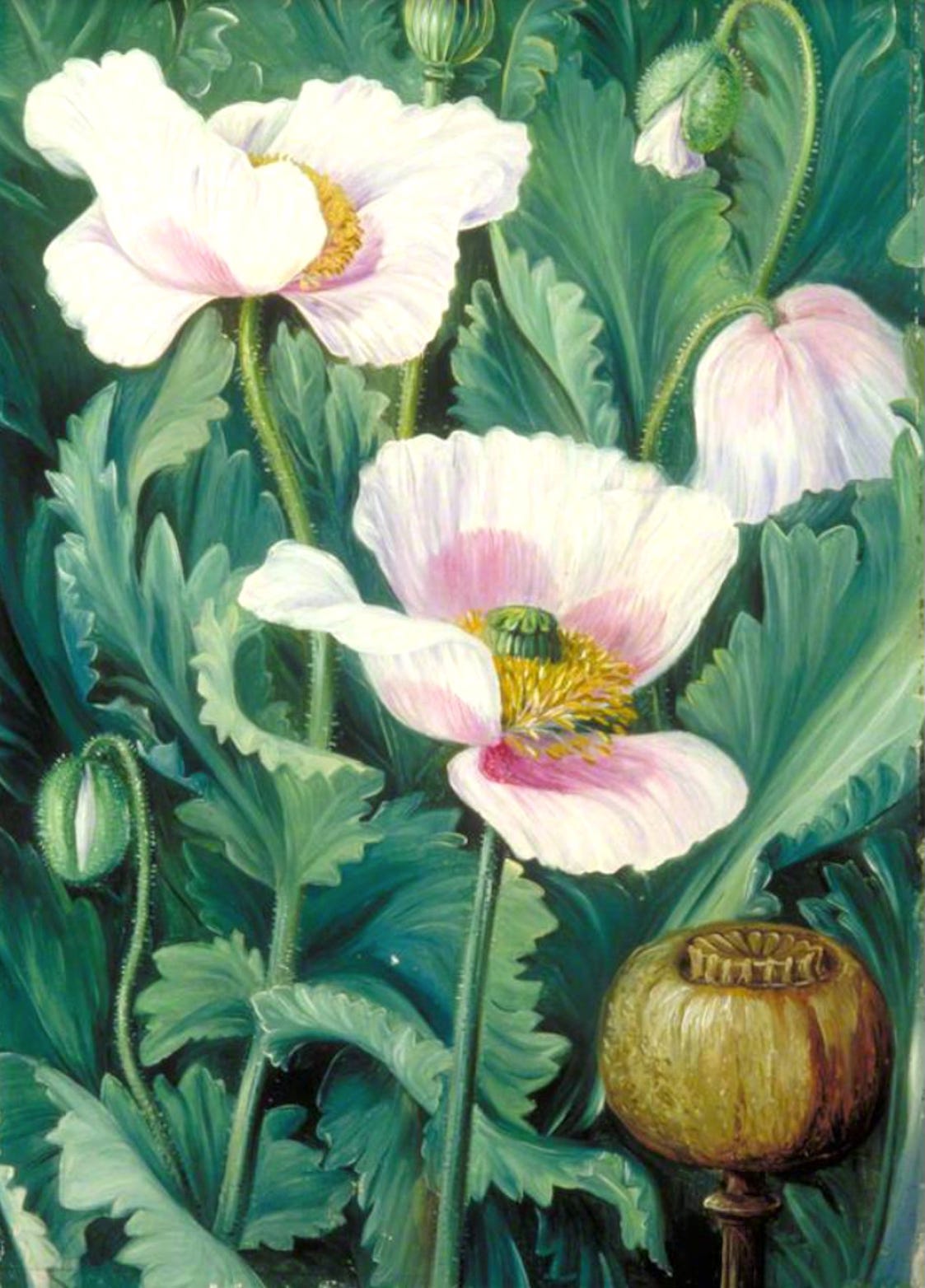
Marianne North, ‘Foliage, Flowers and Seed Vessel of the Opium Poppy’ (1870s). Marianne North Gallery, Royal Botanic Gardens, Kew. Public domain via Wikimedia Commons.
Her oils brought life and colour back into the plants. She used a limited palette, and avoided black, giving a vibrancy to her paintings. Plants appeared in their habitats, creating a naturalism that had been dispensed with.
She began her travels in Egypt, but was encouraged by Lucie Duff Gordon, another female explorer, to travel more widely.
Like Bilbo, facing his trolls and goblins, North’s travels were not without their dangers.
In the Seychelles, she was perched so high on a boulder that ‘the slightest slip or cramp would have put an end to both the sketch and to me.’
In Sri Lanka, she thought someone had left a plant specimen on her stool. She reached out her hand to pick it up – realising just in time that it was a poisonous snake.
Her sister later wrote that North led a ‘charmed life. She could apparently sit all day painting in a mangrove swamp, and not catch fever.’ She could survive without food and sleep and return home ready to enjoy a ‘flattering reception’ in London.
By challenging what people thought proper for a respectable woman, she left her mark on botanical history.
Don’t forget your hat and walking stick
In retrospect, it seems as if success came easily to Marianne North.
She was friends with Charles Darwin, who encouraged her to visit Australia. He thanked her afterwards for the specimens she sent back to him.
In Borneo, North painted an enormous pitcher plant. This carnivorous plant was unknown to science and later named in her honour. Several other species first depicted by North have also been named after her.
Along with James Fergusson, North designed the gallery that bears her name at Kew Gardens. Over 800 of her paintings still cover the walls.
As North’s biographer Milbry Polk puts it:
She was one of the truly fortunate people who discover what they love to do, have the means and courage to follow their passion, and the gift to share their discoveries.
North had the money to travel – and to refuse the marriage that may have tied her down. Her father had encouraged her hobbies, and she had grown up around the greatest scientists of the day. Had she been born into different circumstances, this path may have been unthinkable.
Today, many of us tell ourselves similar stories.
I don’t have enough money
I don’t have the right connections
I need people behind me
But often what we mean is, I’m scared.
We can’t all be Alex Honnold, dulled to the fear that grips everyone else when contemplating something out of the ordinary.
But maybe we can be a bit more like Bilbo Baggins – worried about what people might think, but taking that first step on the road to adventure anyway. Even if we do forget our hat and walking stick as we rush through the door.