

The way to write a thriller is to ask a question at the beginning, and answer it at the end
Lee Child
Getting the sack
Jim Grant was about to be laid off. He’d worked for a TV studio his whole life. He didn’t know any other way to make a living. But as the union rep during times of trouble, Grant would be first for the chop.
Things didn’t look good. Other TV studios would find out about his union activities and give him a wide berth. He’d had the same job since he graduated from law school. And he had never even practised law, so he didn’t have that to fall back on.
Grant was about to turn forty. It didn’t seem like the ideal time to learn a new skill. But the day he was laid off, he took a walk to the shops and bought a pad of paper and a pencil. He sat down at the kitchen table and began to write. And he hasn’t stopped since.
The Cliffhanger
You might know Grant better as Lee Child. He’s the creator of Jack Reacher, the hulking ex-Military Police investigator known informally as ‘Sherlock Homeless’. His books have sold more than a hundred million copies and been turned into films starring Tom Cruise and a blockbuster Amazon Prime series.
Child didn’t need to reskill, it turned out. He had learnt everything he needed about creating the Reacher books during his time at the TV studio. To keep viewers tuned in during the ad breaks that came every fifteen minutes, TV producers put a question at the end of a segment, then revealed the answer after the break. Not the most dramatic cliffhanger, but it told Child something about human psychology. Putting a question at the end of each chapter in his Reacher books keeps readers flicking the pages. It’s a hint of new information. Or of danger. Child is the master of the surprise in the final sentence.
Child didn’t invent the cliffhanger, of course. Like Scheherazade, telling stories to King Shahryār night after night to postpone her own execution, The Arabian Nights has kept readers in suspense for centuries.
Dickens was a master of the craft. Commercial necessity was his teacher, as it was for Lee Child in the TV studio. Because his stories were serialised, Dickens had to keep readers hungry for the next instalment. There are stories of crowds storming the docks in New York as ships arrived from England to find out what happened to Little Nell in The Old Curiosity Shop.
The term ‘cliffhanger’ comes from Thomas Hardy’s A Pair of Blue Eyes. See if you think it still holds up as a how-to guide in the Netflix age of how to build tension.
In the novel, Henry Knight is wooing Elfride Swancourt, unaware of her relationship with another man. Henry and Elfride are walking along the cliffs when Henry’s hat is pulled from his head by a gust of wind. He leans over the cliff to retrieve it and is pulled over the cliff edge himself.
Here’s an abridged version (Victorian novels aren’t famed for their concision):
Knight was now literally suspended by his arms.
‘If I can only save you by running for help!” Elfride cried.
‘How long will it take you to run to Endelstow and back?’
‘Three-quarters of an hour.’
‘That won’t do; my hands will not hold out ten minutes.’
A minute—perhaps more time—was passed in mute thought by both. Suddenly the blank and helpless agony left her face. She vanished over the bank from his sight.
Knight felt himself in the presence of a personalized loneliness.
And there the chapter ends.
The Zeigarnik Effect
To understand why cliffhangers are effective, we need to turn to the work of the psychologist Bluma Zeigarnik.
Zeigarnik was sitting with her mentor Kurt Lewin in a busy Viennese café, so the story goes. Lewin was famed for his meandering conversations with friends that could last all afternoon. Eventually, he called the waiter over and asked how much they owed. The waiter knew what they’d all had and answered immediately. After the group finished their drinks, they were discussing the bill and Lewin called the waiter over again: ‘How much did we just pay?’ The waiter couldn’t tell him.
Intrigued, Zeigarnik set about investigating. She gave people simple tasks to do – solving puzzles, folding paper, or answering mathematical problems. Half of the participants were allowed to finish their activities; the other half were interrupted when they were engrossed in the activity. Zeigarnik was a pioneer of the experimental method in psychology. She made sure to carefully balance the time and difficulty of the tasks between the two groups. The only difference was whether the participants were allowed to complete the tasks. Her findings were clear: those who had been interrupted were twice as likely to recall what they had been doing as those who were allowed to complete the task.
She probed further. The most effective points to interrupt people were in the middle or towards the end of the task. Those just getting started were not as good at recalling what they had been doing. Zeigarnik also found that people who were more ambitious, or saw the lack of completion as a failure, had a better memory for the tasks.
Zeigarnik put the effect down to psychische Spannung, or ‘psychological tension’. The tension builds in the mind during the activity, peaking just before it’s finished. After the activity is done, the tension dissipates.
This is the same tension that a skilled novelist builds in their reader. Will Elfride make it back with help before Knight falls? The clock is ticking – the psychological tension is building. Access to Knight’s thoughts while he is hanging builds the suspense. Elfride returns – alone. How long can he hold on? Not long – not long enough for help to come. So the enterprising Elfride tears her clothing into strips and knots it into a rope, tying one end around her waist before throwing the other down to Knight. He makes it up and they embrace.
But there’s still that business of the love triangle to resolve…
A skilled novelist zooms in and out, building and releasing tension moment by moment, but leaving other questions simmering in the background. The tension is never fully released until the resolution at the end of the novel.
Zeigarnik’s work tells us why cliffhangers are useful: if a question isn’t resolved, it sticks in our mind. But this doesn’t tell us much about the characteristics of a successful cliffhanger.
For this, we need to turn to the work of another psychologist.
The Goldilocks Zone
For George Loewenstein, curiosity is a state of deprivation. Imagine someone asks you to name all the US states and you come up two short. You have an information gap – a space between your current knowledge and the knowledge you could have. It creates a desire, like an advert that promises a perfect life if only you buy the bottle of perfume or the latest SUV.
When your mind is focused on something you lack, your need for it increases. According to Loewenstein, the closer you come to the information, the more motivated you are to get it. Whenever your attention is caught by a clickbait headline or teasing advert, that’s Loewenstein’s version of curiosity tugging at your sleeve.
But not just any gap will do. There’s a ‘Goldilocks Zone’ where the gap is just the right size.
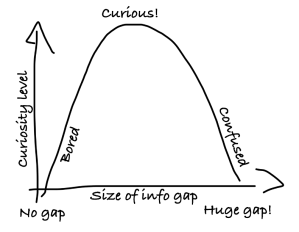
Curiosity’s ‘Goldilocks Zone’: if the information gap between what we know and what we want to know is too small, we become bored; too large and we get confused. We become curious only when the gap is exactly the right size.
If you start asking primary school kids questions about quantum physics, you’re unlikely to elicit much curiosity. Ask quantum physicists about primary school science, and you’re only going to induce yawns. The gap between what you know and the tantalising information dangled in front of you has to be just the right distance to leap over.
When Lee Child puts Reacher in a dangerous situation, the solution has to raise questions. If there’s one bad guy between Reacher and freedom, he’s just going to crumple the guy’s head in. But ten, one of whom is the size of three average guys squashed together – that’s more interesting. The psychological tension ramps up.
A cliffhanger is a hard thing to get right. We’ve all seen far more clickbait headlines than we’ve clicked on, adverts than products we’ve bought and we’ve probably all stopped watching halfway through a series, leaving those questions dangling.
Often, this is because the gap is the wrong size: someone has failed to get to us to the peak curiosity point on the graph. At other times, though, we lose trust. That TV series that keeps throwing questions at us – who’s the mysterious woman we keep seeing in the distance? What does that weird writing mean? And what’s the secret the main character is hiding? At some point, we stop believing the questions are going to be resolved. There will simply be more cliffhangers. The writers themselves don’t know what the solutions are.
It’s easy to leave the protagonist hanging by a fraying rope over the mouth of a volcano, but harder to get them free when we’ve implied the situation is impossible to escape from.
A cliffhanger is a contract with a reader or viewer. Keep going, and the pay-off is going to be worth it. Authors neglect that contract at their peril.
When to follow the rules (and when to break them)
It was a Catholic priest, Ronald Knox, who wrote the first rules that detective novelists must follow if they are to play fair, including no supernatural forces at work, no scientific device that needs a long explanation at the end and no identical twins (unless the reader’s been prepared beforehand).
The cleverest writers know how to bend – and even break – the rules, and nobody does this better than Agatha Christie. The airport bestseller that claims to be genre-bending or with a twist you never saw coming – the chances are that Christie got there first.
There are a set of rules, though, that every suspense writer must follow if they hope to keep their readers. These were not put together by a novelist (or a priest) but a psychologist. In the same paper he described his Information-Gap theory, Loewenstein also described the situations that can pique someone’s curiosity:
When they’re presented with a puzzle
When they see a sequence of events with ‘an anticipated but unknown resolution’. People will make a prediction, and have to stick around to find out whether they’re right
When their expectations are violated
When they discover someone else has information they don’t
In The Science of Storytelling, Will Storr claims that Loewenstein wrote ‘a perfect description of the police-procedural drama’. Whether it’s a Lee Child novel or the latest crime drama streaming into your home, you’ll see these four methods being used. How-to guides on crime writing tell you to give the reader a body on the first page – but unlike the stories on the front page of the paper, there must be something impossible about the murder, something that doesn’t make sense. The tension will build through the use of red herrings, characters who must be the murderer but have an alibi. Virtually every character has a motive – the only one that doesn’t (spoiler alert) is probably the real killer.
Staring into the void
The curiosity that Loewenstein describes is a very particular form of curiosity. Lee Child learned his craft by putting trivia questions before ad breaks in TV shows. This is the same situation psychological researchers like Loewenstein present research subjects with in the laboratory. When we come across a new situation in the real world – when we’re travelling, or in the classroom or in a scientific laboratory – it isn’t always that easy to say what the gap is. Our curiosity is often provoked by something more complex than the four situations that Loewenstein outlines.
When the astronomer is presented with a shiny new telescope, the most powerful in history, and she stares into a galaxy nobody has ever seen before, what will she discover? Information-gap theory feels too limited for this case. There are no multiple-choice answers, no set of US states or lineage of kings and queens that can fill the gap. Instead, there’s a yawning, gaping, unknown. Depending on what the astrophysicist discovers, that psychological tension might carry on building and building.
These aren’t the kind of questions that underpin cliffhangers. Cliffhangers are controlled situations – controlled by the writer or the psychologist. But there are some situations that we just can’t control. And these are the situations that can drive a lifetime of curiosity.
When we gaze into the abyss, Nietzsche wrote, the abyss gazes back into us.
Sources
Books:
Thomas Hardy (1873) A Pair of Blue Eyes
Will Storr (2019) The Science of Storytelling
Academic sources:
George Loewenstein (1994) The psychology of curiosity: A review and reinterpretation, Psychological Bulletin, 116(1), 75-98
Colin M. MacLeod (2020) Zeigarnik and von Restorff: The memory effects and the stories behind them, Memory & Cognition ,48, 1073–1088
The post The Psychology of the Cliffhanger appeared first on Get Curious.