

When I first started teaching, my Year 8 class (age 12-13) played a game with me. I didn’t realise it was a game until a few lessons in.
It began when we started a new topic – space. After a low demand starter like a wordsearch (those were the good old days) they’d start with the questions:
‘How big is space?’
‘How many stars are there? (And can I name one after myself?)’
‘Are there really aliens?’
We’d spend whole lessons like this: someone would pose a question. I’d rhapsodise about SETI and the Drake Equation for calculating the probability of extraterrestrial civilisations. They’d ask another. It went on until most of the class were clearly so bored they were almost willing to start some genuine work.
At which point, I began to realise what they were actually doing.
What’s a question?
I’ve been reading Lani Watson’s excellent exploration of questioning, Q. It’s hard to work out exactly what a question is, Watson points out, but it’s always something intended to gain information. She includes exploratory behaviour and internal thought processes as questions, but to me, these are examples of curiosity.
From a teacher’s perspective, a question does involve an apparent request for information, but it also involves a hand up.
In my research, students have told me, somewhat hopefully, that they sometimes try to satisfy their curiosity by looking at wall displays or the notes in their books. Others will think through what they’re learning and the implications. Sure, curiosity might be involved, but a question involves asking something, out loud, often in front of your classmates. And for teenagers, as I’ve found out, this is often the hardest bit.
For various reasons, not least the fact it’s either unpublished or in the publication pipeline, I’m not going to draw on my own data for this post. I’ll refer to other people’s findings, I’ll draw out some data from tens of thousands of students, but I’ll also lean heavily on my own teaching experiences to investigate two things I’ve been wondering about for a while: what questions do students ask, and who’s actually asking them?
Can I go to the toilet now? Please, it’s urgent
I get one question more than any other. Sometimes, before the lesson’s begun. Sometimes, from one student; at other times, from two or three at once: ‘Sir, can I go to the toilet?’
Sure, it’s a genuine question in that it’s seeking information. Curiosity-driven? I’m not so sure.
While researchers like J.T. Dillon have noted that students almost never ask questions – at least compared to the frequency that teachers question their students – anecdotally, I get lots of questions, even from the most disengaged classes. These are sometimes curiosity-driven questions, and we’ll come back to those in a minute, but many fall into what I’ll call the CDE bracket:
Confusion questions
Distraction questions
Evasion questions
Confusion questions aren’t really questions at all. Usually, a kid will put up their hand (if I’m lucky) and tell me they just don’t get it. It’s nearly always in response to a task. They’d probably zoned out while I was explaining, but now that I’m expecting them to do something with the information, they’ve been forced into action. It’s a request for knowledge; not a very skilled one, though, and I wouldn’t class it as a form of curiosity.
Distraction questions are perhaps the most interesting of the three. Sometimes, they’re a little tedious, like a student pointedly asking what the time is and hoping everyone else realises they’re bored. At other times, it might get more creative, as I found out in my space lesson.
It’s hard to tell, as a teacher, whether a student really wants to know the answer, or simply wants to signal something to their classmates, like their boredom – or to take the lesson off course. Often, it feels like a bit of all three.
Evasion questions are a whole group with two things in common. First, they all exist on a spectrum from ‘complete fabrication’ to ‘genuine and urgent request’. Second, they’re all intended as a way to get out of the lesson:
‘Can I leave the lesson early?’
‘I have a headache and need to go to the medical room. Can I take a friend with me?’
‘Can I use my exit card?’
And, of course, the frequent requests to use the toilet.
Some classes do ask genuine curiosity questions. Some classes will ask question after question without an apparent sense of trying to distract the teacher from making them do real work. But, in my experience, whole classes tend to fall into one of three categories: no questions; confusion and evasion questions; curiosity questions.
While I don’t have data on this, Andrew Whittaker does. In a 2012 article he reported on a small-scale study of the type of questions secondary school students ask. And their effects.
The dark side of students’ ‘inquiry questions’
Whittaker observed eight secondary school lessons with students aged 11-16 and classified students’ questions. Non-content questions were unrelated to the lesson, like my toilet example. Clarification questions were ones students needed to know the answer to in order to complete a task the teacher had set, like my confusion questions. Inquiry questions were curiosity-driven – related to the topic, but the student wasn’t asking just so they could complete an activity.
Here’s what Whittaker found over the eight lessons:
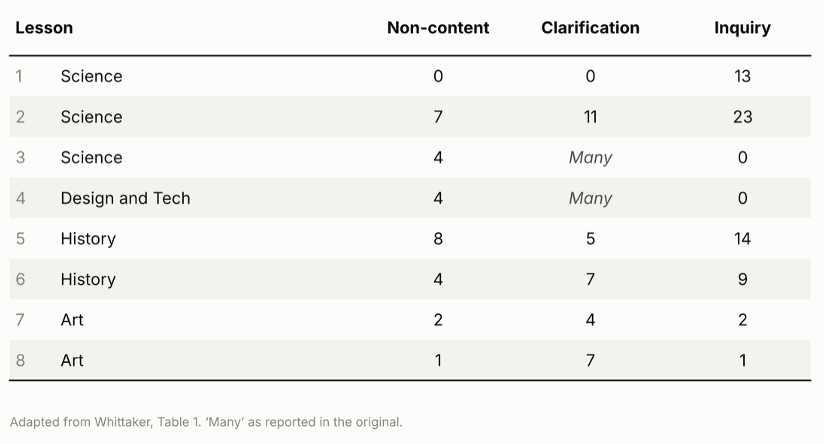
But the numbers hid something only an observer could detect:
In the first lesson, the pupils asked 13 questions, all of which were further inquiry questions that were well posed, thought provoking questions that showed they were well engaged with the topic. However, when the teacher was answering the question the dialogue moved to a one-to-one discussion, the rest of the class began talking amongst themselves and the lesson was disrupted. In the second lesson […] the questioning was so frequent and persistent that the lesson could not progress.
He concluded that, rather than students asking too few questions, ‘they may, in some circumstances, ask too many’.
Only eight lessons, admittedly, but Whittaker’s findings make perfect sense to me. For a teacher, students’ questions are not always welcome. There can be a conflict between what teachers want to cover in a lesson, and what the students are asking about. Sure, understanding how scientists are looking for alien life is fascinating, but it’s not on the scheme of work and won’t be on any exams.
For a long time, I had a theory that students got a sense of this as they got older. Teachers were also less welcoming of students’ curiosity-driven questions as classes approached high-stakes exams, so students asked fewer questions and their curiosity dropped. I even planned my doctorate around investigating this question. Then I found a whole dataset with tens of thousands of students that allowed me to test it without having to send out a single survey myself.
Does question-asking decline?
In 2019, the Survey on Social and Emotional Skills (SSES) asked over 60,000 students in ten cities, from Houston to Suzhou, how curious they were and whether they liked asking questions. Even better, it asked 10- and 15-year-olds in the same city. Were the 15-year-olds still as curious as the 10-year-olds? I crunched the numbers to find out.
Here’s how the students responded:
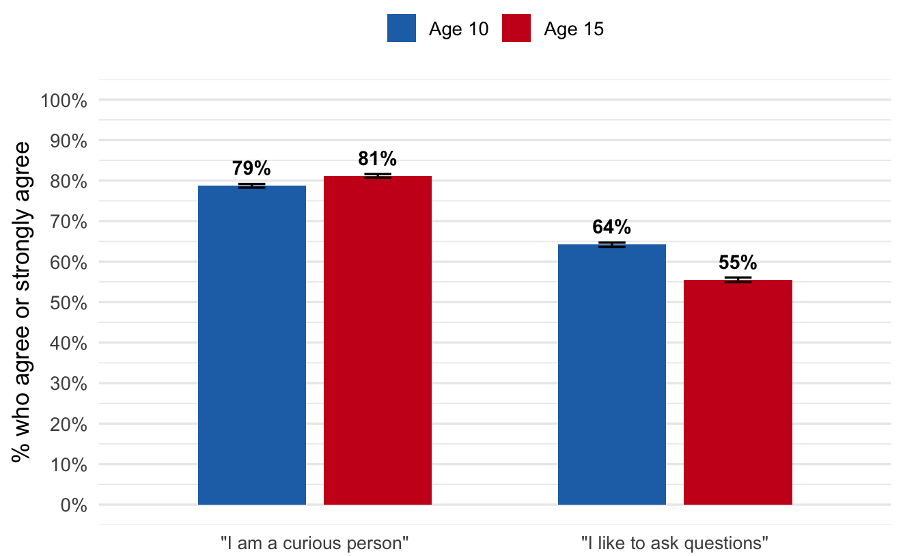
So, 15-year-olds were ever so slightly more likely to describe themselves as curious people than 10-year-olds, and the numbers overall were pretty high. Fewer liked asking questions – 64% of the 10-year-olds compared with 55% of the 15-year-olds.
Half my theory survived. Maybe curiosity didn’t fall with age, but something was affecting how students expressed that curiosity. Of these 15-year-olds, who was still asking questions? Which ones still felt confident or keen enough to express their curiosity?
Who asks questions?
SSES is useful, but imagine we had a sample from a greater range of countries and could check whether students’ question-asking varied by gender, wealth or attainment? Imagine we could look at cultural effects – do the famously egalitarian Nordic countries have less of a ‘question-asking wealth gap’ than the rest of continental Europe? Are students in East Asian countries, often described as more collectivist, less likely to ask questions than those in the supposedly more individualistic Anglophone world?1
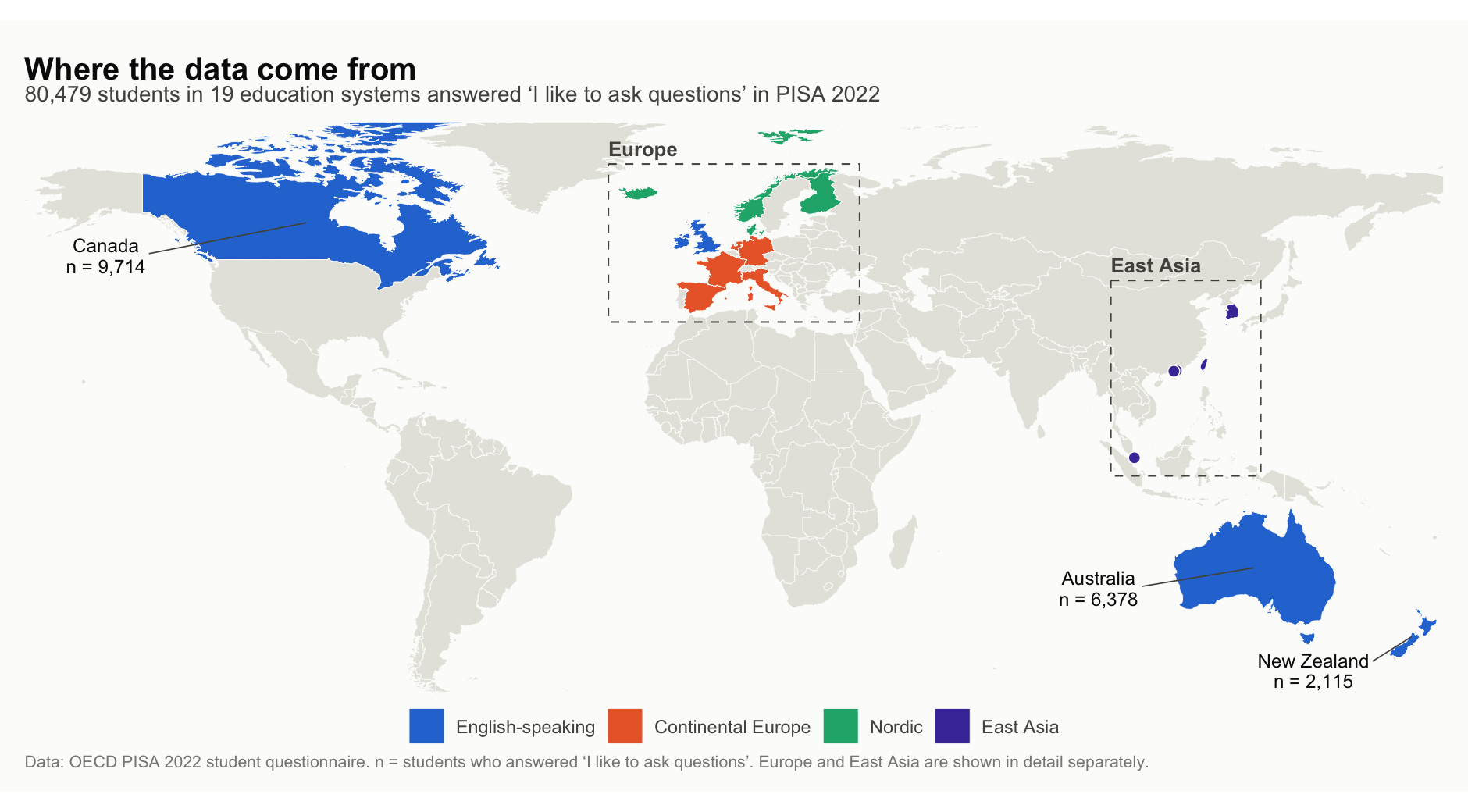
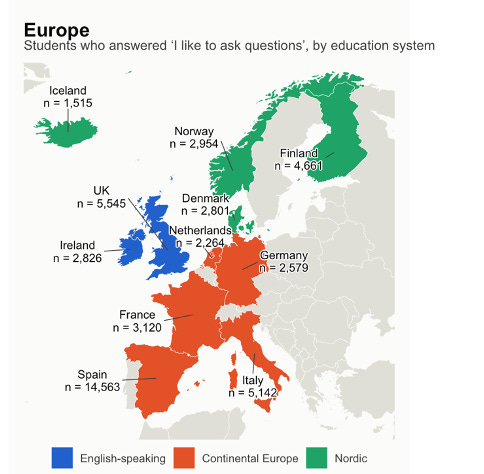
Luckily, the SSES’s better-known cousin, the OECD’s PISA dataset, asked that in 2022 (it was dropped for 2025). Not every country included it, which is why the US and Sweden are missing from this analysis. Even where it was asked, only some of the students sampled were given the question.
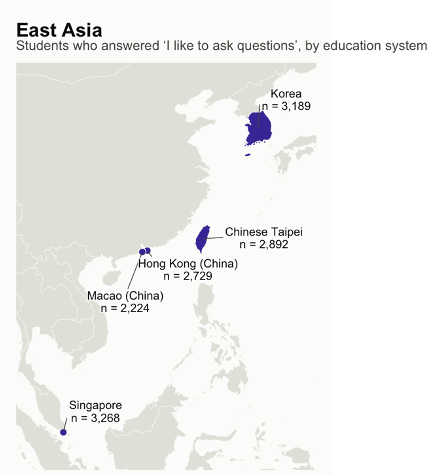
I’ve decided to split countries/regions by ‘bloc’ – a very rough division by culture and geography – to assess how cultural expectations around question-asking interact with differences according to gender, socioeconomic status and how well students did in their maths tests. Here’s how I’ve grouped the students:
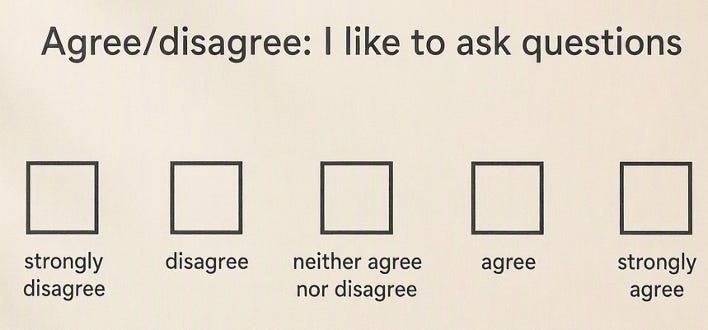
They were asked something wonderfully simple (although, ironically, not a question):
Here’s what we get when we simply look at the percentage in each country agreeing or strongly agreeing with the statement:
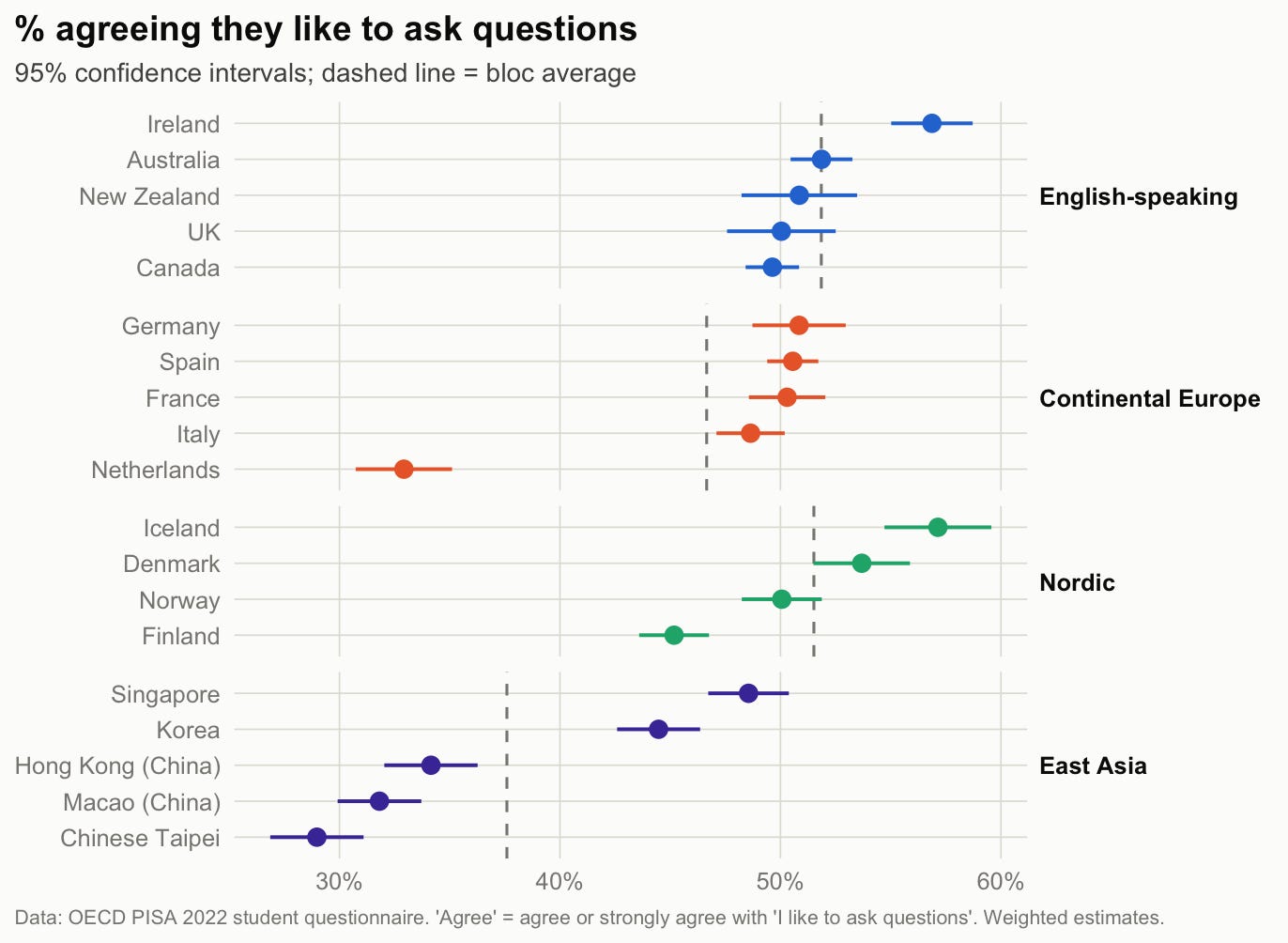
Clearly, there are some outliers. Dutch teenagers are particularly reluctant to say they like asking questions. As a bloc, though, the East Asian regions – especially Chinese Taipei, Macao and Hong Kong – are far less likely to agree, on average, that they like asking questions than the European or Anglophone nations.
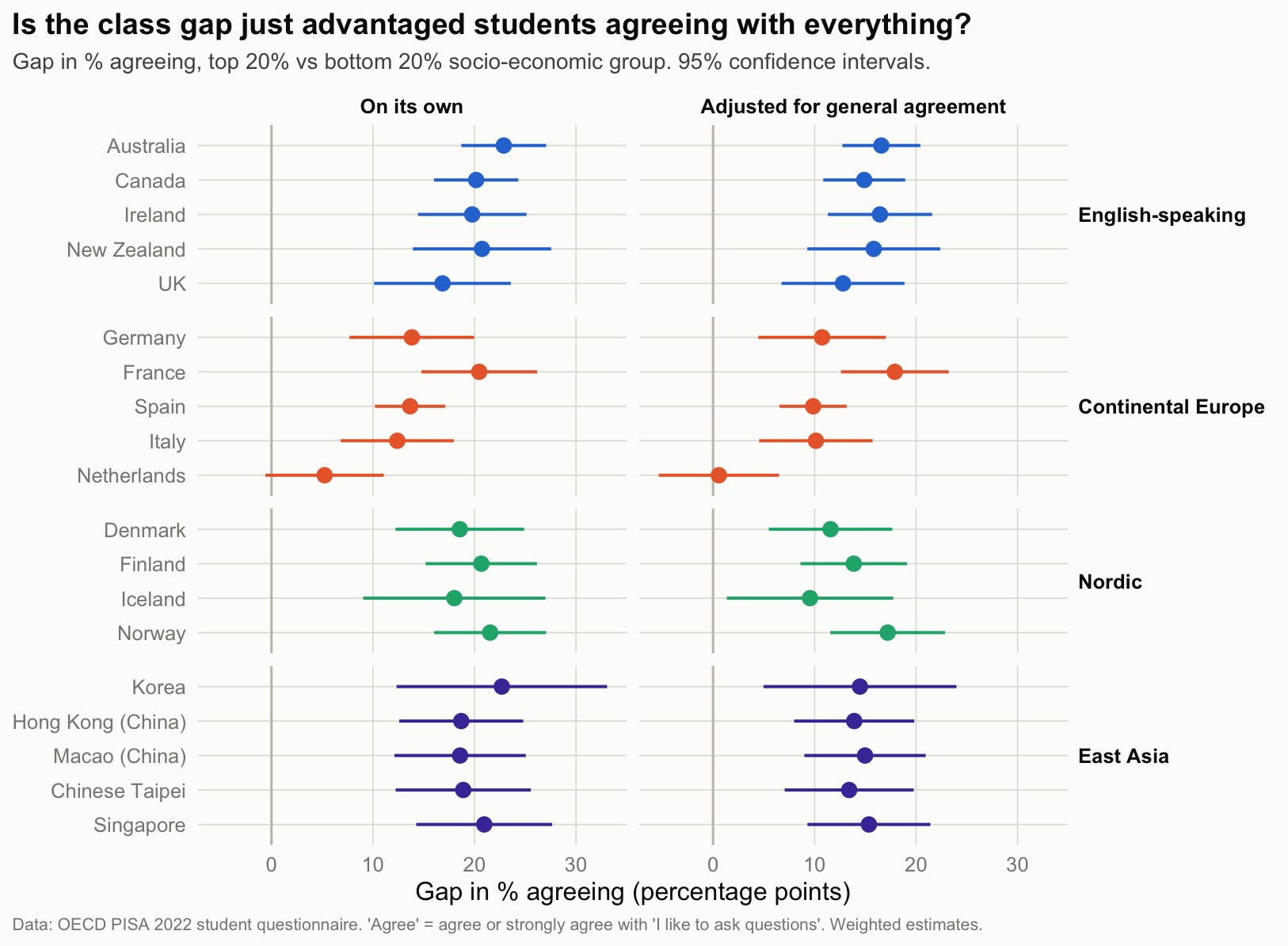
But what if this just reflects a general tendency to agree – or disagree – with everything? Here’s what we find if we compare students’ answer to this question to how likely they are to agree with 88 other questions on the survey:
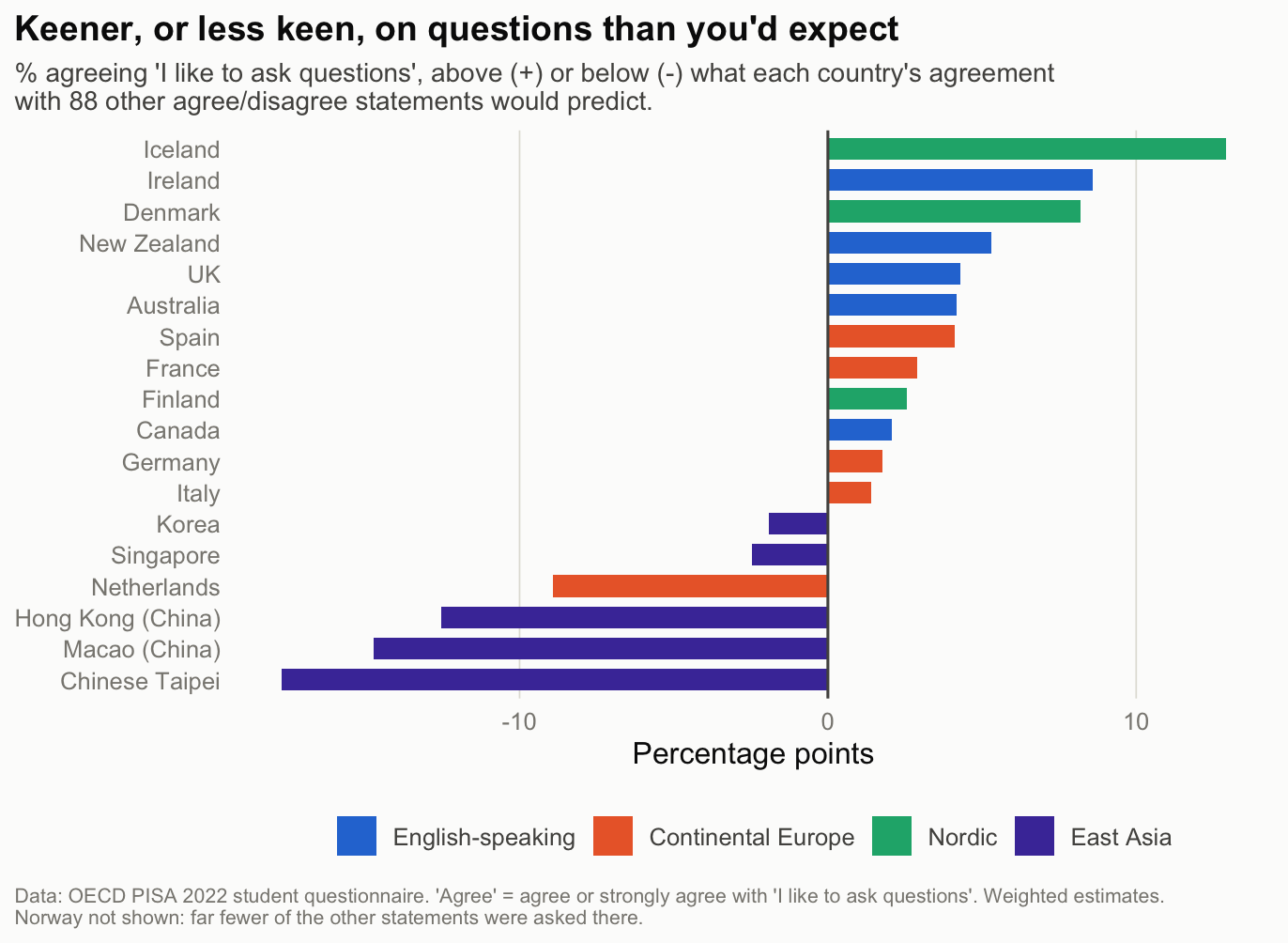
Icelandic, Irish and Danish students are much keener on asking questions than their general agreeableness would predict. Hong Kong, Macao, Chinese Taipei and the Netherlands are the clear outliers in the other direction: far less keen than you’d expect. Korea and Singapore are only a couple of points short.
Dutch students are generally pretty disagreeable on the PISA questionnaire – they agree with fewer statements than students in any other country here – but even allowing for that, they’re still about nine percentage points short.
We can also separate students according to three characteristics to see which groups are more likely to agree they like asking questions:
1. Gender (self-reported, with only male and female as options)
2. Top 20% versus bottom 20% by socioeconomic status (based on parents’ education and occupations, and household possessions)
3. Highest and lowest quintile in maths attainment (chosen because maths was the focus subject of this round of PISA)
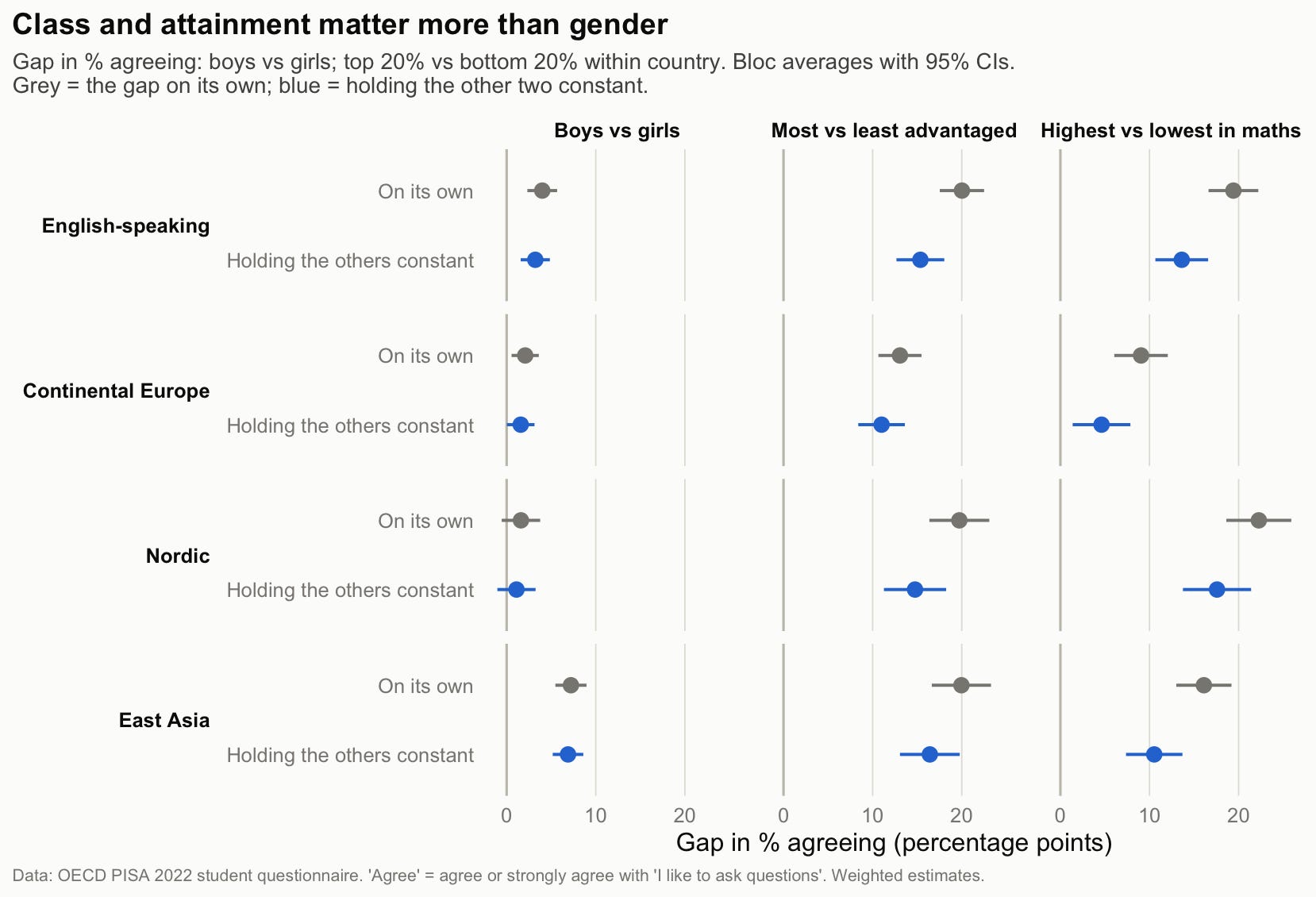
Most striking is how small the gap by gender is – but it does always run in the same direction. In every bloc, the estimate is higher for boys than girls, although in the Nordic countries the confidence interval crosses zero.
In every bloc, though, the gender gap is much lower than the gaps by wealth and attainment. And the famously egalitarian Nordic countries? Their wealth gap is as big as the English-speaking and East Asian blocs’, and larger than the gap in continental Europe.
What the graphs by bloc hide, though, is the story that individual countries tell:
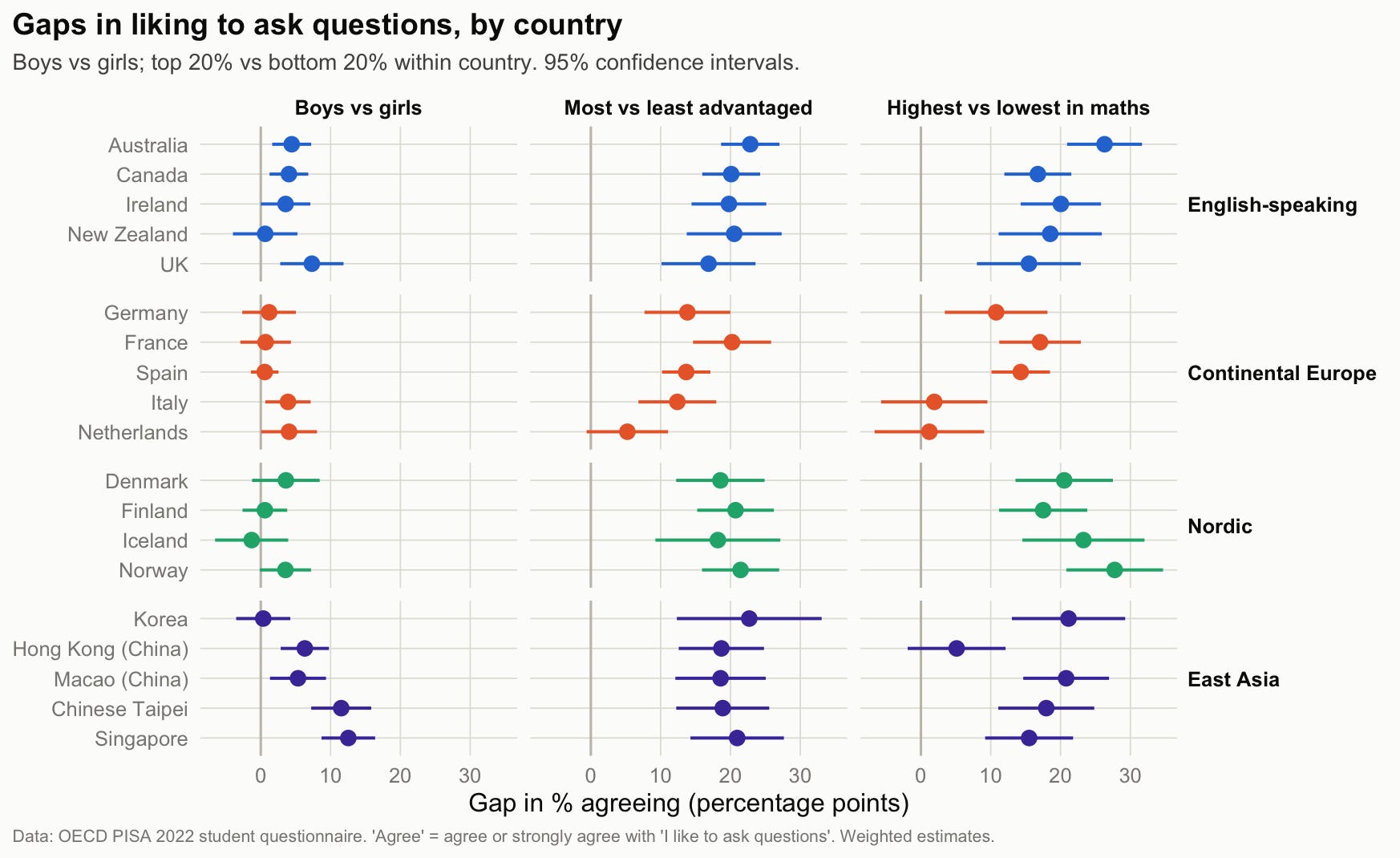
Continental Europe shows almost no gap by gender; the Anglophone nations – especially the UK – have a larger gap, but parts of East Asia, especially Singapore and Chinese Taipei, show the largest.
In every bloc there are countries with considerable gaps according to maths ability. High-attaining students across the sample are happier asking questions than low-attaining students. About three quarters of this gap survives, even after accounting for the fact that high-attaining students are more likely to agree with statements than low-attaining students. This doesn’t tell us that being happier to ask questions causes higher maths attainment any more than being good at maths causes students to be happier asking questions. The association is intriguing, though.
While Dutch students are generally reluctant to say they like asking questions, they have the smallest gaps by wealth and attainment of any country here. Outside the Netherlands, every country shows sizeable disparities in question-asking by wealth. And again, outside the Netherlands, most of this gap survives even when we account for the fact that wealthier students are just more likely to agree with everything on the survey:
No questions, it’s time for learning
PISA can tell us who claims to like asking questions. It can’t tell us what they ask, or how their teachers respond. I suspect, though, that few of the students who agreed had ‘Can I go to the toilet now?’ in mind.
We now have indications of who is more likely to say they enjoy asking these kinds of questions. First, younger students are more likely than older students. Boys slightly more than girls. Richer students over poorer students and high-attaining students over low-attaining students.
Of course, these are differences in what students say about themselves, not observations of how often they actually put their hands up. Also, we can’t tell, from this cross-sectional data, what causes these differences.
Instead, we’re left with much smaller, observational studies, like the work of Whittaker and my own PhD. Many of these point to a similar conclusion, captured nicely in an anecdote from Susan Engel, whose work inspired my own.
In The Hungry Mind, Engel describes a lesson she was observing on the American Revolution. A fifteen-year-old raised his hand: ‘I can’t answer questions right now,’ the teacher told him. ‘Now it’s time for learning.’
This reminds me of a study by Louise Archer and colleagues – pointedly titled ‘Killing curiosity?’ – in which the team spent nine months observing science lessons across six London secondary schools. Three types of ‘performance’ were encouraged by teachers and students alike: ‘tick box’ learning, compliance and – my favourite – ‘muscular intellect’. That’s the kind where a kid sticks up their hand and begins waxing lyrical about quantum mechanics and string theory when all you’ve asked is how many protons there are in a carbon atom.
Instead of completely disappearing, maybe curiosity is hidden behind these performances that allow students to survive in the secondary classroom, to navigate the unwritten rules, the norms, and expectations from teachers and classmates alike. This is what transforms curiosity into simply confusion, distraction or a desire to evade.
Ultimately, we end up with the kind of behaviour we promote. Curiosity is more often celebrated rhetorically, in policy documents and departmental mission statements than it is in the classroom. There, we often celebrate compliance and accurate recall.
Real curiosity can become a threat to knowledge transmission. And, as a teacher, something worries me: if a student wanting to know more can derail a lesson to the extent the teacher needs to put a stop to it, what is the relationship between teaching and learning? As so often, we circle back to the same question – what are our schools really for?
Of course, these nations are not homogeneously English-speaking, but there are similarities between them that extend beyond simply sharing English as a main language. Singapore also took the test in English, but despite its British-influenced exam system, its classroom culture arguably has more in common with other East Asian systems than with e.g. the UK or Canada, which is why I've grouped it accordingly. Interestingly, on some charts Singapore does resemble its Anglophone peers – but working out why would take me into a policy discussion I'll save for another day.