

Something isn’t working in our schools. The number of persistent absentees – students missing more than one in ten days of school – is almost double what it was before the pandemic, and remains stubbornly high.
There are empty seats in my classroom. When those students do come into school, it’s clear that many of them are struggling to cope.
Can we pin these struggles on school policy, or are the causes broader than this?
This is the question Daisy Christodoulou took up in a recent post.
I’m going to split my reply into three parts:
First, what I agree with.
Second, I’ll investigate the data she didn’t include.
Third, I’ll ask what the knowledge-rich curriculum aimed to do, and judge it against its own targets (well, one in particular).
One – what I agree with
Too often, we talk about what happens in UK schools when what we mean is England.
Also, teen mental health has fallen across rich countries for reasons that have little to do with whether or not we now celebrate ‘our island story’, as Gove famously asked teachers to do.
And in terms of PISA data (which I assume she’s referring to), while England hasn’t improved in absolute terms, given the international falls since covid, treading water is an achievement in itself. England has improved in comparison to the G7, whole sample averages and the other UK nations.
All of this seems reasonable enough.
She also conducts a ‘quasi-experiment’ using the devolved nations of the UK. Compare England to Wales and Scotland: if Scotland and Wales chose very different curriculum paths and ended up with similar wellbeing results, then curriculum policy can’t be doing much here.
This seems fair. And the numbers appear to support it.
But a closer look at the data she cites muddies the water.
What she argues
Christodoulou’s claim rests on the WHO’s Health Behaviour in School-Aged Children (HBSC) survey. She uses three charts of 15-year-olds in England, Scotland and Wales – life satisfaction, liking school, and feeling pressured by schoolwork – to point out how similar the three countries look.
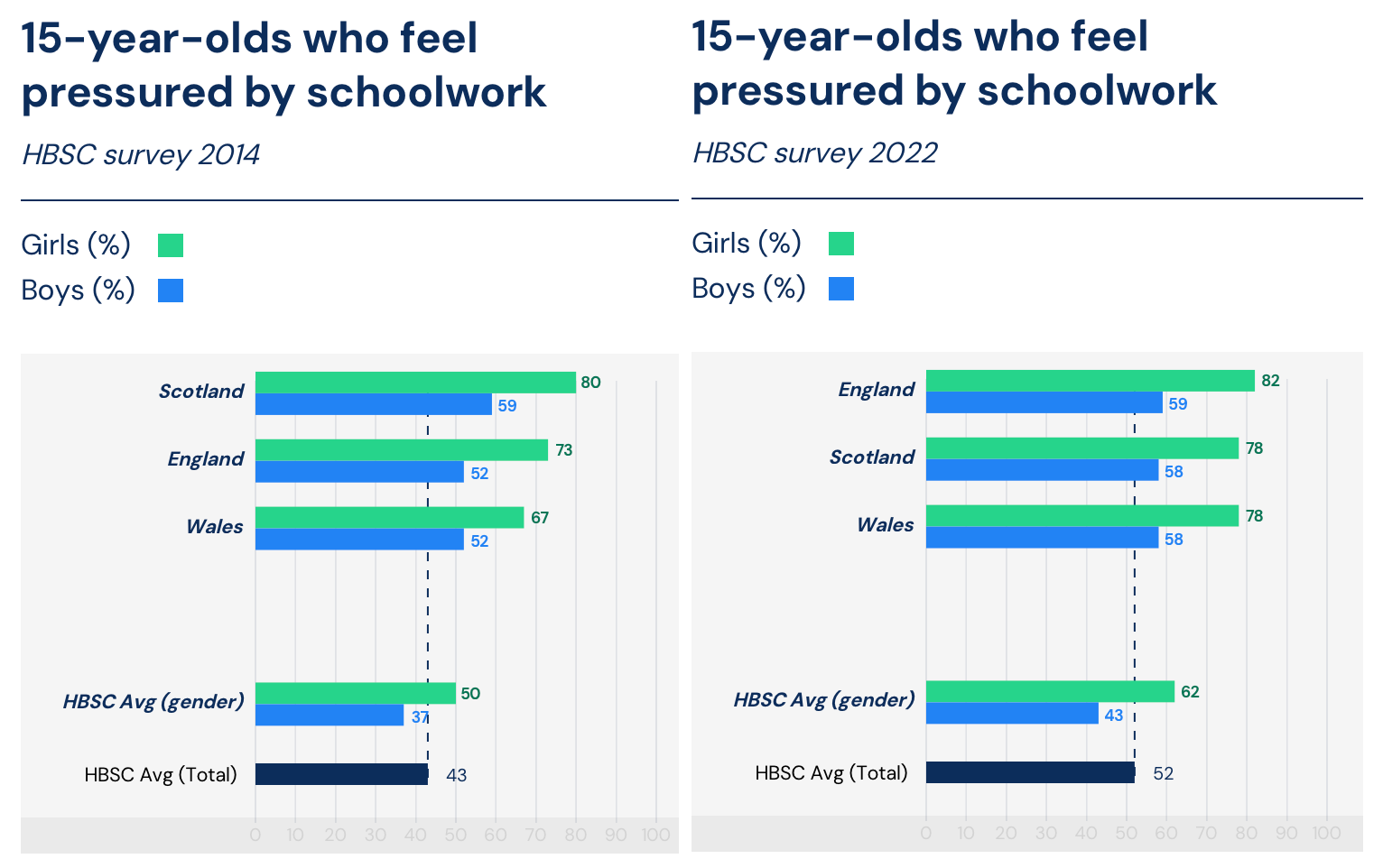
From this she concludes:
Their education policies and attainment scores have definitely diverged. But happiness and wellbeing have not.
Her argument: if curriculum policy mattered for wellbeing, English 15-year-olds would be doing worse than their Scottish and Welsh peers. There is no difference. So no smoking gun.
That’s reasonable from the charts she shows.
But what about the ones she doesn’t?
What happens at 11 and 13?
HBSC doesn’t just survey 15-year-olds. It also covers 11- and 13-year-olds.
If curriculum reform is affecting school experience, these ages are exactly where we would expect to see it most clearly. Especially on the two questions that cover attitudes to school.
Christodoulou doesn’t include that data. Here’s why.
First, the proportion of pupils who say they feel pressured by schoolwork, in 2014 and 2022:
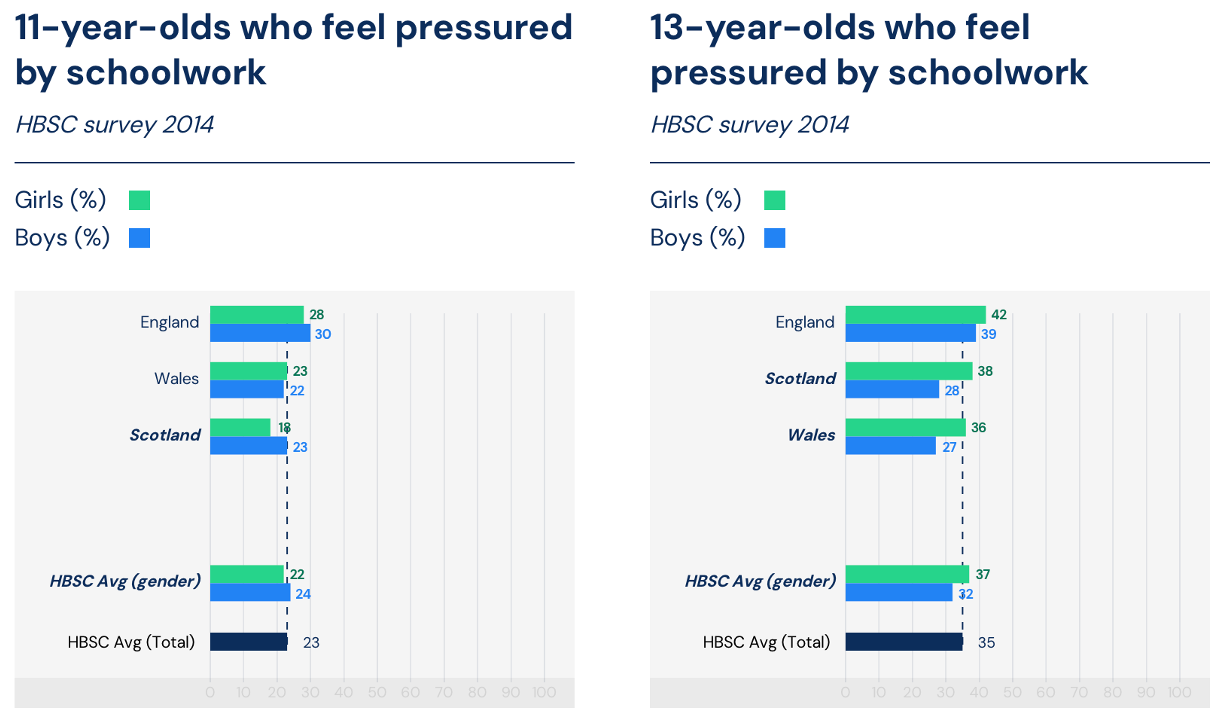
HBSC 2014: 11-, 13-year-olds who feel pressured by schoolwork, by gender and nation.
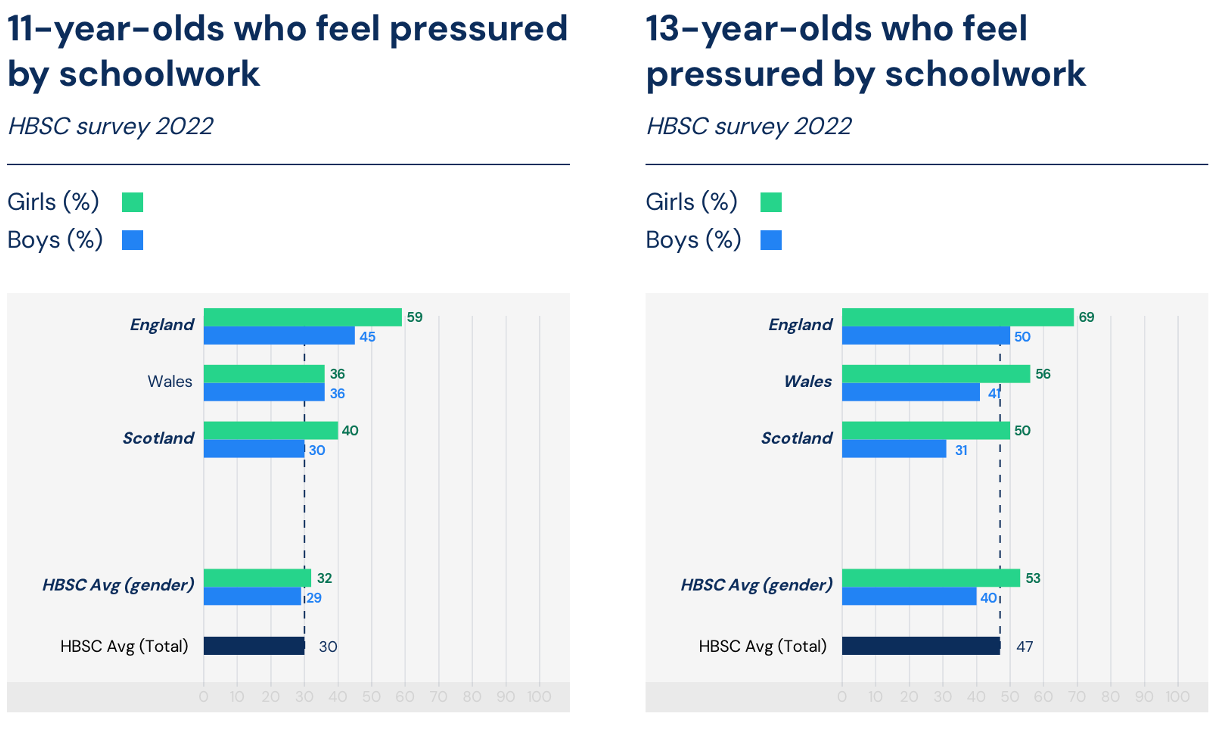
HBSC 2022: the same question, eight years later.
At 11 and 13, the picture is different.
On every one of these measures, the English increase is the largest in the UK, and on several it’s double the Welsh or Scottish change.
The second measure is the proportion who say they like school a lot. We’ll talk about why this is such an important question for the knowledge-rich curriculum in a moment.
First, here are the numbers at 15 again:
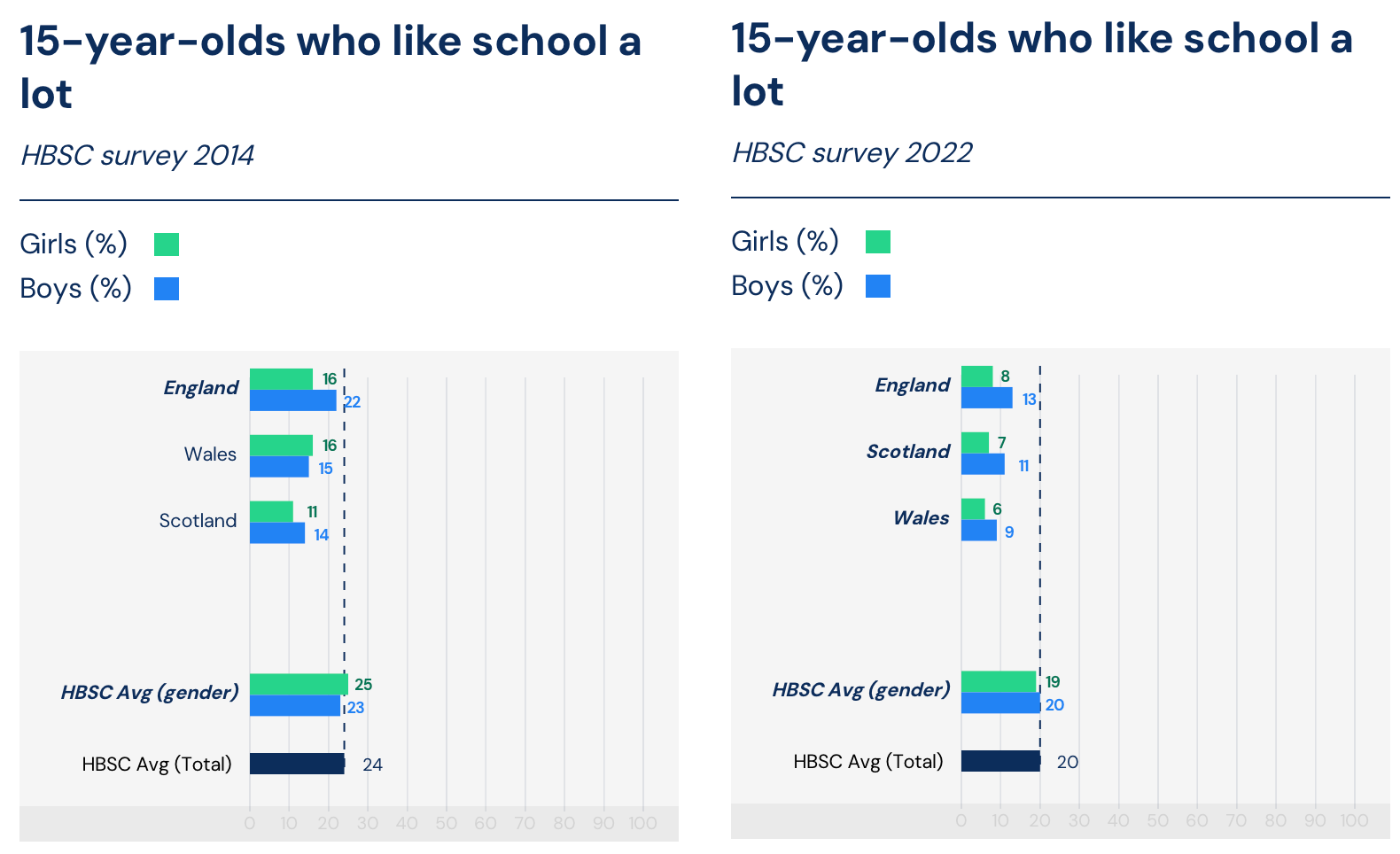
Christodoulou concludes: ‘The vast majority of English teens do not like school a lot. But the vast majority of Welsh and Scottish teens don’t either.’
The fall is largest for English 15-year-olds, but the findings are stark – lots of children don’t like school a lot.
Now let’s see what happens to those bright-eyed 11-year-olds just starting secondary school, and their 13-year-old peers.
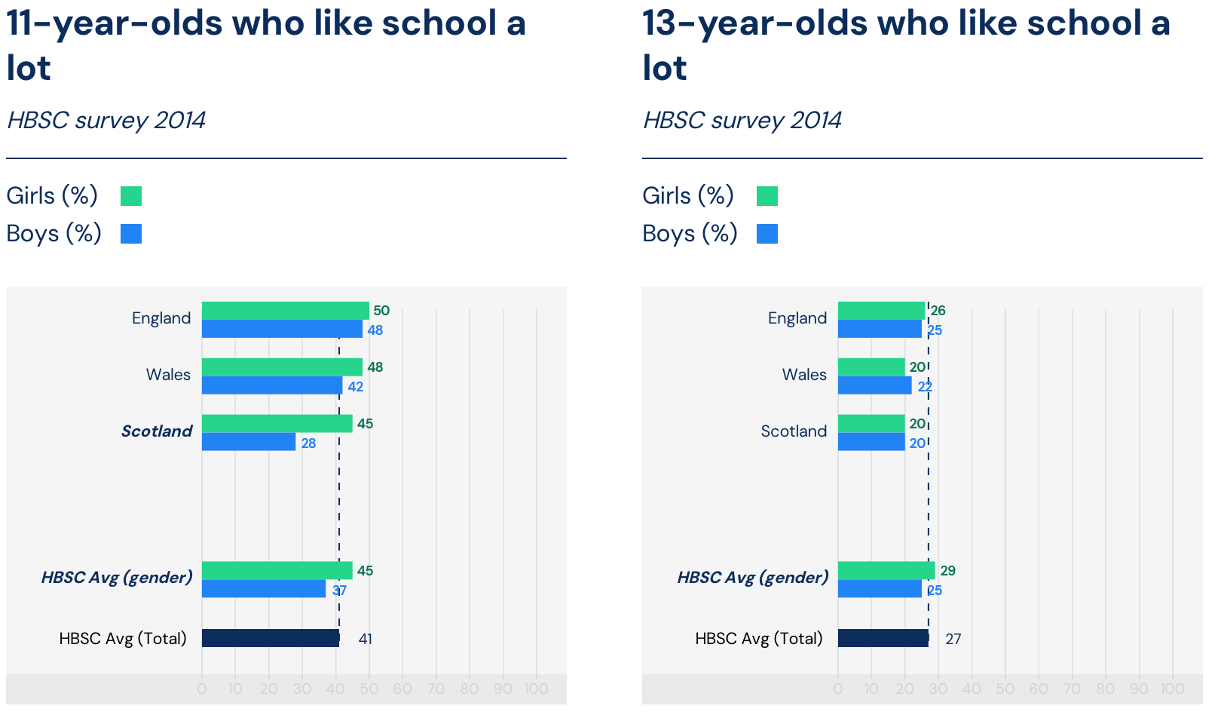
HBSC 2014: pupils who like school a lot.
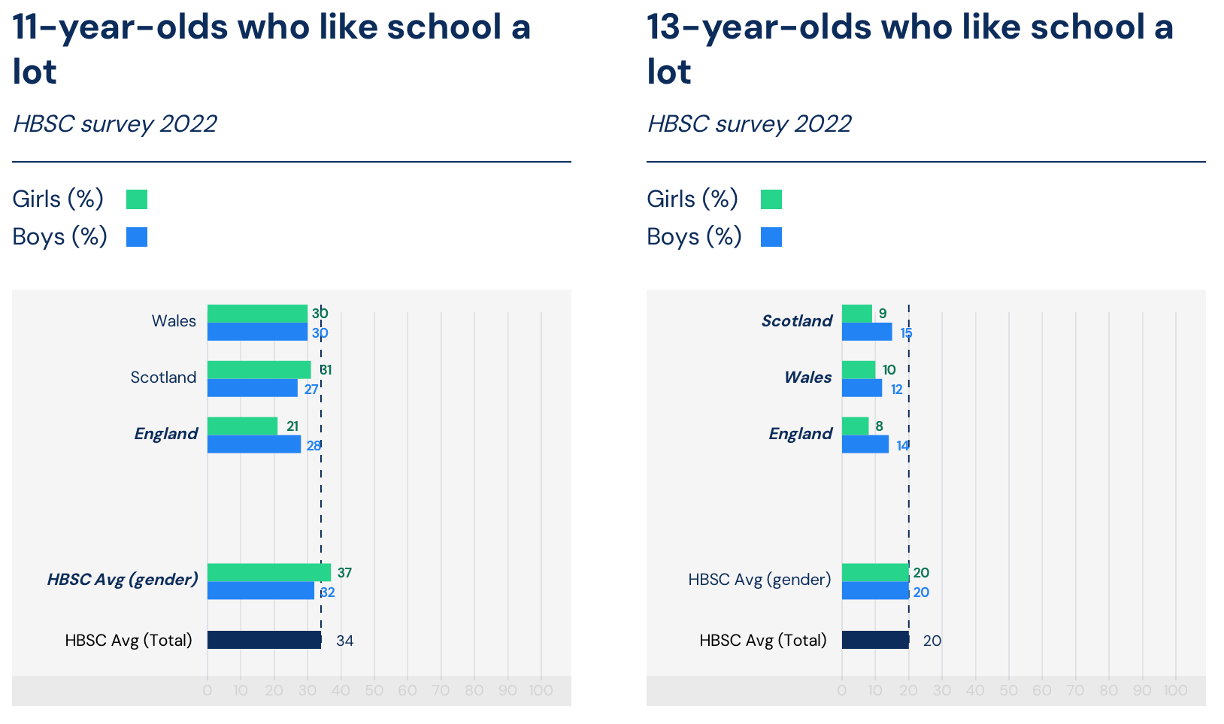
HBSC 2022: the same question, eight years later.
In 2014, English 11- and 13-year-olds were top of the liking school charts.
By 2022, England had fallen to the bottom.
For 11-year-old girls, liking school fell from 50 per cent to 21 per cent. For 13-year-old girls, from 26 per cent to 8 per cent — a drop of more than two thirds, the steepest fall of any UK group on any age band.
Again, the English change is larger than that of Wales or Scotland on almost every comparison.
These aren’t small gaps. With roughly 1,500 to 2,500 students sampled per nation at each age band, the 15-point divergence between England and its neighbours is unlikely to be statistical noise.
Christodoulou’s headline claim – that wellbeing has not diverged between the three nations – is true only at 15. At 11 and 13, it has, using her own source (and her own words), ‘definitely diverged’.
It’s also worth asking here if we’re looking at general wellbeing or something more specific – how students feel about school, and what school is doing to students.
But wasn’t this just Covid?
The obvious objection is timing. English pupils took the survey between December 2021 and April 2022, when the country’s schools had things besides a questionnaire to contend with: Covid’s Omicron wave, staff shortages, Year 6 pupils who had just sat the first post-pandemic SATs in a chaotic catch-up year.
It’s not all that surprising English 11-year-olds felt pressured.
But Covid hit Scottish and Welsh 11-year-olds too. If the pandemic was the dominant story, we would expect similar shocks across all three nations. Instead, the English change is substantially larger than the Welsh and Scottish change, both on school pressure and on liking school.
The pandemic affected every student in each country. Something above and beyond this is showing up in the English data.
Is it catch-up intensity in English primaries, the weight of the English SATs regime, accountability pressure passed down from secondary league tables, a cultural shift in how English primary schools operate?
It might not be the knowledge-rich curriculum, but Christodoulou could do a little more in investigating why the pressure ramped up for English students.
The symmetry problem
Christodoulou argues that global trends in teen wellbeing can’t be explained by English school policy alone.
But this isn’t quite what the data says.
She slides between three things – clinical mental health, general wellbeing, and how children feel about school – as though they’re the same category. They’re related, of course, but those changes in English children’s school experience deserve their own explanation, above and beyond smartphones and the pandemic.
There’s a bigger problem: Christodoulou also credits English curriculum policy for the fact that English attainment has held up better than Scottish or Welsh attainment on PISA, against a backdrop of global decline.
This is important. The Gove reforms were sold not just as attainment policy but as a route to greater motivation and enjoyment of school. If curriculum policy is powerful enough to buck a global attainment decline, it’s powerful enough to be part of the explanation when children report pressure and dislike of school – especially when its own architects promised it would do the opposite.
Why don’t students like school?
Michael Gove’s reforms were sold, in part, as a route to greater motivation.
In his 2012 speech ‘In praise of tests’ he told his audience:
Exams matter because the happiness I have described sustains future progress. We know that happiness comes from earned success.
He cited the cognitive science of Daniel Willingham – author of Why Don’t Students Like School? – and Willingham’s argument that genuine mastery produces the kind of satisfaction that shallow engagement can’t. In ‘The purpose of our school reforms’ two years later, Gove praised Willingham and Christodoulou by name as the thinkers whose work underpinned his curriculum changes.
Gove’s reforms weren’t intended just to gain a few more PISA points. Motivation and enjoyment of school were a key part of their justification.
Yet, sixteen years on, English children report the steepest decline in liking school of any UK nation.
The proportion of 11-year-old English girls who feel pressured by schoolwork has doubled.
We can’t necessarily blame the failure of Willingham’s cognitive science – again, this is a complex topic. But if Gove wanted us to judge the reforms on their ability to improve children’s enjoyment of school, we need to ask serious questions about whether they’ve been successful here.
More bluntly, if curriculum reform was meant to affect how children feel about school, we can’t now say that how children feel about school is none of curriculum’s business.
Why this matters
Just as we can’t prove that the curriculum changes caused England’s PISA success relative to its UK neighbours, the HBSC data can’t prove that knowledge-rich curriculum reform caused English children to feel worse. There are enough candidate explanations for the English divergence at 11 and 13 to publish a book on it.
But Christodoulou argues that the HBSC data lets us rule curriculum reform out as a factor.
It doesn’t.
11- and 13-year-olds’ perceived pressure due to schoolwork in England has increased relative to children in Wales and Scotland. Their enjoyment of school has plummeted. Any honest reading of the evidence has to engage with that rather than crop it out.
‘Sometimes the problems we think are unique to our own system are not,’ Christodoulou writes.
That’s true. Teen wellbeing – both general satisfaction and school-related measures – have fallen. They’ve fallen across wealthy countries, and Anglophone ones in particular, as she points out. No single policy lever will fix it.
But we could say the same for PISA scores. Well, they’re complex. Let’s just accept that’s the way they are.
An education secretary who tried this would be out the door the next morning.
Why don’t we pay the same attention to the statistics that are more meaningful to students themselves? The one in five children in England who are persistently absent from school. The 11-year-olds who feel pressured by their schoolwork. Those 13-year-olds who no longer like school.
Christodoulou is right that we shouldn’t blame Michael Gove for everything. But ‘not everything’ and ‘nothing’ are different claims.
The data she cites supports the first.
It doesn’t support the second.