

Jason’s Story
In Assessing Children’s Learning, Mary Jane Drummond tells the story of Jason.
Jason is seven and a half. He’s been at school for nearly three years. Now he’s taking a maths test in the school hall with the rest of his class.
Out of thirty-six questions, Jason gets one correct.
Jason hasn’t learnt much maths, Drummond says. But he’s learnt quite a bit about how to be a good pupil:
‘He has learnt how to take a test. His answers are written neatly, with the sharpest of pencils. When he reverses a digit and sees a mistake, he crosses it out tidily. He places his answers on the line or in the box as instructed…’
Jason doesn’t understand a thing on the paper, but he knows he can’t get angry and turn the table over. He can’t shout. He can’t speak to the child next to him.
He knows he’s sitting a maths test, and he knows he has to write numbers.
What Jason has really learnt
Exams, as Jason has shown us, breed compliance.
I used to lead a team of exam invigilators. It was only when I found myself standing through my tenth assembly on exam regulations that it occurred to me what a strange ritual exams are:
Silence.
No communication of any kind.
No phones. No writing on your arm. Clear pencil case. You’re recognised by a candidate number, not your name.
Why go to such extremes?
Because pass or fail, you do so on your own merit. In that exam hall, there can be no excuses. No unfair advantages.
And the stakes are real.
In 2015, England’s Department for Education announced that ‘knuckling down and succeeding in school puts an average of £140,000 in a young person’s back pocket.’
(How much of a difference does ‘knuckling down’ at school really make? I looked at what the data actually shows in my previous post.)
By 2021, inflation had struck: the DfE estimated that gaining one grade higher across a full set of GCSEs was linked to around £200,000 more in lifetime earnings. The conclusion? Develop new policies ‘to help pupils achieve better GCSE grades’.
For the DfE, exams are the focus. They drive policy – and the rules ensure a level playing field.
Sure, there are concessions. Extra time for pupils who need it. A separate room if sitting the exam in a hall would be too much. Different coloured paper, different sized scripts.
All carefully designed to make exams appear scrupulously fair. There can be no claim that the odds were stacked against you. If you fail maths, that must mean you’re a failure in maths.
What other explanation could there be?
I’m bottom set in maths too
I recently taught a lesson to a class of 14-year-olds. It didn’t go all that well.
One of the students put her hand up:
‘Sir, are we bottom set?’
She’d nailed it.
For those unfamiliar: in many secondary schools in England, kids are sorted into classes by ability – based on previous test results. This class hadn’t done well on theirs. Research shows that having a lower household income or special educational need is a powerful predictor of those who end up in the bottom set, regardless of ability.
I didn’t want to answer in front of the class. I told her to stay back at the end if she wanted to talk about it.
I was hoping she’d forget. She didn’t.
‘I’m bottom set in maths, too,’ was all she said before heading off to lunch.
Not, I’m in the bottom set, but I am bottom set.
A couple of weeks earlier, in my first lesson with the group, another student told me she was stupid. It was one of the first things she said to me, as if preparing me for disappointment.
You’ll just be a McDonald’s cooker, just flip patties
These are not unusual moments. Any teacher in a comprehensive school will recognise them. What’s frightening is how early the process begins.
Eleanore Hargreaves, Laura Quick and Denise Buchanan at University College London followed 23 children labelled ‘low attaining’ from the age of seven.
Saffa loved art – learning about pointillism was her favourite thing at school.
Did that mean she’d rather do art than maths each morning?
No – art would become ‘quite meaningless,’ she said. ‘Because you have to do plus and take away and division and stuff.’
At seven, she’d already learnt which subjects counted and which didn’t. The curriculum hierarchy had overridden her passions.
She also knew the stakes. If you didn’t listen in class, ‘You’ll just be a McDonald’s cooker, just flip patties. You will be unsuccessful.’
And when she had to leave her friends to join a younger class for maths, she called it ‘The walk of shame.’
The children understood that the way to succeed was through what the researchers called ‘compliant hard work’: listening, concentrating, doing what you’re told.
Bob, who was struggling himself, prescribed the same medicine for a classmate who wasn’t doing well. What should the teacher do? ‘Let her stay for her whole lunchtime… Work!’
But compliance wasn’t protecting them. Jake worried that struggling children would be told: ‘Oh you’re bad at mathematics, oh you’re bad at English… Oh you’re not smart.’
Chrystal felt that children like her would end up alone: ‘no-one cares’ because ‘they have no friends to stand up for them’.
Ben dreaded passing the headteacher’s office, terrified they’d call him in and tell him he had to go down a class. The fear existed only in his head – but stayed there across several terms.
Neymar hid in the toilets to avoid a maths test, despite how disgusting he found the smell. When the teacher found him, he complained of a tummy ache.
All except two said school was boring.
Seven years old. Already ranking themselves. Already afraid.
Already convinced that hard work was the answer – inside a system that had already decided they weren’t good enough.
Stop napping!
These children’s experiences don’t happen in a vacuum. They’re produced by a system that has steadily constricted around what can be measured.
In the US, social studies, art, music and physical education have all been squeezed to make room for tested subjects. Even time spent on science – supposedly a core subject – has decreased by a third to make room for English and maths.
The pressure of standardised testing was so great that one school superintendent stopped kindergarteners from napping. Another school cut lunch to less than fifteen minutes.
In England, Alice Bradbury and colleagues found that children as young as five are being grouped by ability based on phonics knowledge. And it intensifies as high-stakes SATs approach at 10–11. They surveyed 288 primary headteachers. 35% agreed that ‘SATs mean we have to group by ability’ in English. In maths, this rose to 47%.
Several heads were uncomfortable with this. One said: ‘Pupils get into a psyche of failure because they’ve always been in the bottom set… You’re just written off.’
Another felt ability grouping was necessary so that the children would learn to cope with the test pressure, but said: ‘I worry about the effect this has on children’s maths mindsets and it goes against everything I believe in.’
But they felt they had no choice.
The measurement becomes the purpose
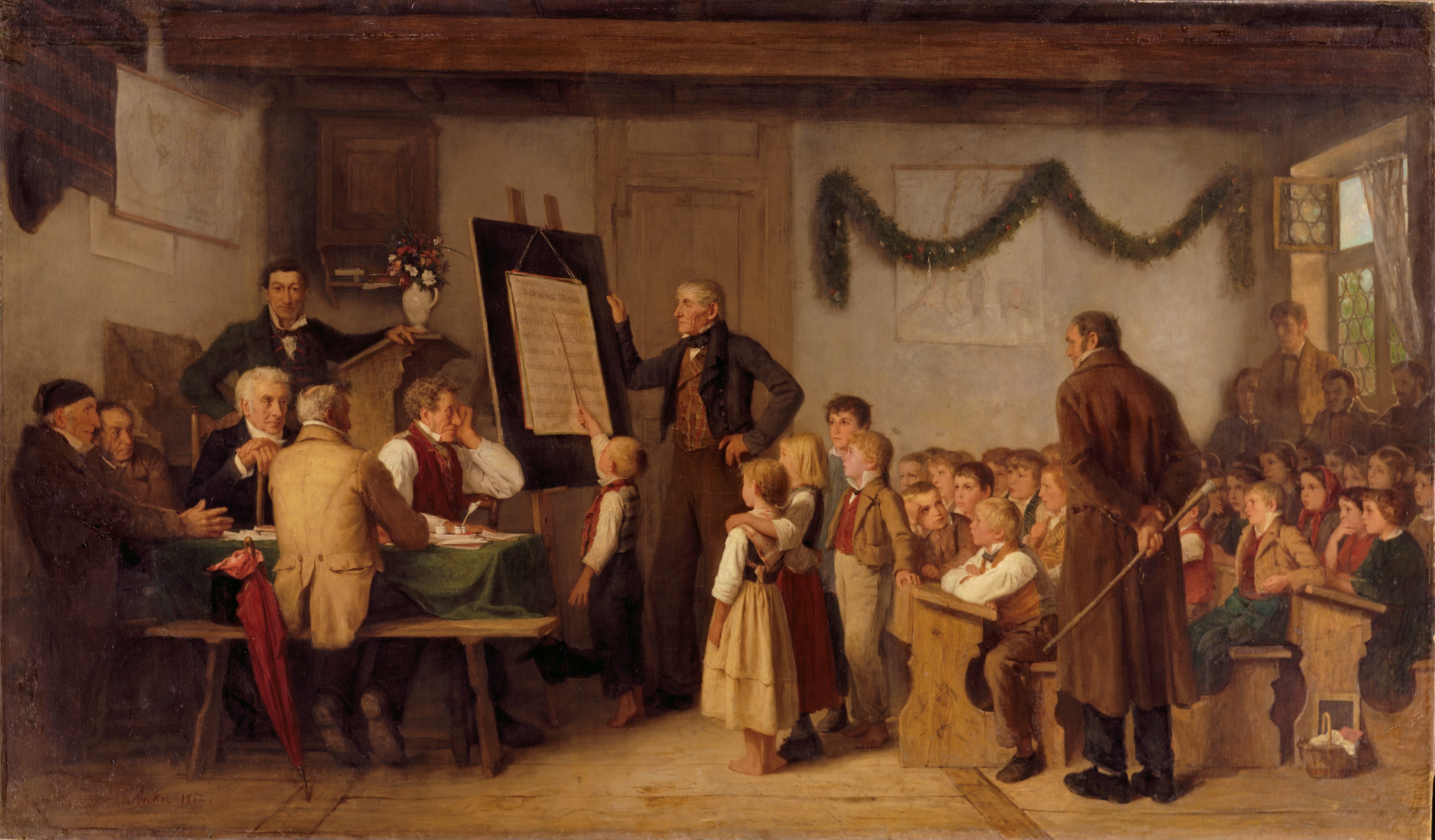
It’s impossible to put a date on the beginning of mass education in England, but 1862 was a significant year: Viscount Robert Lowe’s Revised Code.
Schools would receive government funding based on how many children passed tests in reading, writing and arithmetic. Inspectors would visit, examine the pupils, and the grant rose or fell according to the results.
When their salary depended on it, what did the teachers do?
They taught to the test.
Matthew Arnold – Victorian England’s most celebrated poet, who also spent 35 years as a schools inspector – watched it happen: ‘it is now found possible, by ingenious preparation, to get children through the examination in reading, writing and ciphering, without their really knowing how to read, write or cipher.’ (It would be cool if kids used to learn codebreaking, but cipher here just means maths.)
Arnold could see it coming.
He warned that tying school grants to a minimum test standard ‘must inevitably concentrate the teacher’s attention on the means of producing this minimum and not simply on the good instruction of his school. The danger to be guarded against is the mistake of treating these two… as if they were identical.’
The original idea of a good schooling would be forgotten. Passing exams would become a good education.
Five years later, the vote was extended to the working classes. Lowe announced: ‘we must educate our masters.’ Now the working classes could vote according to their beliefs, it was imperative they hold the right kind of beliefs.
The Revised Code was eventually abandoned. But the instinct behind it – measure children, fund accordingly, trust the numbers – never went away.
As psychologist Donald T. Campbell put it over a century later: ‘The more any quantitative social indicator is used for social decision-making, the more subject it will be to corruption pressures and the more apt it will be to distort and corrupt the social processes it is intended to monitor.’
In schools, no social indicator is more powerful than exams.
We’ve built a system around measuring children, and the measurement has swallowed everything else. The curriculum narrows to fit what’s tested. Children are sorted by their results. Teachers who value curiosity and creativity find there’s no room for either.
Who’s failing the ‘low attainers’?
It is not the teachers who are failing Saffa, Ben and Neymar. The teachers are keeping seven-year-olds in over break to catch up when they’d probably rather be having a cup of tea in the staffroom.
Headteachers are grouping students by ability to prepare for high-stakes testing at age 11. They believe they’re doing the best for the students, often against their own instincts to protect them.
Exams consistently favour those from wealthier backgrounds – as I explored in my previous post. In every one of the 19 countries where the PISA data allowed a comparison, wealthier students who didn’t believe in the value of hard work outperformed poorer students who saw themselves as gritty – by a wide margin.
From government ministers to classroom teachers, everyone agrees that these inbuilt biases are wrong and that we must do everything we can to correct them.
But who deals with the fallout when the kids realise the system has placed them on the bottom rung of the academic ladder?
Not the government ministers.
What if nothing works because exams are designed to discriminate?
What if the main effect of everything we do to correct the gap – grouping by prior attainment, extra work over break, intervention classes, all the mindset programmes – is to form an identity in low attainers as low attainers?
It’s such a strange system that, at some point, it stops feeling like a design fault and starts to feel like a design feature.
What you are describing here, with the idea of equating schooling instruction with standardised test results, is an example of Goodhart's Law. This is a phenomenon I have been very interested in lately and I have touched on previously in: https://samuelkammin.substack.com/p/school-uniform-and-the-performance, although not as thoroughly as you have here. It also resonates nicely with your reference to Donald Campbell, someone I am less familiar with. Thank you for recommending this piece Chris, and I look forward to reading more from you