
Do you like learning? Or do you love learning at school?
How a small difference can tell a big story about children’s curiosity

I have a favourite curiosity experiment.
Psychologist Susan Engel and her student Kellie Randall advertised for some teachers to run a science experiment. Each teacher was brought in separately and paired with a child.
The teachers were split into two groups, both with the same task – guiding the children as they mixed baking soda, vinegar and water, then dropped raisins in.
But while half the teachers were asked to help the child learn about objects floating and sinking, the other half were simply asked to help the child complete the task and worksheet.
Teachers were given only eleven minutes to work with the child – only just enough time to complete the worksheet – so that the teachers (like teachers everywhere) were under time pressure.
Those told to help the children learn made encouraging comments, asked their own questions and gave positive feedback. Those who were helping the children complete the worksheet made ‘restrictive’ comments, according to the researchers, criticising and correcting what the children were doing: ‘The procedure says to add 8 raisins. Make sure you are adding exactly 8; count them out first.’ And, ‘No, no, wait, let’s read through this first.’
And that was even before the kid went off script.
On the bench were some things that weren’t on the worksheet – sweets, crackers, marshmallows. Halfway through the experiment, the child picked up a Skittle from this pile and dropped it into the liquid.
If the teacher asked, the kid was to say they just wanted to see what would happen.
The teachers who had been told to help the child learn were mostly encouraging. They asked follow-up questions: ‘Wow, what’s happening with the Skittle?’ and ‘Do you think the water is going to turn orange now?’
The other half, who wanted to get through the worksheet, were frustrated. ‘You were not supposed to do that,’ one said. ‘Show me where it said to put that in there. It didn’t.’
Another said, ‘Well, curiosity is a very good thing, but probably we should stick to the directions.’
The most depressing part?
After the trial, the teachers who had been told to help the child complete the worksheet thought they’d done just as good a job of encouraging the children’s curiosity as the other group.
When curiosity researchers leave their curiosity at home
That’s one experiment. Conducted in a lab rather than classroom.
But what if this sort of thing does go on in classrooms? And what if it happens lesson after lesson, year after year?
What effect would that have on children’s curiosity?
As well as a favourite experiment, I also have a favourite book about curiosity: The Hungry Mind.
It’s also by Susan Engel.
In fact, it inspired me to start a PhD researching children’s curiosity.
But one line in it bothered me:
‘When older children are asked about their enthusiasm for domains like science, many indicate a great interest in the topic itself, but say they have little interest for the way it is presented in school.’
This is a big statement, and she makes similar claims elsewhere.
It’s certainly plausible. As a secondary science teacher, I can confirm a lot of students have little interest in the way it’s presented in school. Or at least, the way I present it (and I try pretty hard some days to make it as interesting as I can).
Other academic researchers have picked up on what Engel says.
‘Despite its association with positive outcomes, one of the most common manifestations of curiosity – children’s questioning – typically decreases once children enter formal schooling.’
Yes, there’s some evidence for this, but one of the main studies cited was conducted with preschoolers at home and at kindergarten. Nearly all such studies (and there aren’t many that look at how questioning changes with age) are small-scale.
Another, more recent paper cites Engel: ‘typical schooling does not reliably increase curiosity, and might even diminish it in some contexts, i.e, when learning information by rote memorization is emphasized.’
Sure, maybe. But Engel gives no evidence to support an effect of rote memorisation on curiosity. And other authors follow suit (e.g., here and here).
What’s missing is curiosity about the original data.
What does the evidence really say?
If only we had a big, global sample of children to ask
Engel’s ideas have caught on because they’re appealing. Also, in a field dominated by questionnaires and quantitative analysis (erm, see below), she actually watches children and teachers to see what they do.
And she does this in the classroom.
She nails the mechanisms by which teachers might halt curiosity. The sort of thing that, repeated day in, day out, might lead kids to think that curiosity has no place in schools.
In one case study, Engel’s watching Mrs Parker, who has given ten-year-olds some equipment to model how the ancient Egyptians might have built the pyramids.
There’s a sheet to fill in. When one group comes up with some particularly creative ideas, Mrs Parker tells them, in front of the rest of the class, ‘OK, kids. Enough of that. I’ll give you time to experiment at recess. This is time for science.’
In another class of fifteen-year-olds, Engel reports the teacher halting a class discussion: ‘I can’t answer questions right now. Now it’s time for learning.’
These are great vignettes. And I’m all in favour of small-scale research involving classroom observations – it’s the basis of my PhD work. I see many of the same things Engel saw, although I also see teachers patiently answering question after question (ones which are often very tenuously related to the lesson).
But to make universal statements about what happens to children’s curiosity at school, you need more.
You’d need to include tens of thousands of children, from across the world – Bogota in Colombia to Helsinki in Finland.
Imagine you asked all those children how curious they were. Then you’d have something solid to work with.
Then you could begin to make bigger statements about what happens to children’s curiosity as they get older.
Luckily, someone has done exactly this.
Thanks OECD – tell us what you’ve got
If you want big educational surveys, you go to the OECD.
Their PISA study of 600,000 15-year-olds every few years makes headlines and forces educational policy changes.
(If you want to know what PISA tells you about curiosity, head here.)
But they run another study which is, in its own way, even more fascinating – their Survey on Social and Emotional Skills, or SSES.
In 2019, they gave their questionnaire to over 60,000 kids in ten cities across the world. This time, they weren’t creating a league table for academic achievement, but finding out which ‘soft skills’ help kids succeed. They asked about creativity, self-control, cooperation and – crucially – curiosity.
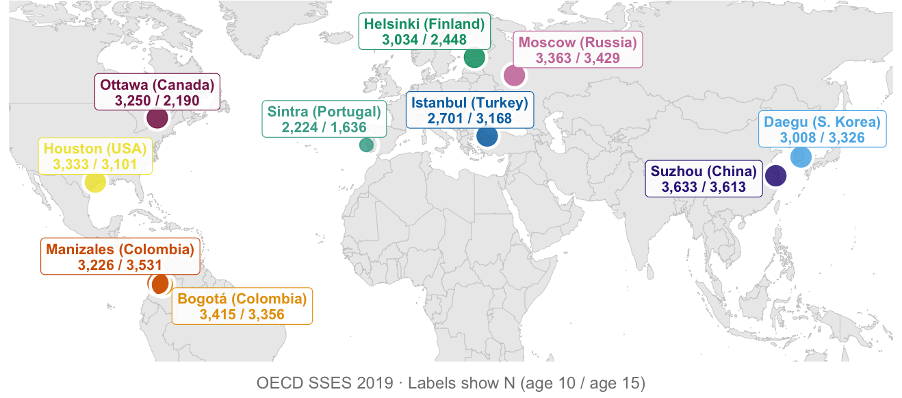
And, more importantly, they include 10-year-olds and 15-year-olds in their study. The kids were asked questions and their answers to these questions were weighted and made into a ‘curiosity score’.
All we need to do is compare the curiosity scores of the two age groups.
This should tell us everything we need to know. If the fifteen-year-olds’ curiosity is, on average, lower than that of the ten-year-olds, then Engel’s right.
So, here we go:

(Technical detail: even if you give this the full stats work-over, you find the same thing. I’ve run the model with more levels than a multi-storey carpark and in every city, the 15-year-olds have lower curiosity than the 10-year-olds).
So, job done.
Schools kill curiosity.
We need to stop all those Mrs Parkers in their tracks and tell them: Experimentation is science! Questions are learning!
But not so fast.
What were those questions asking? What exactly was it the children told the OECD about their curiosity?
On a need-to-know basis only
Ok, I need to ask you something before we carry on.
The questions the OECD ask in their survey are confidential. A couple of years ago, anyone could download the questions and data from their website. Now, you need to be a fully paid-up researcher, go through an application process, and take part in a complex initiation ceremony.
So, you need to promise me something.
I’m going to tell you a few of the questions, but you cannot tell a soul what these are, or my licence to research gets revoked.
Agree?
Thanks, glad that’s out the way.
Let’s see them. Or at least the fun ones.
To what extent….
1. Are you curious about many different things
2. Are you eager to learn
3. Do you like to ask questions
4. Do you like to know how things work
5. Do you like learning new things
6. Don’t you like learning
7. Do you love learning new things in school
8. Do you find science interesting
All questions were on a 5-point scale – strongly disagree / disagree / neither agree nor disagree / agree / strongly agree.
The results are in…
If we split the results by question, a more interesting story emerges.
Let’s start with the first one: If kids are curious, surely they’ll agree or strongly agree with question number one.
How do 10-year-olds and 15-year-olds vary in their responses?

Wait.
What was that?
There’s not much in it, but more 15-year-olds are curious about many different things than 10-year-olds. So, curiosity, by that measure, actually increases (slightly) as kids get older.
What about question three – the percentage who like asking questions?

This is where things get interesting. Although students feel at least as curious on average at the age of fifteen, they don’t like asking questions. Not as much as the 10-year-olds, anyway.
(Note that we aren’t looking at what happens to the same children over time – we’re looking at two different groups of children. And this would make a difference if something like the pandemic had happened, and might affect different age groups differently. This is an issue with later SSES data but not this 2019 cohort.)
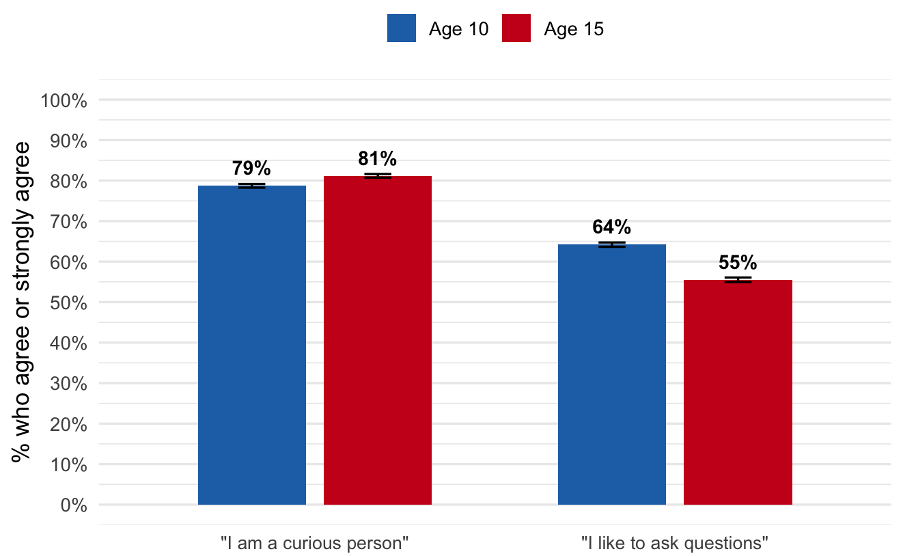
So, curiosity stays the same (or increases) but enjoyment of asking questions decreases.
But maybe this has nothing to do with school. Maybe this is developmental.
It could be that 15-year-olds don’t need to ask as many questions, because they have other ways of finding out (although even on Google and ChatGPT, you need to ask questions to resolve your curiosity).
There is, however, a way of testing this.
Look at questions 5 and 7. They ask whether students…
(Question 5) like learning new things.
(Question 7) love learning new things in school.
There are two differences between these questions.
If students’ answers differ, it might simply be because they like learning, although they don’t love it.
But there’s another difference, one that jumps straight out: question 7 asks specifically whether students love learning new things in school.
Most students – aged 10 and 15 - agree or strongly agree with both questions. But looking at the number who don’t agree or strongly agree makes the changes a bit clearer:
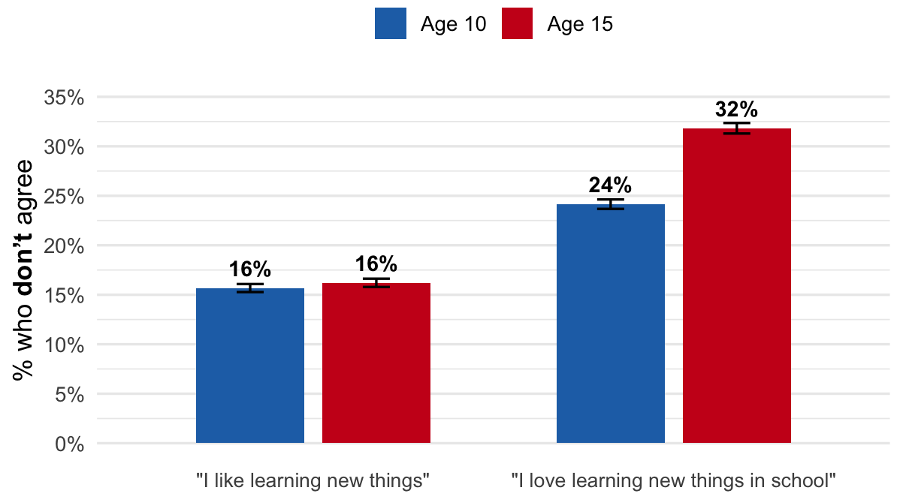
The number who don’t agree that they love learning new things in school is much larger than the number who don’t agree they like learning new things.
Even at ten years old, it’s fifty percent larger. But by fifteen, that gap has doubled. Now, twice as many 15-year-olds don’t agree that they love learning new things in school compared to the number who don’t like learning new things.
Houston, we have a problem
We can even look at this ‘curiosity drop’ city by city.
I averaged the scores for every student in each city at age 10 and age 15.
On the y (vertical) axis, I’ve plotted their agreement that they love learning new things in school.
The x (horizontal) axis tells us whether they like asking questions.
We can then see the changes between 10- and 15-year-olds in each city.
Of course, we have to be cautious. We only have twenty data points. But an interesting pattern begins to emerge.
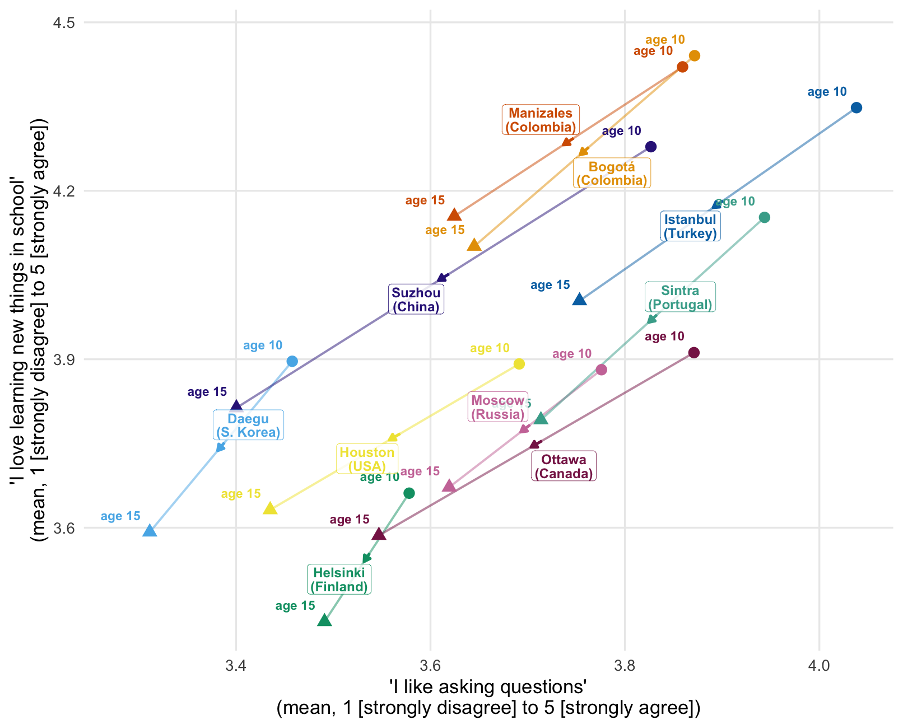
Those arrows are shooting back towards zero (although note that the axes only start at about 3.5).
In our diverse sample of cities from across the world, something changes for the average student between age ten and age fifteen. They don’t like asking questions as much, as their love of learning new things in school is falling.
Why, though? What’s causing this?
So who’s responsible? Lining up the suspects…
This is where we have to be cautious. It’s easy to fall into the trap I gave at the start of this post by pointing the finger at the most obvious candidate.
Researchers have been quick to blame the Mrs Parkers of this world, squashing questions and pulling Skittles out of chemical concoctions.
But let’s look at this from Mrs Parker’s perspective.
Her mind could have been on an upcoming inspection, or the headteacher was going to check through her class’s books later that day: ‘oh look, this kid (who’s in the disadvantaged group) didn’t manage to complete his worksheet.’
The teachers in Engel and Randall’s study were randomly assigned to a group. They hadn’t decided to focus on completing the worksheet – they’d been told to do that.
We know from survey evidence that teachers value children’s curiosity – something I’ve heard again and again in interviews for my doctoral research. But teachers work within constraints: a scheme of work to get through, exams to prepare for, and – crucially – the need to ‘prove’ that learning has taken place.
If you’re a teacher with limited time to cover a lot of material, a simple action like a student dropping a Skittle into liquid, or asking an off-topic question, could become a subversive act. You can embrace it, but that sends out a message to all the kids that this kind of behaviour is ok. At best, it puts you further behind in the endless race against the scheme of work. At worst, your classroom authority is challenged and it’s even more difficult to get through everything you planned to.
Or you can put a stop to the behaviour and plod through the lesson’s content. And at the end, you’ll have the worksheets to show for it.
The curious teacher has nothing.
Where is that curiosity going?
So is it school that kills curiosity? Is it developmental – something that happens when kids hit their teens? Or is there something the OECD’s questions are failing to capture?
I don’t think the data can tell us.
But it can tell us something important.
Look again at the difference between those two questions. Only sixteen percent of 10-year-olds don’t agree they like learning new things. The same proportion of 15-year-olds.
Curiosity, in the broadest sense, survives adolescence intact.
But ask whether they love learning new things in school, and the picture changes.
At age ten, there’s a gap between students’ answers to these questions.
By fifteen, that gap has doubled.
The curiosity is still there. It just doesn’t feel as welcome in school.
A final question: what would schools look like if students felt their curiosity was welcome?
Enjoyed this? Subscribe to Get Curious for more content to pique your curiosity.