

I love open evenings at school, but I always feel like a bit of a fraud. Every school I’ve worked in, we put out all the exciting experiments – dissections and exploding bubbles, Van de Graaff generators and sound and light shows. You can see the excitement on the primary school kids’ faces, as if the Hogwarts letter has just popped down the chimney.
That excitement continues through their first weeks in the lab, especially as we let them loose with the Bunsen burners.1 But they soon divide into two groups. There are those few who, like my top set Year 9s, will do an electricity practical on series and parallel circuits. I’ll show them how to set it up and they’ll race through it. They might not derive all the laws themselves, but they understand the trends when we discuss them.
Those with lower prior knowledge, or who pick up new ideas more slowly, too often remain eternal novices. In that same lesson they may only learn how to set up a circuit. Yet they’re still expected to collect the readings, understand the rules for series and parallel circuits and remember them for future lessons.
The curriculum won’t wait. We talk about equity, but I’m constantly denying knowledge to my bottom set class. Setting up the circuit is a genuine achievement, but because the lesson demands so much at once, too many spend the practical copying the results over their partner’s shoulder – no chance of understanding what they’re actually doing, their working memory always in danger of being overwhelmed by the demands the lesson places on them.
Practical has always been an awkward aspect of science education. It’s difficult to manage well, to assess and we’ve never agreed on what the point of it is. But science itself without practical work is unthinkable. Theory alone would be meaningless. Hypotheses are contested in the real world, with real equipment. Without falsifiable theories – and the experiments to test them – science collapses into story.
Little scientists and big scientists
Children cannot do the same things as real scientists, we are told, because they are not experts. They must have the fundamentals in place to do real science. But what do real scientists do?
Ideally, real scientists fully understand the experiments they are working on – the set-up, the assumptions, what each reading means, when a result is too good to be true. And they are driven by a curiosity that carries on burning: even after a long day in the lab, the next reading might be the one that confirms or refutes their hypothesis. That curiosity is never truly satisfied, because greater understanding leads to further questions.
This is where the novice-expert divide comes in. If you use practical work in school with students who don’t have the requisite background level of knowledge, you end up with one of two things: science as magic tricks or science as box ticking.
Magic tricks
Science as magic tricks – that’s the promise of all the open day exhibits. Science will be fun, because you get to do these cool new things, schools are telling those over-excited Year 6s. And it does generate curiosity – you can see it in their faces, hear it in their questions. But it’s a shallow kind of curiosity. While the professional scientist might be spurred on after a discovery, once that ‘ooh-ah’ school demo is over, you’re left with the same disappointment you get after finding out how a card trick’s been done.
Take the elephant’s toothpaste demo in chemistry:
I take the kids outside to watch me and there’s one question I get again and again – ‘can I film it?’ Occasionally someone might ask what just happened but most simply remember a vaguely chaotic demo.
But maybe these experiments help to promote a long-term love of the subject? The evidence says otherwise.
Less boring than writing
Ian Abrahams, of the University of Roehampton, interviewed 96 students about their views on practical work. Most liked it. By far the most common reason? ‘Because it is less boring than writing’.
Here’s an example. Abrahams asked one student if they were going to continue with science after it became optional:
Student: No not really I’m not really into it all.
Researcher: But you did say you liked practical.
Student: Yeah but, ’cause sometimes it’s fun, and practical’s easier than, well, writing.
Abrahams split students’ responses into two categories: ‘absolute’ and ‘relative’ liking of practical work. Those who liked practical work absolutely said things like ‘it’s fun’. Those who liked it relatively only preferred it to something, e.g. ‘because it is better than reading the textbook.’
Here’s how those students’ preferences changed between Year 7 (age 11-12) and Year 11 (age 15-16):
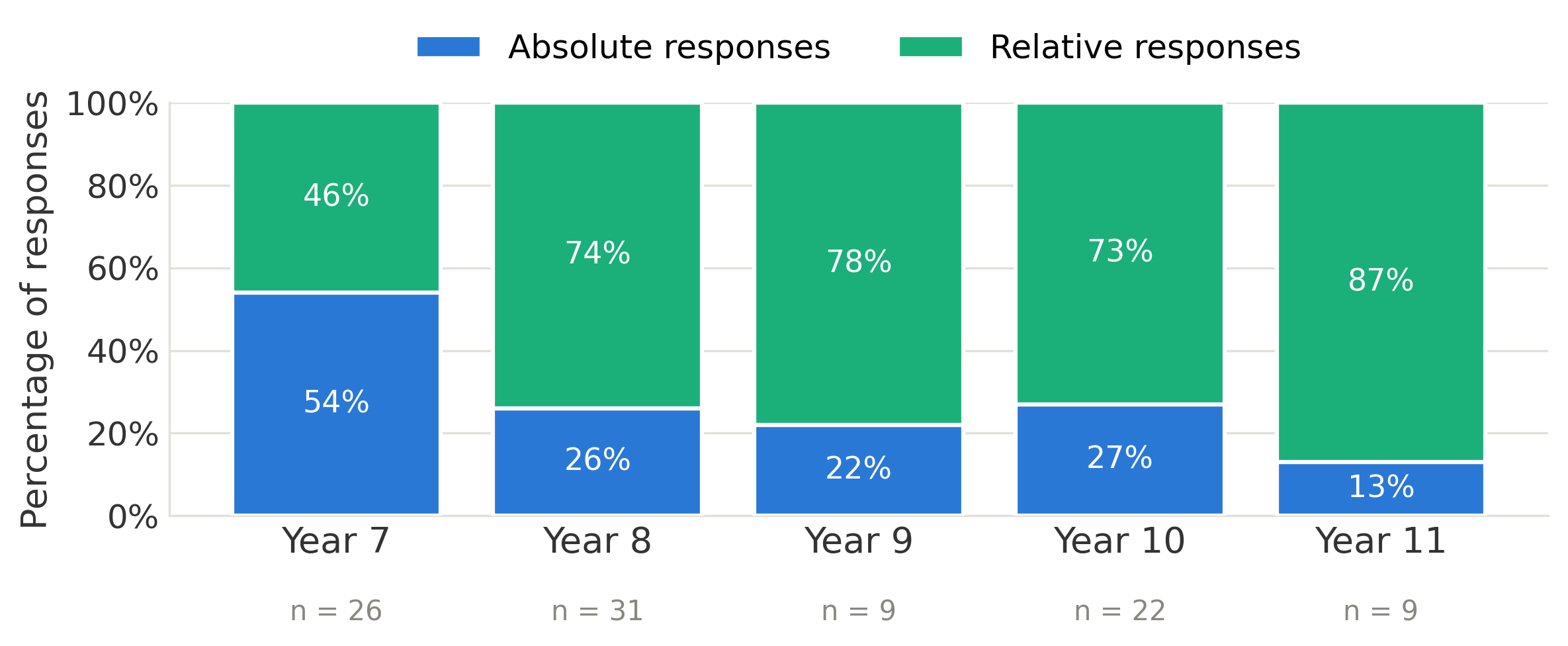
Obviously this is based on a relatively small sample, but there’s still a clear trend – liking practical for its own sake declines steeply after Year 7.
Abrahams concluded that students’ interest was ‘situational’: ‘unlikely to endure beyond the end of a particular lesson’. The result was that ‘pupils will perceive science as boring despite their having used practical work on numerous previous occasions.’
Teachers, Abrahams found, used practical work primarily for two reasons:
1. To help in the behavioural management of the class—particularly with low to low/middle academic ability pupils.
2. To help off-set the image of science as difficult, dull, and boring by presenting an alternative, arguably misleading, image of science in which the emphasis is primarily on ‘doing’ fun and enjoyable ‘hands-on’ work rather than on learning about ideas.
One head of department put students’ enjoyment of practicals down to the fact they didn’t have to think hard during them.
Practical doesn’t have to be this way, of course. Drawing on the work of scholars like Abrahams, England’s Education Endowment Foundation’s review of best practice is an excellent starting point for making practical work meaningful. But the EEF note:
Pupils should know why they are doing an experiment, but young people often report ‘just following the instructions’ without understanding the purpose of practical work.
This ‘just following the instructions’ is the second category that practical work falls into all too often.
Box ticking
Box ticking happens when we make students do practicals they don’t really get or care about. It’s like dragging your kids around the art galleries and big houses of Rome, pointing – That’s a Titian! That’s a Caravaggio! – and they yawn and ask when you can get a pizza.
Newton revolutionised our understanding of motion by overturning centuries-old ideas, like those of Aristotle. You can demonstrate his laws of motion quite easily in a school science lab. Take a little cart, tie some masses onto some string and let them fall off a bench to accelerate the cart. Measure the acceleration and plot it against the size of the force created by the falling mass and you’ve demonstrated Newton’s Second Law. What better gift to students than allowing them to see this?
We do, of course. In fact, at GCSE, it’s what’s called a required practical. The issue is that very few students appreciate there’s any magic here, because it would take weeks rather than a lesson or two for most to understand the significance of that one experiment. We rush through it and they end up with only the faintest idea about why they’re hanging masses off a cart.
We outsource the importance from the material itself to the qualification that enables students to progress in life. We make students care by putting the practicals on the theory exam. They must memorise a recipe to get top marks, according to the exam board:
The method would lead to the production of a valid outcome. The key steps are identified and logically sequenced.
This can be done with absolutely no knowledge of what the practical itself is for. I spend one lesson doing the accelerating cart practical, then revise it again and again – always in theory. The system doesn’t prize understanding why that simple demonstration of Newton’s second law is revolutionary. It doesn’t know how to. You can recall a method? You can plot points? You know the name for the shape of the graph? That’s what success in school science looks like to students.
Impotent Knowledge
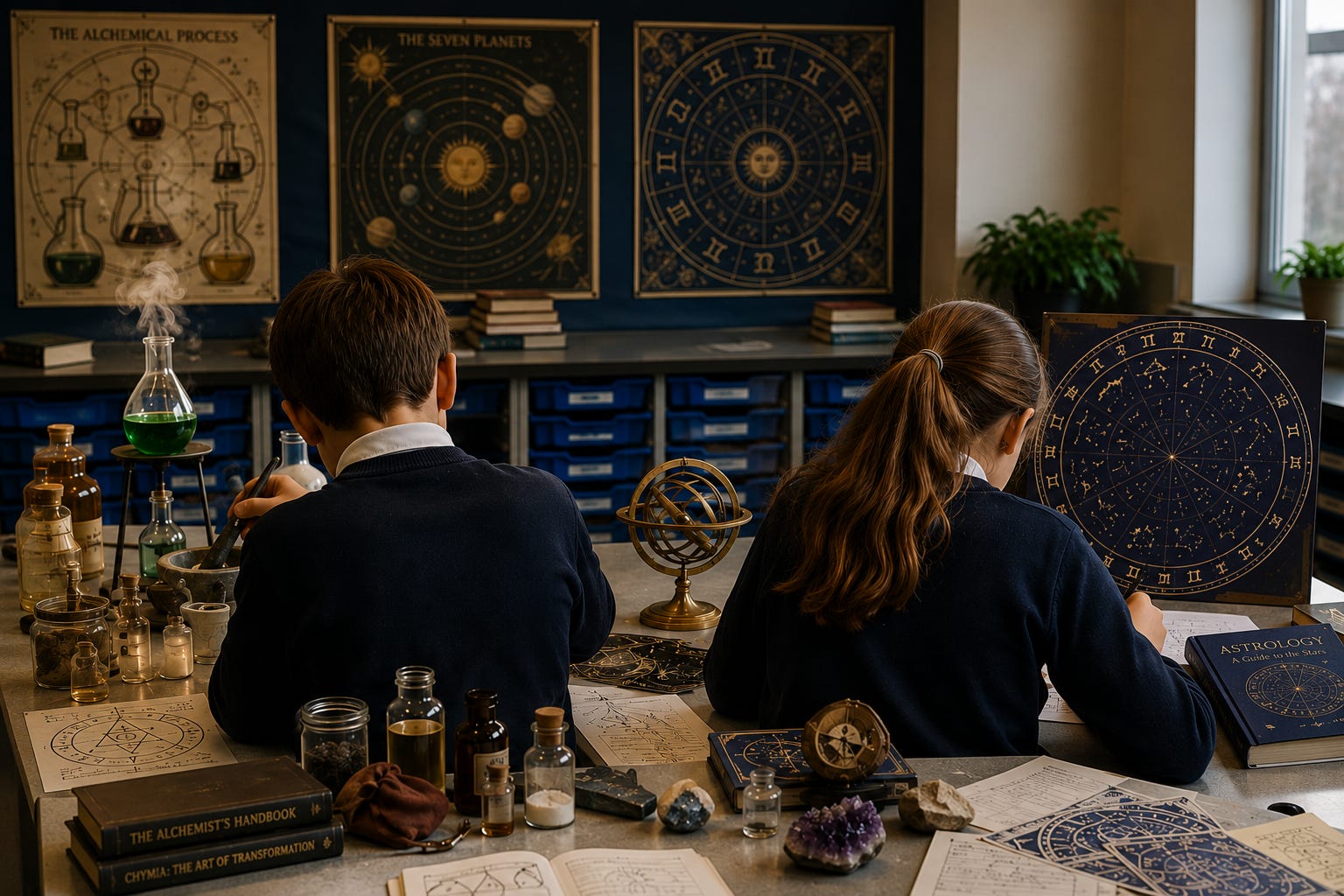
Let’s imagine, for a moment, our curriculum was a little different. Instead of the sciences, we had subjects like astrology and alchemy. These subjects were detailed and investigated rigorously.2 Let’s imagine we codified the knowledge and put it into textbooks and examined students on star charts and the best recipe to turn mercury into gold. Sure, the practicals didn’t always work out, but that’s just what happens in school experiments, isn’t it?
The difference, of course, as Michael F.D. Young explained, is that powerful knowledge allows us to make predictions. It tells us something about reality. Alchemy cannot turn base metals into precious ones, but scientists really can transmute elements – we have created atoms in the laboratory that, as far as we know, have never been seen in nature. Astrology cannot foretell when the end may come for humankind, but physics allows us to track that asteroid which might be heading towards earth.
Except that students can’t do these things. What most actually take away from school science is either banal, like the fire triangle, which they could probably put into action if the bin went on fire in front of them without having been taught it. Or something they couldn’t apply in the real world. Newton’s laws are great, but there’s very little students could predict with them in practice. Every question that tells them to ignore friction and air resistance is another step away from reality.
Our curriculum, for many students, is like the struggling kid at sports day, tripping over their own heels in a doomed effort to catch the pack running ahead of them. The knowledge the curriculum contains, so powerful in expert hands, is impotent for those students – a star chart with better PR.
Do we need to lower our standards to raise them?
Thinkers like Michael Young and E.D. Hirsch – whose ideas underpin our curriculum – are right: our students need to know science to participate as educated members of society. But, at the moment, most don’t. One of my Year 11s told me just before they went on exam leave that they wished Newton had never existed – that their lives would have been much easier without having to memorise his stupid laws. This doesn’t smack of being empowered by knowledge.
I’ve discussed before how little students need to know to pass their science exams in England. We claim we have high standards because of our packed, uniform, knowledge-rich curriculum; but what if we started calling out the contradictions that we saw? Success isn’t making every student work through every lesson regardless of whether they get it or not. Knowing 25% of a huge amount of stuff isn’t necessarily superior to knowing 80% or 90% of something smaller but more coherent and meaningful. Doing practicals as magic tricks or tick box exercises belittles science itself.
If pupils never move past novice stage, they lack the apparatus to judge the power of the ideas they’re learning. What if, instead, we slowed down, where we needed to? We could let that Year 9 class, who have just mastered the art of setting up a circuit, pick up where they’d left off and start taking readings the next lesson, slowly building up an understanding of what they’re doing and why they’re doing it. Without that understanding, science is no more meaningful to them than alchemy or astrology, except that they have some vague sense it’s valued by society whereas alchemy and astrology are quackery.
Nobody has asked me to write a scheme of work or a national curriculum, but if they did, I’d reverse it. I wouldn’t have a set of facts students needed to have in their head by the end – I’d start with the most foundational ideas and take it from there. Students would become expert, theory and practical reinforcing one another, so they truly appreciated the significance of each idea. ‘Pure’ discovery learning certainly isn’t the answer here; instead, we need to carefully tailor teaching to the students in front of us.
There is a strong argument against this: that slowing down for the students who struggle most is just low expectations dressed up as compassion – the very thing the knowledge-rich movement set out to fight. But we aren’t comparing a little knowledge to a lot; we’re comparing nominal, superficial coverage to genuine acquisition. Students are entitled to a curriculum they understand, not a speed read of a book in a language they only half know. And yes, it would pose problems for exams if students didn’t all cover everything at the same pace, but do we really want that one consideration to be the beating heart of our education system?
This resembles mastery learning – refusing to move on until students understand the key ideas. The EEF Toolkit rates mastery learning as having a moderate impact (+5 months), but English trials found much smaller effects. That’s hardly surprising if schools remain bound by a system in which everyone is ultimately expected to move through the curriculum together. Mastery without genuine flexibility over pace is mastery in name only.
Rather than an entitlement, the curriculum too often serves to deny powerful knowledge to those who need it most. Our teachers are waiting, ready to help students understand the real magic behind each practical. But too often they have to push on, well aware that most of the class just don’t get it, but what choice do they have? There’s a rota, a scheme of work, today’s powerpoint to get through. That’s when practical work becomes the carrot to get them through another lesson, as one of the teachers from Abrahams’ study put it.
Where facts stop and understanding begins
Equity is the right goal, but we’re going about it the wrong way. Power lies not in a series of half-remembered facts, but in understanding how science works, what it’s for and where its limits lie. To understand how science works is to know the tricks that climate change deniers pull and why those who promulgate ‘race science’ are deluded. It’s easy to produce an apparent counter-fact and claim that nothing is settled, which means that all views are equally valid. But, as Hannah Arendt argued, if we want the next generation to improve the world we’re leaving for them, we need to give them the tools to genuinely understand it first.
Instead, we teach that science is simply an accumulation of facts. When you know the facts, you know science. That route might end in you acing your exams, but it might also result in thinking that absorbing all the facts about how America staged the moon landing is a valid scientific approach.
I’m going to change how I teach science. Before each experiment, I’m going to ensure that students understand why we’re doing it. If they don’t, we’ll go back over the rationale and, if necessary, cut the practical. Why waste their time with magic tricks and box ticking?
But something else needs to change. We need to give the big ideas space to breathe. Science is the most powerful tool we’ve ever discovered for understanding reality. If children could leave school really, truly understanding that idea – that, to me, would be genuinely magical.
Do Bunsens exist only in science classrooms? I’ve worked in chemistry labs and I’ve never seen a scientist crack out the Bunsen.
Newton and other scientific luminaries like Robert Boyle dabbled deeply in alchemy; chemistry has its origins in the quest for the philosopher’s stone.
Interesting Chris. Practical work being used as a way of managing behaviour, is an interesting use of practical work. I have always had the view that there is disciplinary knowledge linked to AO3, which requires pupils to have a set of skills which answer these types of questions. Secondly, there is a link I have attached on slow practical's which may be useful:
https://achemicalorthodoxy.co.uk/2018/12/06/the-slow-practical/
Completely on board with all of this Chris, great to read a piece delving into your subject expertise as well.
I found it quite striking how steady the absolute engagement declines alongside the relative engagement increasing as the school years progress. I wonder if this phenomenon would be observed in other subjects as well? Perhaps this trend is telling of any active hands-on practice that children get the opportunity to partake in; I wonder if this graph suggests a decline in children's subject interest overtime generally speaking as well, although I'm cautious about overgeneralising based on the one data set, as you mentioned.
Glad you cited Young in this discussion, I'm finding his work more and more relevant lately and a lot of it ties in nicely with your thinking here. I can see how the apparent 'out of reach' applicability of certain school knowledge can be demotivating for some children, but I believe this is precisely what Young is a big advocate of; the exposure to knowledge that their local experiences may not necessarily provide. But like you say, if the children understand the purpose behind these scientific facts and if they know why they matter, that makes the knowledge a lot less out of reach and a lot more motivating.