

I gave back some GCSE mock exams a few weeks ago, congratulating my Year 11 class. Nearly all of them had got the same grade or improved since the last set of mocks (we do a lot of mock exams).
Then I looked at the papers I was handing back. ‘Well done’, I’d scribbled across a paper that had got 55%. ‘Great work’ on another that had got 48%.
Most of these kids had sat the ‘foundation tier’ – the lowest difficulty paper, the one that cut out the hardest material. Some of the questions were pretty straightforward, like calculating an average or plotting a couple of missing points on a graph. Others were even easier:
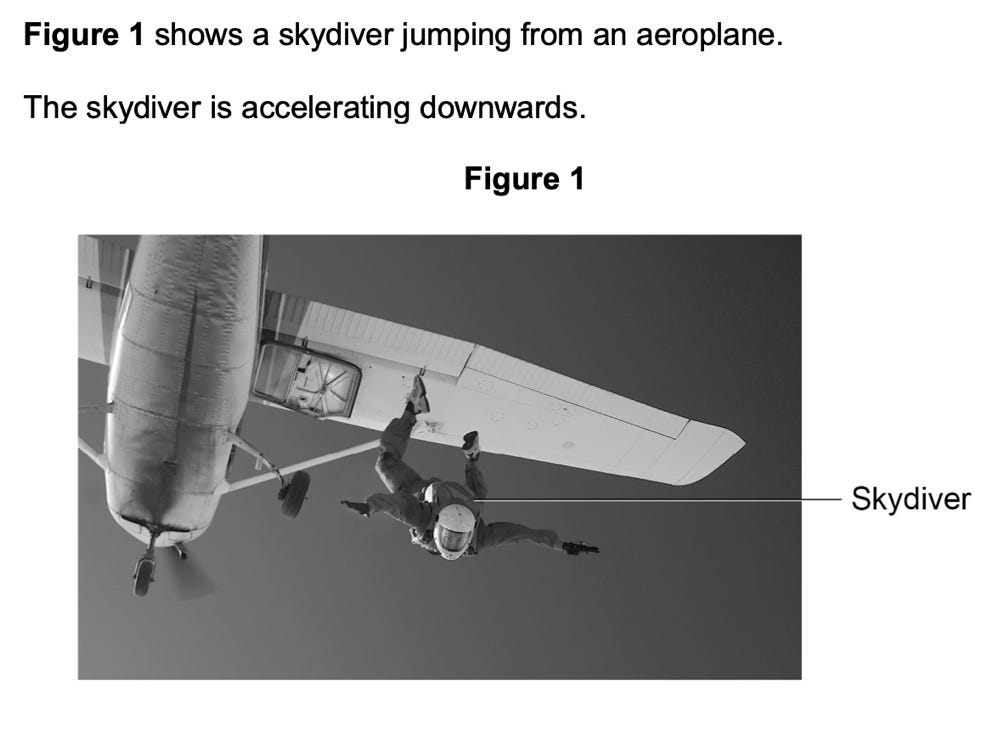
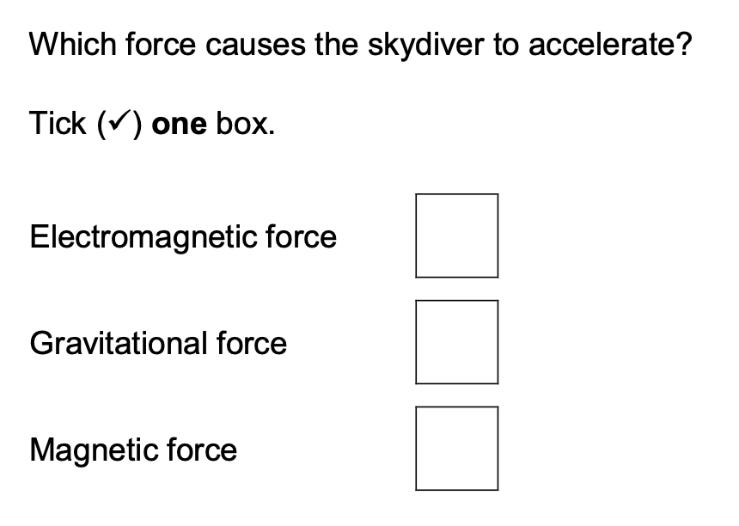
Not all of them got this question correct.
I’d always prided myself on holding my students to the highest standards. They were a couple of months off being done with school forever, never to take physics again. I was sending them out into the world knowing a fraction of the knowledge-rich curriculum I had been presenting them with for three years.
I thought I was doing everything right: Retrieval starters, mini whiteboards at every opportunity, carefully sculpted explanations with no distracting, twirling PowerPoint animations. No hint of problem-based or discovery learning in my class and the only practicals we did were the ones fully embedded in the scheme of work or required by the exam board. I’d read every kid’s SEN report and tilted the tables by sitting the most disadvantaged kids at the front of the class.
All this, and if they took the higher tier physics paper, the top scorers in the class would probably get between 20% and 30%
Where had I gone wrong?
A very Conservative revolution
When the Conservative government came to power in the UK in 2010, ministers began their revolution of teaching in England with big promises. There would be new exams, ‘designed to address the grade inflation, dumbing down and loss of rigour.’ The ‘knowledge-rich curriculum’ would now contain the ‘essential knowledge and skills which every child should master’.
Ministers also acknowledged that ‘failure to secure a good maths or English GCSE renders any student effectively unemployable.’ If students did not meet the required standards in mathematics and English, they would retake the exams until they did. And, naturally, the idea of students sitting an easier paper and being limited to just passing would be a thing of the past.
Michael Gove, Education Secretary and architect of the changes, warned that results might dip when standards increased. But that was only because they were ‘honest’ in a way previous exams hadn’t been.
The poverty of low standards
The rhetoric was strong, but underneath, Gove was undermining his own high standards. Rather than push for a system where students really understood everything on his ‘knowledge-rich curriculum,’ he let them leave school grasping only a fraction of it.
Let’s take one of those core subjects – mathematics. Let’s take the biggest exam board by entries – AQA. And let’s look at the grade boundaries for the new ‘good pass’ – a grade 5 (on the scale 1, lowest, to 9, highest).

(After 2019, pass grades changed dramatically, and so I’ve not included these. ‘Standards fell as a result of the pandemic’ would be an easy target. I’m interested in the immediate changes.)
At around 30% for a grade 5, three students could be awarded a ‘good pass’ and allowed to move on to the next stage of their education and into work, while having no overlap at all in their understanding of the curriculum, with its ‘essential knowledge and skills which every child should master’.
The situation is worse, in fact. Because Gove set the effective standard of a pass at grade 4. If you can get a fifth of the questions right on the paper, you don’t have to retake your exams. Knowing only 20% of that knowledge-rich curriculum, apparently, transforms your prospects from ‘effectively unemployable’ to government-certified school leaver.
And, as you will have spotted, Gove did not remove the ‘foundation tier’ in all subjects. Nearly every student in my class is limited to a grade 5, moving those aspirational top grades out of reach.
The Curiosity Gap
The knowledge-rich curriculum was designed to be the great social leveller. Michael Gove, drawing from others such as E.D. Hirsch, explained it in terms of the ‘Matthew Effect.’ Following the biblical passage, those who start school knowing most are the ones who gain most. They have the concepts in place to build on and so progress is easier. As Gove put it:
We cannot anymore ignore the evidence that shows that pupils from less advantaged backgrounds are less likely than their peers to access this ‘communal knowledge’ at home, who by contrast enjoy frequent guided reading with parents from a young age, as well as rich conversations at the family dinner table as they grow older.
Gove’s revolution sought to give all students access to this communal knowledge. But he forgot one vital factor: it wasn’t only access to the knowledge that differentiated between rich and poor, it was also the desire to gain that knowledge, when they were presented with it.
Some children may experience this ‘communal knowledge’ in art galleries, science museums or in discussion over dinner when their parents return from their jobs that require it. To these children, the value of school knowledge might be self-evident. To children without this range of opportunities, it may not be. That doesn’t mean they’re less curious, but it might mean they express it less at school.
Rather than guessing, though, let’s test the theory.
We’ll begin by looking at England alone, given it’s England’s knowledge-rich curriculum we’re discussing. In the 2022 PISA survey, the OECD gave children around the world tests of their science, mathematics and reading knowledge, as well as a questionnaire about their attitude to learning. Even if we restrict the data to England, we’re still left with almost 5000 students.
We’ll split the students into quintiles – five equal groups – from poorest to wealthiest. Then we’ll compare their answers to two of the curiosity questions (how much they strongly disagree to strongly agree on a 5-point scale with the following):
I am curious about many different things.
I love learning new things in school.
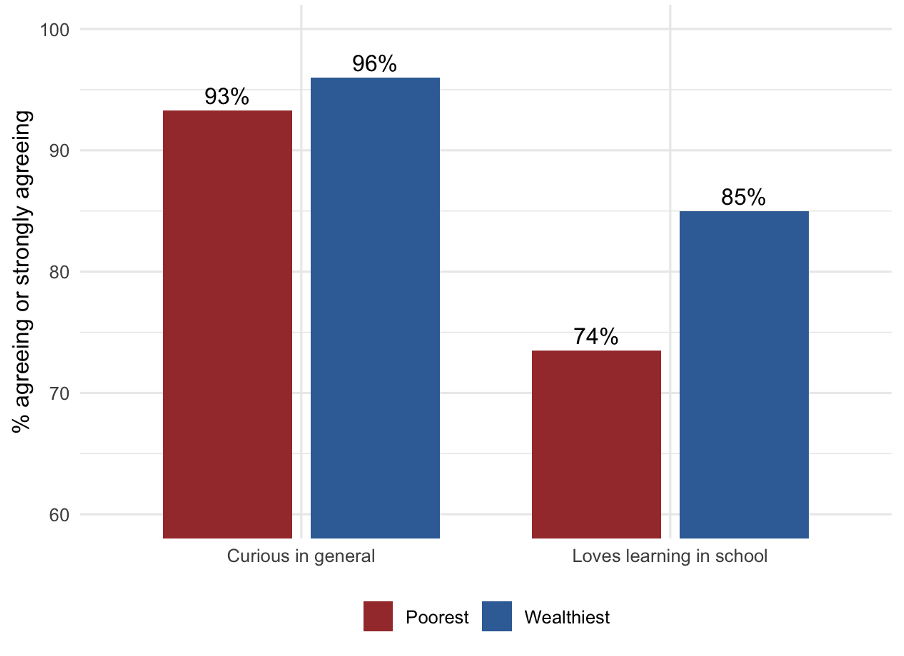
Between the wealthiest and poorest 20%, there’s little difference in how curious they feel. The gap comes in their attitude towards learning in school.
Another question: by 2022, we’d had the knowledge-rich curriculum for some time. Was it the great leveller it was intended to be?
Here are the test scores for the richest and poorest, which we’d expect to converge if indeed the knowledge-rich curriculum had closed the wealth gap:
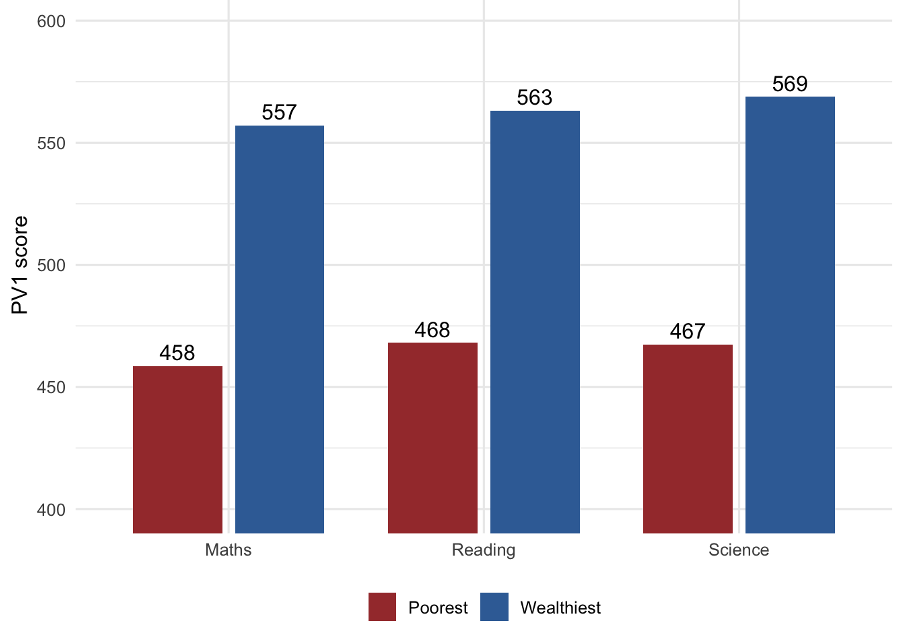
Obviously we aren’t quite there yet.
At an average of almost 100 points between the wealthiest and poorest across all three subjects, England ranks 21st out of 75 PISA nations in terms of the size of its attainment gap.
If quintiles were nations, the wealthiest would rank second in the world in mathematics, just after Singapore. The poorest would be 39th in the world, ‘statistically significantly below the OECD average’, according to the OECD.
This isn’t good, but it doesn’t mean that curiosity is the solution, nor does it mean the ‘curiosity gap’ is a uniquely English phenomenon. To investigate those two points, we need to go global.
Going global
If curiosity did correlate with better test scores, this might just be because it encapsulates a positive attitude towards learning more generally. So, let’s compare the effect of being curious to having grit or a growth mindset - while holding the effects of the other two traits constant.
Here’s the data, from over 80,000 students across 41 countries.1
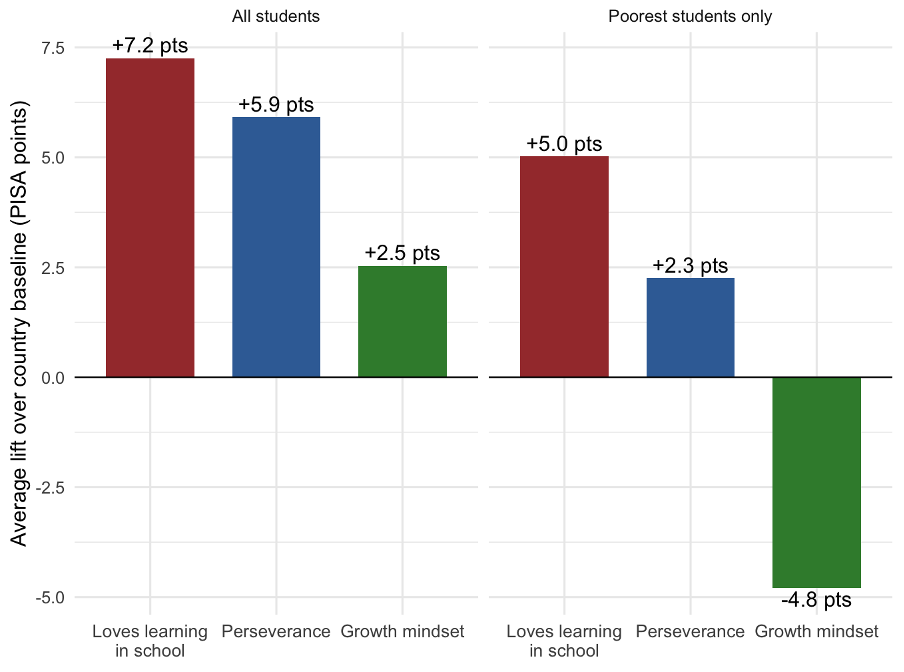
According to PISA, 20 points equates to about a year’s worth of schooling. So, loving learning in school gives the poorest a boost of roughly 3 months compared to their equally-poor compatriots who do not love learning in school.
And it’s England specifically we should worry about.
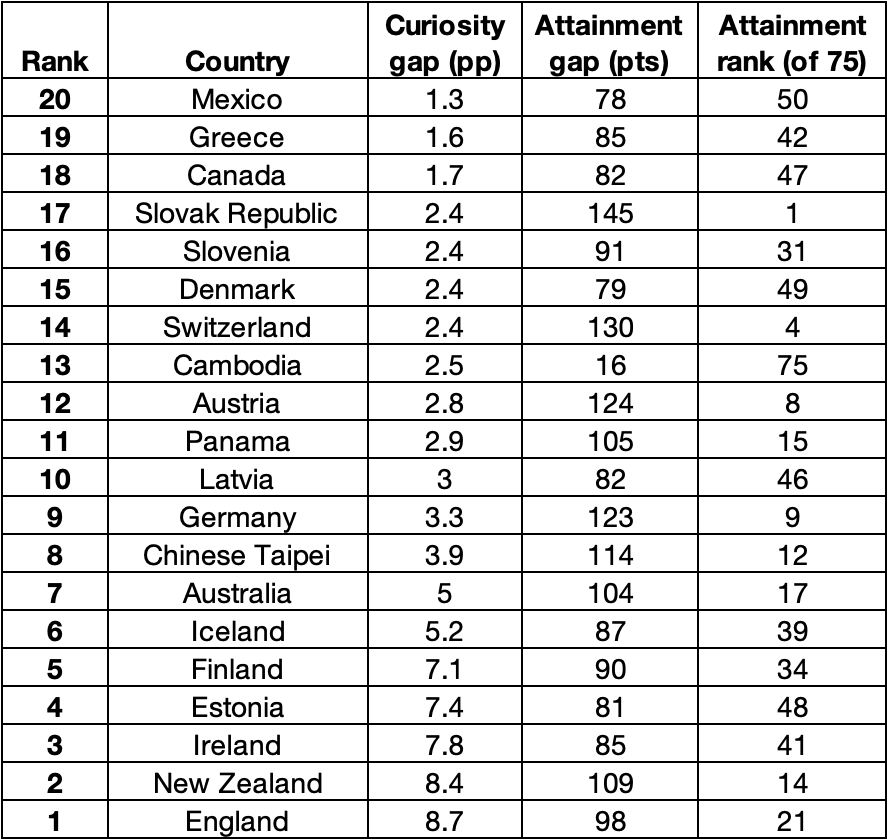
We can calculate the curiosity gap (general curiosity minus love of learning new things in school) for all 75 regions in PISA. Here are the top 20:
And here’s that information for all 75 regions – with the attainment gap between poorest and richest plotted against their curiosity gap:2
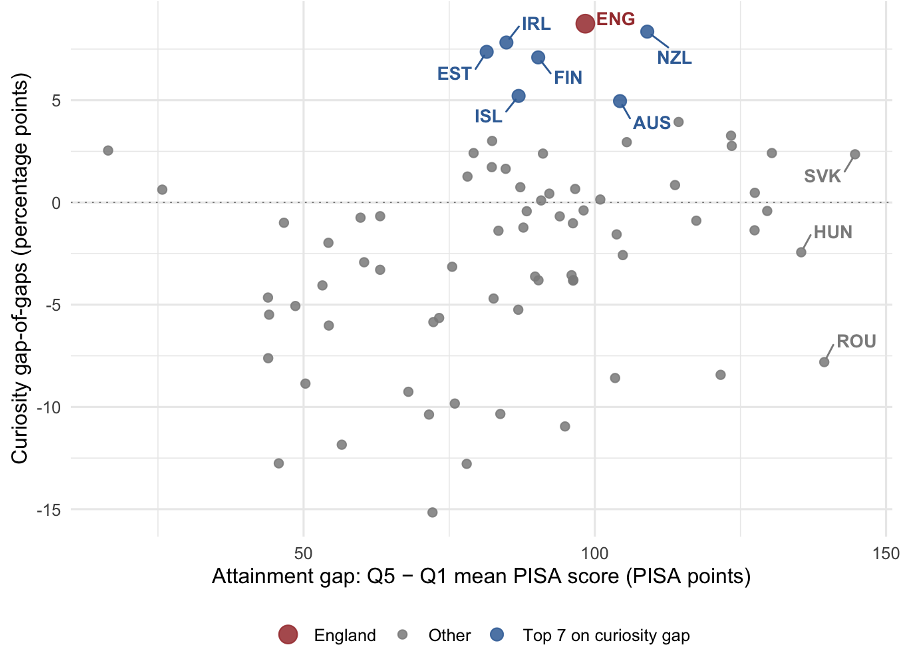
In summary, the difference between England’s poorest students’ curiosity gap – general curiosity minus love of school learning – is 19.8 percentage points, against 11.0 for the wealthiest: the largest of any of the 75 regions in the comparison.
Poorer students who enjoy learning new things in school do better than those who don’t. If we believe we have a moral obligation to close the achievement gap, maybe we should be trying to close the curiosity gap, too.
The Moral Case for Curiosity
Daisy Christodoulou has argued that the knowledge-rich curriculum has held England’s PISA performance steady while the other devolved nations have fallen. I used the same data to show that English children’s enjoyment of school has collapsed over the same period.
Neither of us touched on curiosity.
The HBSC data Christodoulou cites shows only around 11% of English 13- and 15-year-olds say they like school a lot. The curiosity ranking suggests we now have a more specific problem: it’s not just that students don’t enjoy school; it could be that students - and especially the poorest - may place a lower value on the knowledge school teaches them.
Maybe it’s time to look at the curriculum in a different way.
We tell students about careers and the qualifications they need to get into university, as if this alone justifies everything we teach them. Each lesson is simply building up to this end point.
We talk about the curriculum as if it’s a gift to students. We treat it, though, like it’s something we do to them.
Justifying the curriculum – explaining why we think students should learn it – is something that should accompany the gift. We might not think students should get to choose what they learn, but if we believe it’s for their own benefit, what’s the harm in saying so?
This matters especially for disadvantaged kids who aren’t as likely, according to Gove, to enjoy ‘rich conversations at the family dinner table’.
We need to tell these kids why it matters for them to learn this ‘communal knowledge’. If we believe, as the architects of the Conservative revolution put it, that this knowledge belongs to everyone, we need to give them a case for possessing it.
In my last post, I made the case for curiosity in school from a scientific perspective. Children have access to more of their working memory when they’re curious. They remember more – even incidental information they come across. The latest neuroscience and cognitive science evidence indicates that curiosity is a high learning state.
Here, I’m giving the moral case for curiosity.
Rather than pretending the curriculum is self-evident, what if, before presenting them with the information, we told them why they were expected to learn it? From languages to mathematics, science to music, every single sentence in the curriculum would have a purpose.
And if we can’t justify each sentence? Maybe we need to rethink why we’re actually teaching it.
Curiosity – on an atomic level
This isn’t about making every lesson fun. It’s not about putting on costumes and dropping apples while pretending to be Sir Isaac Newton to learn about gravity. It’s about telling students why it matters to learn about gravity.
A couple of weeks after I gave those mock exams back, I was revising atomic structure with the class.
A student put her hand up. ‘But why do we need to know this?’
‘Because your first GCSE exam is in a month,’ I was about to snap back.
I caught myself.
Instead, I gave a rambling explanation centred on two ideas. First, the point of science is to understand the intrinsic structure of the universe – like, what the desk in front of you is made of, what you’re made of. When we find an answer, we ask a new question. Science is curiosity, systematised.
Second, I asked how long it took her phone to charge. For about ten minutes of that hour, on average, her phone had been powered by nuclear energy. Nuclear energy requires an understanding of atoms.
And the minutes that were powered by fossil fuels, driving global warming, sending species extinct and flooding whole communities? If we had nuclear fusion, fossil fuels might be a thing of the past. Maybe, when we understand more about atoms, we’ll have it.
It took a couple of minutes. Then we got back to the lesson.
During the starter, the student had been staring blankly at the desk. Now, her eyes lit up. She raised her hand to ask another question.
If only I’d tried this two years ago, I thought, when we had all the time in the world.
There are numerous caveats with this approach, not least that we’re sampling quite small numbers of students in some countries; the large number of countries helps, in part, mitigate this, but see the full code here for further methodological notes.
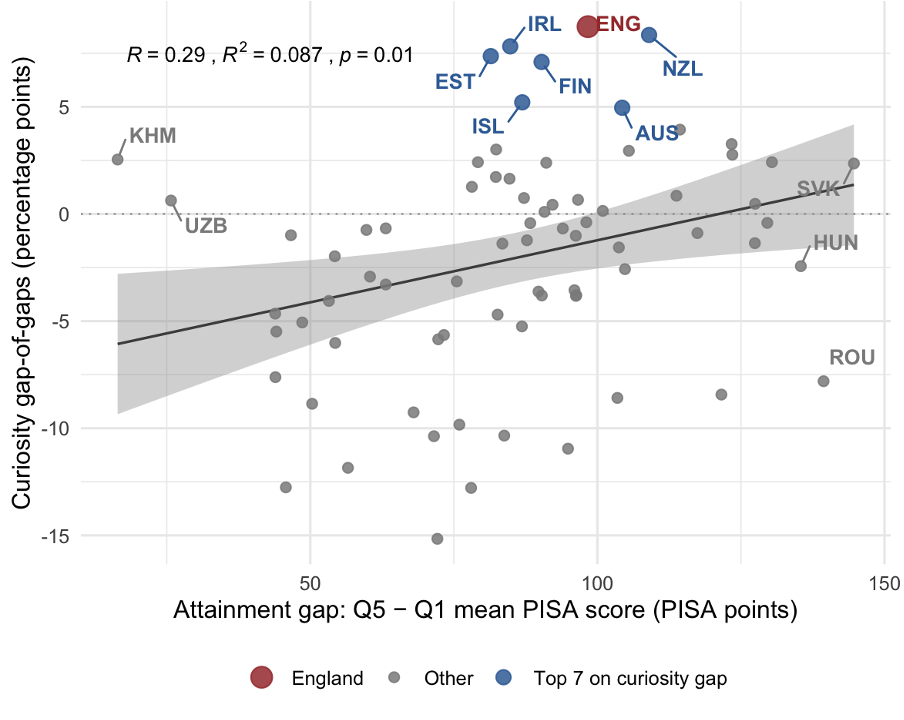
Reader Max has just asked how meaningful the trend is. Great question. We can look at three figures to help us decide, all labelled top left:
The p value means it’s statistically significant (<0.05 is normally taken as the threshold).
The R^2 means attainment gap explains about 9% of the variation in curiosity ‘gap of gaps’ (i.e. between general and school curiosity in poorer and wealthier students). A modest amount, but there are so many factors that affect an education system’s performance and whether its students say they’re curious, this isn’t that surprising.
The r is the correlation strength, which is probably the most important: about 0.3 – on the cusp of small and medium. Which isn’t huge, but education trends generally aren’t. And it would be larger (about 0.38) without the outliers (Cambodia and Uzbekistan) on the top left
Thanks Chris, that's really helpful to see. Do you think that the causality could potentiallt be working the other way around (low attainment in school making students feel that, even though they are curious generally, their curiosity doesn't translate to results in school, which pushes down their love of school score)?
Thanks Chris. Found this article really informative. For your analysis on the curiosity gap of PISA countries, were you able to see anything meaningful in terms of an average trend line? It looks like there are some countries on the left hand side with a relatively high curiosity gap that seem to have lower attainment gaps.