

You’re constantly being watched and told what to do, and being checked up on. I don’t think there’s any autonomy.
Cáit (from Skerritt, 2019)
An open door
Imagine you start off teaching in a system with relatively low accountability and high autonomy – like Ireland, at least until recently. Then you migrate somewhere with low autonomy and high accountability, like England.
Maybe you feel more supported: you enjoy the extra structure, appreciate the regular feedback and feel motivated by being held accountable.
This is what Dublin City University academic Craig Skerritt wanted to know when he interviewed six Irish teachers who’d moved to the English system.
Here’s Aoibheann:
You are accountable for absolutely everything that goes on, including things you have no control over. From what I understand to be autonomy, you have no autonomy. Everything you do is checked by your head of department, then it is checked by the head of faculty, who is then checked by an assistant head, a deputy head, and it trickles up to the principal. If you put a foot wrong twenty people know about it before you do. I don’t think there’s any autonomy. Everything you do as a teacher you are told to do.
English schools are increasingly mandating a collection of practices as if they’re a coherent whole and holding teachers accountable without trusting them to exercise their judgement – a practice I’m going to call Total Instruction. It happens when schools take a grab-bag of techniques, call them evidence-based, and then remove teachers’ decision-making power.
Large-scale data, as we’ll see, can rarely prove that a lack of autonomy causes job dissatisfaction. But the voices of teachers can give us a few hints.
Skerritt’s teachers experienced regular ‘learning walks’ as managers came into their rooms unannounced. Bronagh said, ‘Oh it makes me sick. It terrifies me knowing that I’m going to get observed because it’s like, you know something bad is going to come from it. You never get an observation where you go “Oh that went great and I’m going to get told I’m fantastic”.’
Breaking down the barriers to a knowledge-rich curriculum
Robert Pondiscio wrote last week about the obstacles to a knowledge-rich curriculum. I want to show things from the other side: what happens when you arrive, apparently, at your destination.
Knowledge is good. Better knowledge-rich than knowledge-poor. But the version England built has coupled grand rhetoric with low standards and has produced the widest rich–poor ‘curiosity gap’ in the OECD’s worldwide PISA data. Even granting Daisy Christodoulou’s case that the curriculum lifted PISA scores, we have record lows in students’ enjoyment of school and record highs in pressure from schoolwork.
I don’t think building a knowledge-rich curriculum requires removing teacher autonomy. But England has done both. This is the story of what happened.
What is Total Instruction?
Ask yourself:
1. If I felt I’d planned a lesson well, then found out an observer was coming in next period, would I change something?
2. If a lesson was going well but an observer suddenly appeared in my room, would I feel a pang of panic that I hadn’t included something or done something I should have done?
If yes to either, your school may be imposing aspects of Total Instruction.
I’m not against accountability – we owe it to students to justify the good our schools are doing. I’m not against standardisation across a school – it’s impossible to run a school otherwise. I’m not against routines – which are often a part of effective parenting, as per my analogy last post, as well as a necessary aspect of school life. What concerns me is the removal of teacher autonomy under the guise of evidence-based practice, when the practices themselves outstrip any evidence.

We have two axes: horizontally, how much freedom teachers have in implementing practices – often, low autonomy is associated with higher standardisation and monitoring; vertically, how much whole-school focus there is on teaching and learning practices – high can be supportive, when coupled with autonomy, or feel surveilled without.
Supported autonomy is, in many cases, the ideal: teaching and learning leads share evidence-informed ideas and model good practice, but teachers keep the freedom to combine techniques using their own judgement.
Total freedom – little guidance, complete classroom autonomy – barely exists in England’s state sector now that national accountability has tightened.
Skerritt’s teachers can give us a sense of how it feels to fall into one of the left quadrants. Unsupported accountability is the environment that makes Bronagh feel sick at the thought of another observation. It’s the veneer of accountability without the clarity or support to meet expectations.
Then, encapsulated by Aoibheann’s experience, there is Total Instruction: ‘Everything you do as a teacher you are told to do.’ As I mentioned in the last post, nobody explicitly advocates for Total Instruction – online, in their school, in policy. Typically, it’s a hodgepodge of different ideas picked up from other schools, professional development events, books, magazines, blog posts, and leftovers from old regimes. These aren’t a problem in themselves; the key move comes when they’re formalised as ‘good teaching’ and mandated for all teachers.
This can be more or less extreme. It might be a few techniques that must be present in every lesson. Or it can be full, scripted lessons that allow for little or no teacher discretion. And the last point – teacher discretion – is key.
Where does Total Instruction come from?
As Haili Hughes put it, ‘What begins as professional guidance becomes managerial compliance.’ Total Instruction is a top-down phenomenon. England’s Department for Education’s own research shows pedagogy gets standardised when schools are failing: they’re taken over by better-performing schools or trusts, and managers assume that the techniques or practices that worked in one setting can be exported, wholesale, to another.
But when a struggling school improves, who picks cause from effect? The mandated techniques often get the credit over better management, tasks cut to free up teacher time, or a new approach to behaviour.
And autonomy is a one-way street: standardisation is the first reaction to ‘falling standards’; autonomy is rarely suggested as a tool for improvement.
Can scripts ever be justified?
There are two cases where we may be justified in curtailing teacher judgement. The first is where strong structure has good evidence behind it and no sign of collateral damage. Complete, evidence-based programmes – structured early-literacy sequences are the clearest example – are not Total Instruction. You may dispute their choice of evidence, but the evidence, the assumptions, and the translation into practice are transparent, and can therefore be contested. Total Instruction is the opposite: techniques scraped from several sources, assembled ad hoc, then mandated as though they were a coherent programme.
And even in the strongest case for structure, autonomy doesn’t vanish: you can support structure in teaching without turning teacher judgement into a problem to be eliminated. Some of the better-structured programmes separate ‘tight’ elements – the skill sequencing, to be followed faithfully – from ‘loose’ ones – pacing, use of examples, formative assessment practices – that rely on teacher judgement.
England has been running this experiment for fifteen years. Four-fifths of state schools have taken part, as the Education Endowment Foundation has pitted programme after programme against ‘business as usual’ – which, in many classrooms, still involves teachers using their own judgement.
The EEF has discovered some high-quality, well-structured programmes, but business as usual has proven hard to beat. A 2019 analysis of 141 randomised controlled trials conducted in the UK and the US, including the EEF’s – involving over 1.2 million students in all – found that interventions, on average, gave about a month’s extra progress (to use the EEF’s own metrics) compared to the control group. About 40% were statistically uninformative. Research commissioned by the EEF themselves found that the effect of seven promising programmes shrank from about three months’ extra progress to no progress, on average, when scaled up.
The second case for curtailing autonomy is narrower. Comparing classroom video and international test scores across eight countries, a UCL team found that pupils of inexperienced teachers may do better when autonomy is constrained. Even there, the teachers with the least autonomy were the most likely to report lower job satisfaction.
Stressed, controlled, directed
Every few years, in their Teaching and Learning International Survey (TALIS), the OECD ask teachers from across the world a series of questions about their workload, training and how they feel about the job, among other things.
I’m going to take the 2018 data. In part, this mitigates the effects of the pandemic, but still gives enough time to see the consequences of any major changes associated with the knowledge-rich curriculum. The main reason, though, is that England didn’t take part in 2024.1
I’m going to re-create the diagram above, plotting real countries (the code and methodological caveats are here). On the horizontal axis, I’ve looked at the degree to which teachers agree they have control over determining course content, selecting teaching methods, assessing students’ learning, disciplining students and determining the amount of homework to be assigned.
On the vertical axis we’ve got the degree to which teachers agree they have whole-school collaborative teaching practices: teaching jointly as a team in the same class, providing feedback to other teachers about their practice, engaging in joint activities across different classes and age groups, and participating in collaborative professional learning. Axes are set to ‘zero’ on the country averages. I’ve also chopped off Chile and Italy because they were way down on the vertical axis, distorting the spread.
Percentages show the top 20 countries according to how many of the teachers surveyed agreed: ‘I experience stress in my work’.
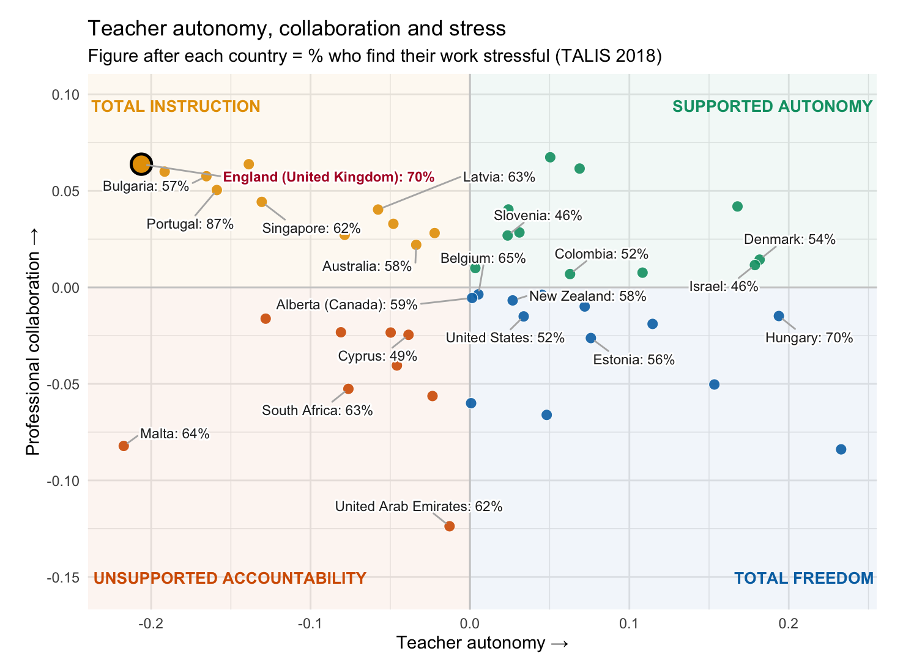
Here are the averages for workplace stress by country according to quadrant:
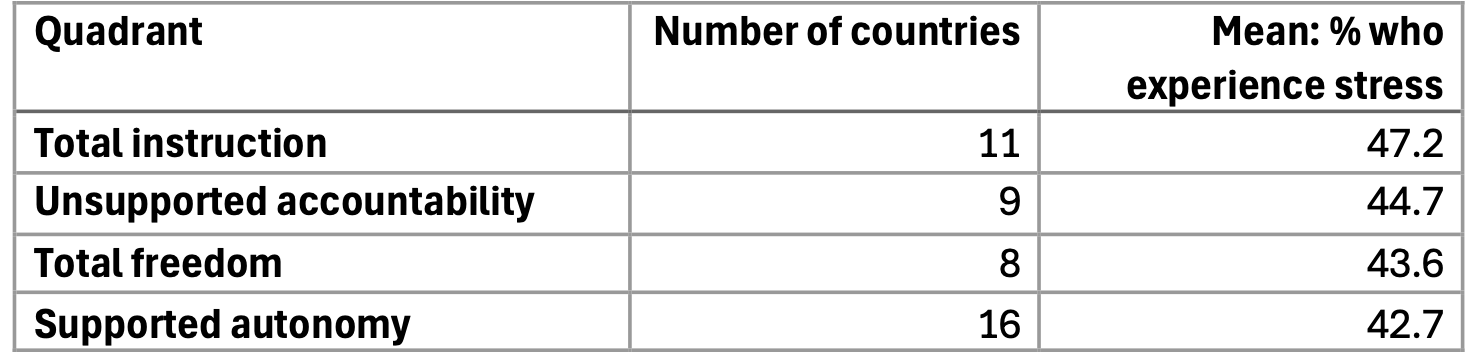
While differences are relatively small between countries and quadrants, England’s teaching workforce edges into second above Hungary, by this measure, in terms of work stress. And if there’s a candidate for a country that embodies Total Instruction, according to the graph, it’s England.
Reader Max asked about PISA scores per quadrant, although this analysis comes with some pretty big caveats, as per the footnote.2

Was it all worth it?
As UCL professor John Jerrim has put it, in England ‘we have lots of accountability in our school system, and also a lot of accountability-driven stress among teachers’. Education Support’s Teacher Wellbeing Index provides the latest UK-wide figures here.3
A study of over a thousand teachers found autonomy strongly correlated with job satisfaction, perceived workload manageability, and intention to stay in the profession – and that the average teacher reports less autonomy than professionals in other fields. Tellingly, it isn’t just the hours: earlier work by Sam Sims found job satisfaction tracks whether workload feels manageable, not how long the hours are.
The promise of the knowledge-rich curriculum, traceable back to E.D. Hirsch, was to close the attainment gap between rich and poor students. England’s disadvantage gap, though, is as large as ever. The pandemic hit disadvantaged students most of all, but even before that, progress was painfully slow. In 2020, the Education Policy Institute calculated it would take 500 years to close the gap. In fact, their analysis suggested that even before the pandemic, the gap had stopped closing. If moves towards mandated pedagogy have been justified on the basis of closing the gap and increasing standards, they aren’t working.
What should we do about it?
Good teaching requires what Aristotle called phronesis, or practical wisdom. This can’t be taught, only gained through experience. But a supportive school environment helps teachers learn from their experience, and allows them the freedom to experiment and combine techniques to suit their classes and approach.
A skilled teacher’s mind is like a Swiss Army knife; whole-school teaching and learning guidance can help sharpen the tools. Most weeks throw up a situation the teacher’s never faced before, but, almost automatically, they can pull out and combine the techniques needed to tackle it. Reteach or plough on? Remove the child or take them aside for a quiet word? And how, knowing the class and the subject as you do, can you ignite their curiosity?
Each decision draws upon the results of a thousand that have gone before.
The opposite is a complete script: the human made predictable, judgement stripped out and replaced with something measurable and narrowly accountable. Multinational corporations in other industries have done exactly this as a halfway point to automation.
England’s Department for Education is beginning AI tutoring trials this autumn. The tools will ‘reflect national expectations for pedagogy’ and ‘drive up standards by complementing high-quality face-to-face teaching – not replacing it’. By the end of 2027 these tools will have reached up to 450,000 disadvantaged pupils in Years 9 to 11.
An AI tutor can be rich in knowledge. It can follow a script to the letter. It can structure the learning journey and give instant, personalised feedback.
Know what it can’t do?
It can’t read Alyssia at the back of your Year 8 class. Usually, she smiles. Today, she won’t make eye contact. Tired? Bored? Something going on at home? The AI tutor logs a dip in her scores. You can’t track that, not in the moment, and not with thirty kids in the class.
You’ve got a break duty, then you’re teaching again and you’ve got a meeting after school and a stack of unmarked mock exams sitting on your desk. But you still hold Alyssia back to find out what’s going on.
Because teaching was never about following the script, or pulling the approved technique from the bag to pass an inspection. It’s about a child’s experience of school. And that’s something an AI tutor can never understand.
Despite efforts to drive down the pressure teachers were experiencing, 2018’s study showed that England’s teachers were working more hours than ever – about 20% over the OECD average. Schools minister Nick Gibb withdrew England from the next round, citing extra workload concerns. Unfortunately, this also removed England from national and international scrutiny and so it’s difficult to tell whether the hour or two each teacher saved avoiding the test made much difference.
Caveats: First, PISA’s a different dataset, but you can ‘join’ the 2018 study results to the data I’ve analysed - TALIS. Second, I’ve done this without weighting and only used the first ‘plausible value’ for scores - a thorough analysis would go further. Third, there are only a few countries per quadrant, so we shouldn’t read too much into the results. Fourth, any differences in PISA scores could be due to hidden variables, like GDP, which I haven’t controlled for. Fifth, a couple of countries are missing/changed from PISA: South Africa didn’t participate in PISA; Shanghai wasn’t a standalone unit that year; most importantly for this analysis, I’ve used UK instead of England, as PISA didn’t report England separately in 2018.
We should be careful of conflating findings for the UK and England, given the devolved nature of the education systems.
It’s really interesting (although sad) to hear what’s happening in public schools in England and it sounds like ‘total instruction’ is a good phrase for it. I feel so lucky to work in a public school where I have a lot of autonomy but I’m beginning to realise that my circumstances are not so common…
Catching up with your backlog Chris and didn't want to miss this one. Your initial quadrants figure is a really useful way of seeing the overlap between autonomy and accountability, haven't encountered this visual comparison before. I then thought to myself, wouldn't it be fascinating to plot different education systems onto this graph? Was delighted to come across this later.
I think the cons of teacher autonomy are often less discussed than their perks, so it was insightful to read your view on the advocates both for and against. And understanding autonomy as a continuum (as per your graph) is certainly more nuanced than is often presented in this conversation. I'm reminded of the sociologist Lortie's notion of ‘egg crates’ (cited in your BERA journal you referenced), in which each a teacher works in isolation within their own self contained classroom. While certainly being a noteworthy drawback of autonomy, this seems in striking contrast with the more collegial autonomy that I observed in Finland (which would probably fall somewhere just above Estonia between total freedom and supported autonomy). So, while there was great autonomy there, at the same time, there wasn't so much of an individualistic, 'every teacher for himself' culture that you might have expected of an Irish school (although I would have to look more into the comparison to the Irish system). I wonder if the degree of collegiality poses an additional dimension in relation to job satisfaction and accountability driven stress? (By collegiality I mean for example, co-teaching, collaborative lesson planning or more evenly distributed leadership responsibilities).
I can't imagine a teacher who is left alone, isolated in their classroom with zero professional encouragement or 'oversight' but given complete free reign to teach as they see fit would be much better off than a teacher who is constantly observed, overseen and scrutinised by colleagues and the leadership team and required to follow a script 24/7. Just an additional thought. Always enjoy reading your work Chris