

Smaller is always better – or at least, that’s what I’ve been told.
At researchED in London on Saturday, Paul Kirschner likened learning to going up a staircase. You want to get to the top, but smaller steps make the journey easier.
It’s also a logic that underlies advice about teaching students with special educational needs – something I’ve heard a lot recently (e.g. David Didau’s argument here):
a) Certain learners – such as students with special educational needs like dyslexia – benefit from a certain approach, such as the chunking of information to avoid overloading working memory
b) Chunking information to avoid overloading working memory is generally good practice
c) Therefore, what works for these learners, we should do for everyone
This is well-meaning advice, and there’s certainly evidence to back up the first two points. The last, followed to the letter, is likely to be damaging for some students. Or, at least, fail to challenge them and allow them to make the progress they’re capable of.
What’s a chunk?
How best to teach? Providing your goal is to maximise learning gains, as measured by attainment testing, there are some strategies that are likely to raise the average level in the room: checking understanding, removing distractions, teaching key vocab and giving clear explanations.
But these are pretty vague. You wouldn’t give them to a trainee teacher in this format and let them loose in the classroom.
If the check doesn’t go well, what should teachers do then? What qualifies as ‘success’ on a mini whiteboard activity? What if most of the students already know the key vocab? What if the ones who don’t still don’t really get it even after you explicitly teach it? Who defines a distraction – a science practical might be a distraction to those who lack the prior knowledge to understand what they’re doing. Perhaps most importantly, what counts as a clear explanation?
Luckily, we have some guidance. If we’re talking about training teachers, we can check England’s initial teacher training and early career framework – the information teachers are expected to have met by the time they qualify. For example, they should ‘avoid overloading working memory’ by ‘breaking complex material into smaller steps’ and ‘reducing distractions that take attention away from what is being taught (e.g. keeping the complexity of a task to a minimum, so that attention is focused on the content).’
These ‘smaller steps’ are often called ‘chunks’.1 Intuitively, teachers know what a ‘chunk’ of information is. You can break down a word using phonics. You can break down an equation into the individual operations. Anyone who explains things for a living is already in the business of breaking complex things into simpler parts – like the construction of a car, in reverse. What are the fundamental bits and how do they fit together?
Unlike constructing a car, though, parts of the school curriculum don’t come prefabricated. Any textbook that slices the knowledge into simpler parts is making, to a degree, an arbitrary division. From understanding a chemical reaction to the effects of the Great Depression, breaking down a complex phenomenon is the challenge – and the joy – of teaching.
The beauty of complexity
The Department for Education’s advice suggests ‘keeping the complexity of a task to a minimum’; learning is driven by students’ emotions in addition to how well structured a teacher’s explanation is, though. Complexity can lead to confusion and cognitive overload. But a lack of complexity can produce boredom. Boredom, as the research of Reinhard Pekrun and colleagues has shown, feeds poor academic achievement, and vice versa. The question is how to find a happy medium.
Columbia University’s Janet Metcalfe and Nate Kornell gave university students English-Spanish vocab pairs to learn. The pairs were labelled by difficulty (those that sounded similar in English and Spanish graded easy, for example) with students given a free choice of which they tackled first. Afterwards, students were tested on the word pairs they didn’t know before.
Students generally went for the easiest items first then moved onto the medium ones, spending most time on these. In the next experiment, the researchers removed the choice and dictated the time spent on each difficulty level. It was the medium difficulty items that produced the best overall recall, indicating, as the authors point out, that ‘the strategy people had used, when given free choice, was largely appropriate’.
Finding the Goldilocks Zone
Research into curiosity shows that it follows an ‘inverted-U’ shape: people are most curious when the information is in the ‘Goldilocks Zone’, just beyond what they already know.
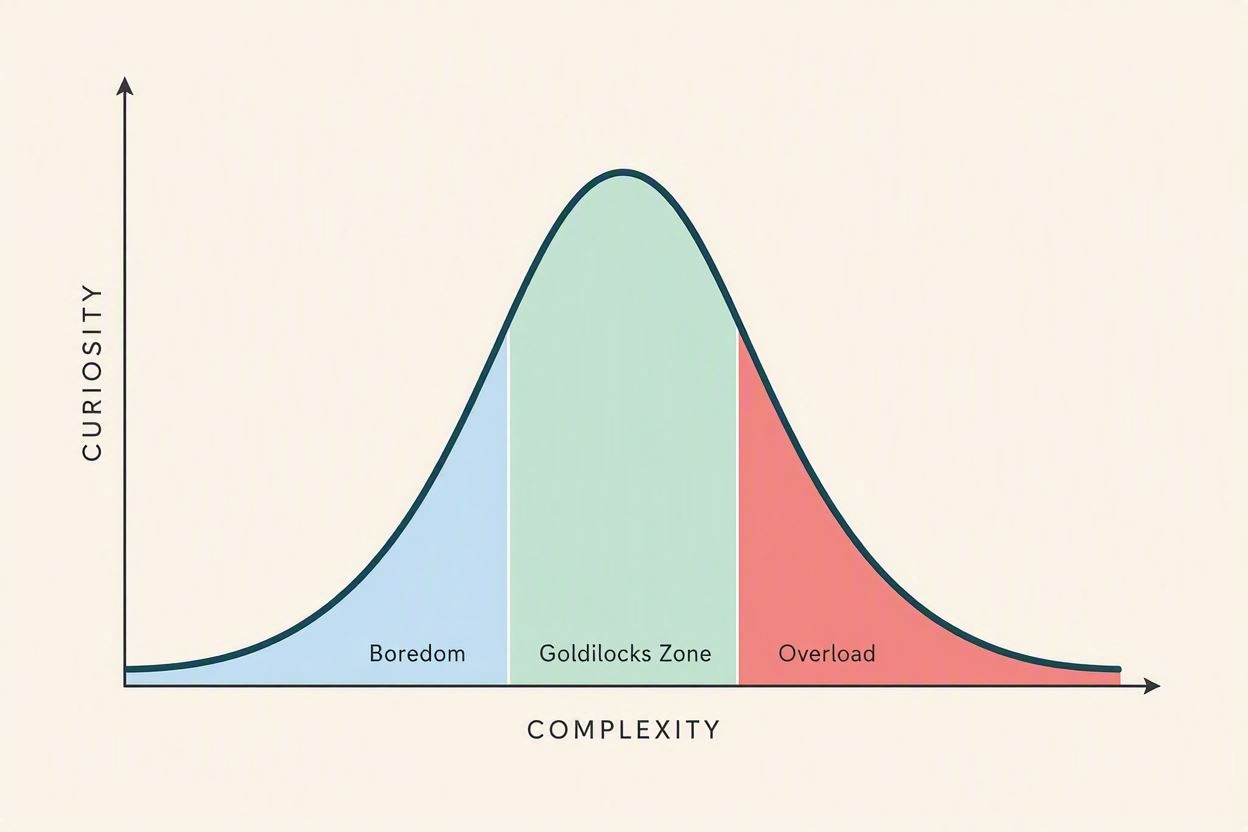
The most obvious danger is that too much complexity or ambiguity puts a strain on working memory, but the question shouldn’t be how can we eliminate complexity, as the Department for Education’s advice implies, but instead what is the right level of complexity to cognitively engage this student.
Some situations require students to grasp deep complexity. In my own researchED talk on Saturday, I asked teachers to consider how they might add novelty, complexity, ambiguity or incongruity into an upcoming lesson (more detail on that here). One attendee discussed changes to a lesson on the Holy Trinity. It struck me that there is no way of teaching the idea that Jesus was man, God and the Holy Spirit simultaneously that doesn’t involve ambiguity or incongruity.
I’m sure RE teachers consider ways to break down this idea, just as I’m sure that art teachers chunk their instruction, but the greatest works of art must be considered holistically. Sometimes, you have to show the thing all at once and risk overwhelming students, because it’s only in overwhelming them with the beauty of the idea them you justify why you’re teaching it at all.
In science, where I’m on firmer ground, we give students ways to explain the world that are beyond their intuitive notions – but we need to show them their current models are inadequate first. The idea of incongruity is essential. Scientists themselves often sit for years with uncertainty and ambiguity – a result they can’t situate, a model they can’t quite piece together – before they can provide an explanation.
In teaching students to think, we should also teach them to be comfortable with uncertainty. Instead of expecting a machine to do their thinking for them, we need to support them while they sit, wondering, grasping at an answer. This is the basis for deep curiosity.
Putting up the scaffold
Students vary in their prior knowledge; they vary in the knowledge they leave the lesson with; they vary with what they do with it – some will go home and speak to their parents or chat to friends about it, while others will forget it almost as soon as they’ve walked out of the door.
To support students while they’re learning, we teach them. Some people call this ‘scaffolding’.2 A lecture is a scaffold. A worksheet is a scaffold. A quiet chat to the kid at the back who’s struggling is a scaffold. Some are pre-designed, like a powerpoint the whole department uses. Some must be created on the spot, like the chat with the struggling student. In a sense, using only pre-designed scaffolds is not really scaffolding at all: scaffolding is a response to the way a student approaches a task and so must be considered from moment to moment.
Anyone who has ever spoken to a child one-on-one soon realises that you have to calibrate the explanation to their prior knowledge. I consider myself a competent teacher, until I try to explain something to my own children. Their responses seem to oscillate between ‘I don’t know what you’re talking about’ and ‘I already know that!’
The students in my class don’t (usually) respond this way while I’m teaching thirty of them at once, but it doesn’t mean they aren’t thinking it. In fact, it’s when they stop thinking this that it becomes a problem, because I want them to judge their prior knowledge against what I tell them. And when they switch off, how I chunk the information becomes irrelevant.
Expertise reversal
Cognitive load theory is a model of how we absorb information – how it goes from our senses, through the bottleneck of the working memory and into the vast store of the long term memory. It can guide task design, given that working memory is limited and the goal is (partly) to get information into long term memory.3 Cognitive load theory tells us to limit distracting – extraneous – information, but there is nothing in cognitive load theory that says smaller chunks of information are always better. In fact, there are situations in which the opposite is true.
Cognitive load theory tells us it isn’t simply the volume of information presented that can limit learning. Instead, we need to consider ‘element interactivity’ – how new pieces of information relate to one another – too. A student meeting material for the first time has much more to process than another who is merely placing information into their pre-existing knowledge networks, making new connections between ideas.
Sentence starters might allow a student’s ideas to flow as they’re learning to write longer pieces. But if those sentence starters are never reduced and eventually withdrawn, that student may never learn how to structure an essay. The same scaffolds that provide good support to students with low prior knowledge can limit the learning of those with stronger prior knowledge.
If I give my physics class an equation to solve, I might teach them a method beforehand for rearranging equations. I tell them to follow the steps while they’re working through a set of questions. But those same requirements – which might benefit a lower secondary class – could limit the ability of a more advanced class to tackle a more complex problem appropriate to their own level.
This is the redundancy effect – students must hold in their heads information that’s redundant for them in that moment. Rather than using the rules they have automated, they must slow themselves down to do a relatively simple problem, limiting their ability to parse and attempt a more complex task. And it isn’t simply about speed. The requirement to keep a method in their working memory takes up brain space that could be used to process the more complex problem.
One study took 48 participants – 24 of whom had never played football; the other 24 were semi-pros. The research team showed them the same kind of animated counterattack, either broken down into small groups of 2-4 players or with all players moving at once. Novices who saw the chunked version remembered more, and it cost them less mental effort than the version with everything moving at once. For semi-pros, the format didn’t affect their recall – but the chunked version did cost them more mental effort. They had to piece together the chunks to process what was going on. These expert players learned more efficiently when they saw the whole structure at once. They had the understanding – the schema – in place to grasp the significance of the complex interacting elements and learn from them.
The problem with advice
Fundamentally, there is no blanket rule that tells us when a student becomes a relative expert, how large the chunks should be at any stage (or even what qualifies as a ‘chunk’), how much of a student’s working memory any given chunk takes up or which scaffolds free up working memory or use it up when it might be better allocated to something else.
All these things require teacher judgement. Sure, teachers can be guided by various forms of evidence – feedback from experienced colleagues, reading research on cognitive load theory or even blog posts. But there is no universally effective scaffold for a class, especially one that contains students who have, by definition, different educational needs. What is effective for one student can, if applied uniformly, limit the progress of other students – even those in the same class. This is true even of advice that seems banal, like ‘limit complexity’.
While students with special education needs are the ones most likely to require bespoke instructional methods, bespoke scaffolding would benefit every student. But with a class of thirty students, we can’t do this. When I began teaching, I worried about stretching the most able. I worried about having tasks that all students could engage with – even the ones who were still scrabbling around in their pencil case for their pen half an hour in. My solution was to create challenge worksheets and extension questions, tasks with different coloured medals so that students could choose their own difficulty level.
It took me ages, especially because I barely knew what I was doing to begin with. Sometimes, I’d glance at a worksheet, conclude it looked fine and print it off before realising, during the lesson, it was completely unsuitable – off topic, too long, too short, or required knowledge that we hadn’t covered yet. This meant that during the lesson, I was racing from student to student, explaining what to do, switching worksheets, inventing new tasks on the spot. Differentiation, for me, at that stage in my career, provided a poor return for the time invested.
Taking down the scaffold
But perhaps there’s an easier way. Rather than pitching the task low and building up, we could trial the more complex activity. Have scaffolds ready for those who struggle but plan the withdrawal deliberately.
I do worry that treating all students, by default, as fragile, may be harmful. We worry about removing the scaffold in case some students become confused or go off track. But the evidence that all students need information broken down into the smallest possible units lacks robust backing – in fact, there’s emerging evidence pointing the other way.
Via Craig Barton’s excellent Research Bites, I came across a study comparing the effectiveness of simpler tasks to more complex ones. As Barton reports, 132 Austrian adults (mostly students) with no Italian were taught to conjugate an Italian verb. The hardest version with interleaved practice came out best and the easiest task performed worst, when students were tested afterwards. Barton quotes from the paper: ‘manipulating tasks in a way that allows them to be easily solved might underestimate a learner’s cognitive potential.’
England’s teacher training framework does tell trainees to take the scaffolding down as expertise increases, but only when pupils are achieving a high degree of success. What counts as a high degree of success? How do trainees make sure they’re getting the removal right? And is presenting a subject in all its glorious complexity ever justified if it risks cognitive overwhelm for some students? Compared to the advice on chunking, there’s little scaffolding here for trainee teachers – no advice on how to spot a redundant scaffold or a student who no longer needs it.
It’s time to challenge the advice that smaller is always better. Rather than always feeding them the tiniest of chunks, maybe it’s time to see how all learners cope when we expect more of them. This way, perhaps, we can discover learners’ true cognitive potential.
As Kylie points out, ‘chunking’ as used here in education has drifted from the original psychological definition. In cognitive psychology it describes grouping separate items into larger meaningful units which can be more easily held in working memory. F-B-I-M-I-5-C-I-A is nine items, but FBI, MI5, CIA is only three. Used in education to mean breaking material down into smaller steps, the term is close to an inversion of the original usage.
Some researchers (e.g. Brush and Saye here) distinguish hard from soft scaffolds. A pre-planned resource like a powerpoint presentation that anticipates potential difficulties is a hard scaffold. Something situation-specific that’s dynamic and responsive like follow-up questioning would be classed as a soft scaffold. Thanks again to Kylie for pointing out the distinction.
I’d like to think there’s more to education than increasing students’ long term memory stores, but I do want them to leave my lessons knowing more than they did when they arrived.
Great questions in this post Chris. The key point is that teachers should try to find the fastest way to teach a concept, which means the very fewest chunks. This is so different from the typical teacher mindset and CPD. Models at standard, good and excellent are great places to start. So are turning your content, where possible, into stories. And obviously, the more is in long term memory, the better those schemas will work for new knowledge - so retrieval is key. Small steps, as in real life, just make everyone take much longer to get there.
I also wondered if you'd come across two (more useful?) concepts coined under the crazily elastic construct of scaffolding in education: hard scaffold and soft scaffold. Look them up. I think these concepts help to clarify what what we're talking about in discussions about 'scaffolding' - which I usually find annoyingly vague!