

A few months ago, I was teaching a lesson. I can’t remember what it was about – which tells a story in itself. But I do remember the blank looks on the students’ faces. I do remember how I felt.
Nothing was wrong. The lesson was going to plan. I’d taught the key points, the students had done a mini-whiteboard exercise and most of them seemed to get it. They were now waiting for me to explain something else.
But something was missing. It was the spark that I’d felt the first time I stood up in front of a bunch of thirteen-year-olds without knowing what was going to happen. The excitement that comes not simply from a properly run lesson but connecting. Helping a student to understand something they never knew before, hearing that creative response that comes out of the material you’ve taught but needed that specific student’s input to bring it to life.
When people talk about teaching being a vocation – the bit that makes up for half your salary – that was what had gone.
I noticed the same thing happening again and again: the lessons were fine but something was missing.
I could do the job; that wasn’t the problem. It was something deeper. Then I remembered I was doing a PhD about the role of curiosity in education. Why not try to use some of what I’d learnt in my own classroom?
Last week, I published a piece for Edutopia about evidence-based strategies for bringing curiosity to the classroom. But that was only the beginning.
Tiny Experiments in the Classroom
Around the same time as my existential crisis in the classroom, I came across author and curiosity researcher Anne-Laure Le Cunff’s book Tiny Experiments. Le Cunff argues for approaching life experimentally: prioritising process and learning over an obsession with outcomes.
I thought I could apply it to teaching. We often start out with the end in mind – raising grades or improving attendance or reducing exclusions. Things we can put a number to. That’s understandable; it’s how schools themselves are judged. But as a classroom teacher, what matters most to me is the minute-to-minute feedback. That feeling I had – that the spark had gone out of my teaching – was the problem I wanted to address.
The point of the Tiny Experiments in the Classroom isn’t to raise grades – although there are good reasons to think that when students are curious, they’re likely to learn more and retain that information better. It isn’t to improve behaviour, although if students are more curious, in my experience, they’re more likely to be focused. Every experiment is designed to make the kids more curious, but that isn’t the point.
For me, at least, the purpose is to help me enjoy lessons more. I enjoy lessons when the students are curious. So, their enjoyment is a means to my own satisfaction and vice versa. By enjoyment, I don’t mean going back to making posters and doing wordsearches – I mean deep and meaningful intellectual engagement with the subject – both on my part and my students’.
It might seem a bit selfish, putting my own feelings at the heart of the changes. But, as I know from my own experience, teaching isn’t something you can do half-heartedly. Apart from anything else, the kids can sense it.
This wasn’t the first time I’d lost my love of teaching. I quit altogether after the pandemic. Both times, curiosity helped me to rediscover it – first, beginning a doctorate to work out what curiosity in the classroom is; now, trying to bring the curiosity back into my teaching.
My Edutopia piece took three situations where I’ve applied curiosity research in my own classroom. I’m going to do things a little differently here. One situation – delayed closure – I’ve discussed here before. We’re going to explore the evidence behind the other two, and I’ll show you them in action.
The Curiosity Triggers
Just before the summer holidays, I had to teach about electrical safety to my Year 9s (age 13-14). A lot of the material focuses on the function of the earth wire – you can use a lot of nice cartoons of someone being shocked, but the slide deck I pulled off the system didn’t seem to have much to trigger curiosity. So I turned to some of the foundational, and still the most powerful, ideas in the psychology of curiosity.
Daniel Berlyne – a pioneer of curiosity research – identified facets of a stimulus that can cause curiosity. He called them ‘collative variables’ but I’m calling them ‘curiosity triggers’ when applied to classroom context. Here are the four most commonly cited:
Novelty – something new or unfamiliar
Complexity – something with multiple elements or relationships to work out
Uncertainty – where the answer or solution isn’t immediately clear
Conflict – clashes with what we expect or previously believed
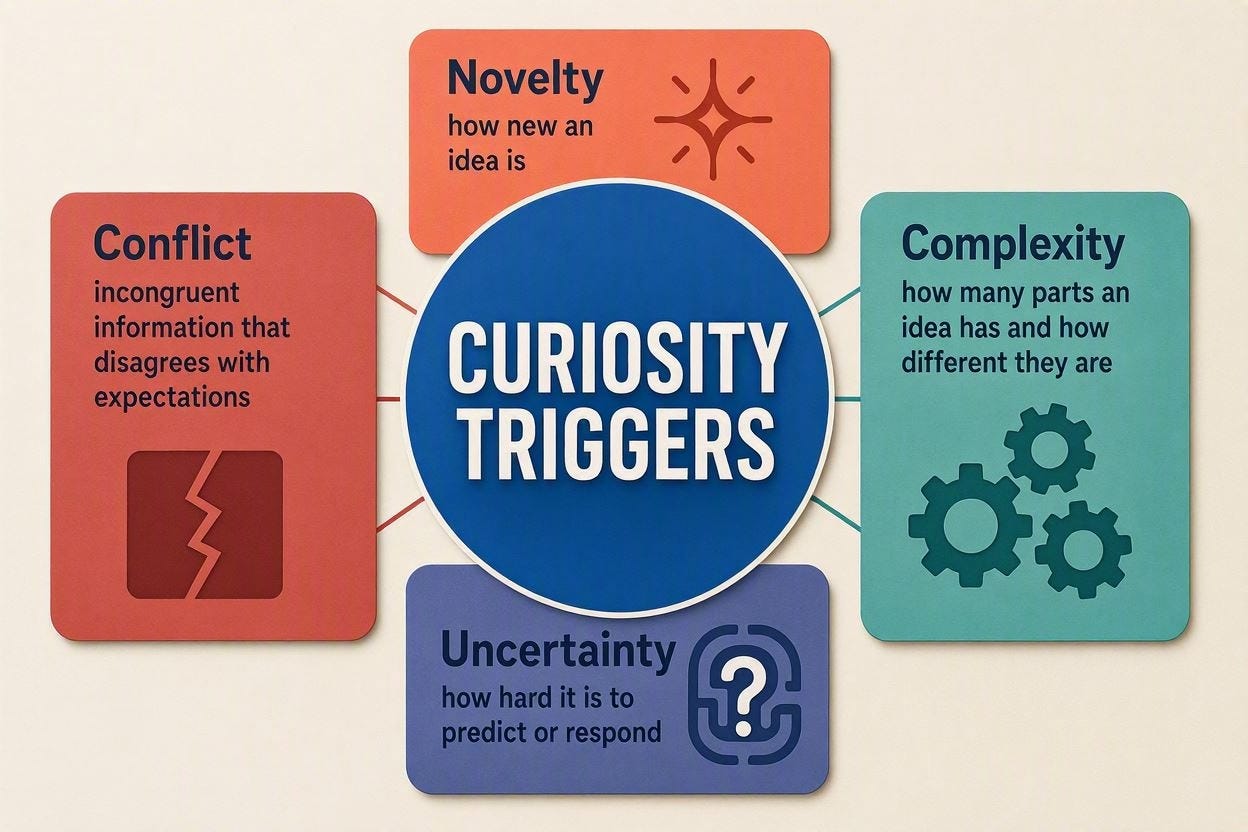
I came up with a quiz for my Year 9s. Which of these would you least want to get a shock from?
Lightning
Toaster
Electric fence
Phone charger
This technique draws too on ‘delayed closure’, in which the active ingredients are getting the students to make a prediction and write it down – but avoid giving them the answer straightaway.
I taught students that potential difference is related to the energy each electron in a circuit is given (technically, the energy per unit charge). The bigger the potential difference, the more energy can be carried around a circuit. Then I revealed the size of the potential differences in the four situations:
Lightning: 100 million–1 billion volts
Toaster: 230 V (UK mains)
Electric fence: 2,000–10,000 V
Phone charger: Typically 5 V
There were looks of surprise about the size of the electric fence’s voltage. And lots of questions. Some of which I deferred answering – I didn’t want to spoil the surprise.
‘Go back to your predictions,’ I said. ‘Now which do you think is most dangerous?’
The key is that voltage is only part of it. You need to know the current – which depends on your body’s resistance – and how long it’s sustained for, to work out the danger. Roughly, 1mA is the point where you can feel a current. Over 100mA is where it can be fatal.
Lightning is, of course, the most powerful. Around 90% of those struck by lightning survive, though it can still cause neurological damage in survivors.
Mains electricity can be more dangerous than lightning, especially if it goes from hand to hand through your chest. If you’re gripping something, the shock causes your muscles to constrict, meaning you can’t release the source of the electricity, and the current can interfere with the heart’s normal electrical activity. People often survive a brief shock; sustained contact can be fatal.
An electric fence causes a painful but brief and low energy shock. It’s virtually never fatal although can be dangerous for those with a pre-existing heart condition.
Finally, a phone charger is too low a voltage to be dangerous – unless you grab the mains side, in which case it becomes the toaster problem.
The extra complexity could be a problem for a class which struggles with new information, but this was a high ability group, and they had no difficulty making links to ideas we’d studied previously, like V=IR: a formula for calculating current from voltage and resistance.
As a Tiny Experiment in the Classroom, it felt like a success. Hearing their ideas about the dangers and seeing the shock on their faces at each stage reminded me why I love doing the job. It wasn’t a full lesson redesign but it took work and a bit of research (which was part of the fun). But you can add novel or surprising facts into your lesson with a lot less effort.
Question Generation
When I saw the lesson plan, my heart sank: another literacy exercise – this one about ecology. I checked the reading ages of my Year 8 (age 12-13) class and saw quite a few were working at an age several years different from their own – below as well as above.
We’ve started doing more literacy exercises in school, but keeping a group with such different abilities cognitively engaged is a challenge. So I drew on one of the few trials into curiosity that has been carried out in the classroom.
Harvard’s Shelby Clark, together with colleagues Allen G. Harbaugh and Scott Seider, conducted a study with over three thousand students to investigate whether directly teaching students how to formulate questions could increase curiosity. For students in the intervention group, their teachers used the Question Formulation Technique:
1. Present students with a prompt.
2. Students produce as many questions as they can, without judgement as to quality or discussion over them.
3. Students can then discuss and change open into closed questions and vice versa.
4. Students select three ‘priority questions.’
5. The class reflect on what they’ve learned during the process and decide which questions to take forwards.
Teachers in the intervention group could use this as often as they liked. The more teachers used the technique, on average, the higher their students’ self-reported curiosity.
With my group, I didn’t use the full technique but borrowed the basic mechanism, using the following prompt:
In pairs, write three questions you’d want answered about how losing whales or birds, or snow leopards would change the world. Three minutes. Any question counts. Daft, weird, obvious, all welcome.
Here’s some of what they came up with (the questions are real; the whiteboard image is an AI recreation):
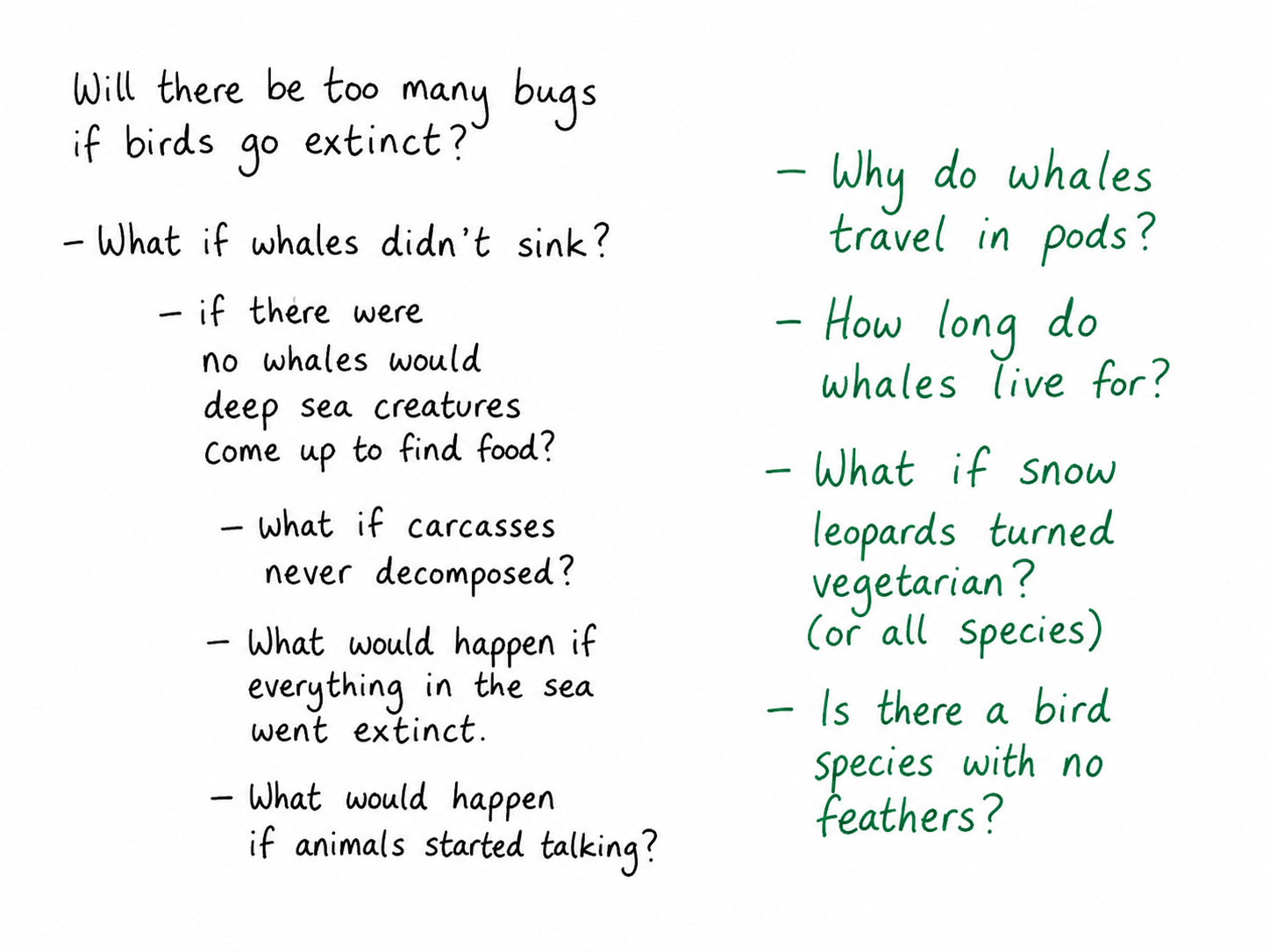
The questions weren’t all relevant to ecology, but the note I wrote to myself immediately after the lesson read: ‘took some a while to get going but better ownership of literacy task and engagement after’. Overall judgement? ‘Was actually much more enjoyable than anticipated.’
Breaking the Script
Do we have an evidence-informed profession, or one in which our actions are dictated by the evidence? Does the evidence shape what we do or constrain it?
I’ve argued that some schools are moving into an era of mandated pedagogy which I’ve called ‘Total Instruction’. Teachers’ autonomy is restricted under the auspices of ‘evidence-based practice’, which often comes down to techniques – elements of which often do have some research backing – that are mandated as a whole script that teachers are required to conform to.
Despite that, most teachers still have agency. Teachers can plan and deliver lessons tailored to the students in front of them. We need to make the most of this freedom – so that teachers can retain their love of the profession while improving their practice for the students in front of them.
Tiny experiments in the classroom are not academic or scientific studies. We’re not trying to ‘prove’ anything that can be peer reviewed and published.
Nor are they action research. I love action research, but it’s often more systematic, drawing on relevant literature and producing evidence to answer a specific question. Tiny Experiments in the Classroom are simply a way to improve today’s lesson.
We want the experiments to be evidence informed. Begin with an idea grounded in research and adapt it for your own students. Keep ‘field notes’, like an anthropologist would do, Le Cunff suggests in Tiny Experiments. Write a couple of lines on a note on your phone after the lesson. How did it go? Then onto the next thing.
At some point, you can check back and see what’s working. Did I enjoy the lessons more? How did the students respond?
This can help shake us out of our cognitive scripts: we have a sense of how things are going to play out in the classroom. We have good classes, bad classes, favourite lessons and ones that bore us.
The Tiny Experiments help us question our assumptions, our relationships with students and even our subjects.
Maybe they can even help us rescript our relationship with the profession.
Like this piecr. Going to try in my classroom.
Why do you say mains 230V AC can be more dangerous than lightning?
Lightning is both more likely to be fatal and more likely to lead to serious injury.