

England’s students sit their GCSE exams when they are 15 or 16 years old. Failure to pass core subjects like English and maths can be costly. Choices narrow and doors close to those who don’t attain a grade 4. Using long-term analysis of those who took their GCSEs at the start of the millennium, the government calculated that falling a grade in just one subject can bring a lifetime earnings penalty equivalent to tens of thousands of pounds.
England has many attainment gaps. One has persisted since the 2017 GCSE reform, yet rarely attracts calls for action. Every year, girls have been considerably ahead of boys in the number of pass grades they achieve. It was surprising, then, on GCSE results day last year to see a BBC article asking: ‘Are girls being left behind in school?’
That year, girls were over six percentage points ahead of boys. Across all exam papers girls sat, this meant they passed around 170,000 more of them than they would have if they’d had the same pass rate as boys. Nevertheless, the chief executive of the Education Policy Institute was quoted arguing for an urgent need to look at what’s happening to girls’ results before it’s too late.
The gap is closing – but this might not be good news
To understand the concern, we need to look at the trend in pass rates over time – something complicated by a pandemic, teacher assessed grades and then changes to pass marks.1 So, let’s skip the years in grey and concentrate on those either side.
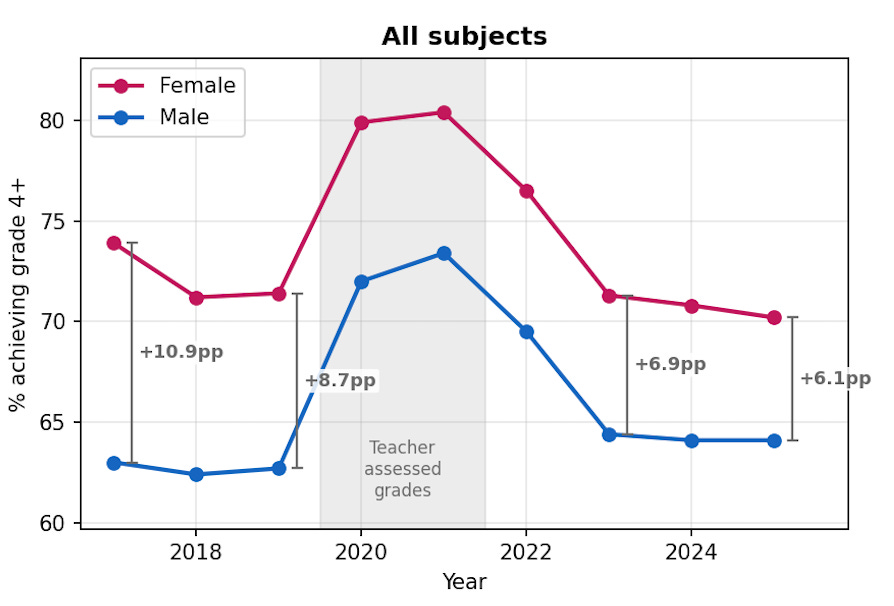
Back when students sat the first reformed GCSEs in 2017, girls were almost 11 percentage points more likely to pass any given GCSE. The gap has shrunk consistently – leaving aside those grey years – down to 6.1 percentage points.
This sounds like a success story. Indeed, in 2025, the Daily Express announced ‘Boys close GCSE gender gap with bumper grades’ and the Guardian reported, ‘Gender gap smallest since 2016… Boys show improved results in major subjects’, although they do note the other side of the closure, too. Because two things are happening, and one is considerably more significant than the other.
First, boys’ scores are improving, but not by much (although small differences have a big impact at this scale): 63.0% in 2017 to 64.1% in 2025. At the same time, pass rates for girls have plummeted, from 73.9% in 2017 to 70.2% in 2025. Across the almost three million exam papers girls took in 2025, they now fail over a hundred thousand more than they would have at the 2017 pass rate.
One policy change accounts for some of this variation: if you fail maths or English, you now need to carry on studying it until you pass, if you are in funded education. This reform has not been universally welcomed.
But to really understand what’s happened, we need to look at individual subjects. We’ll focus on two core areas, the ones so important students need to keep retaking if they fail – English (split into language and literature) and maths, beginning with the latter:
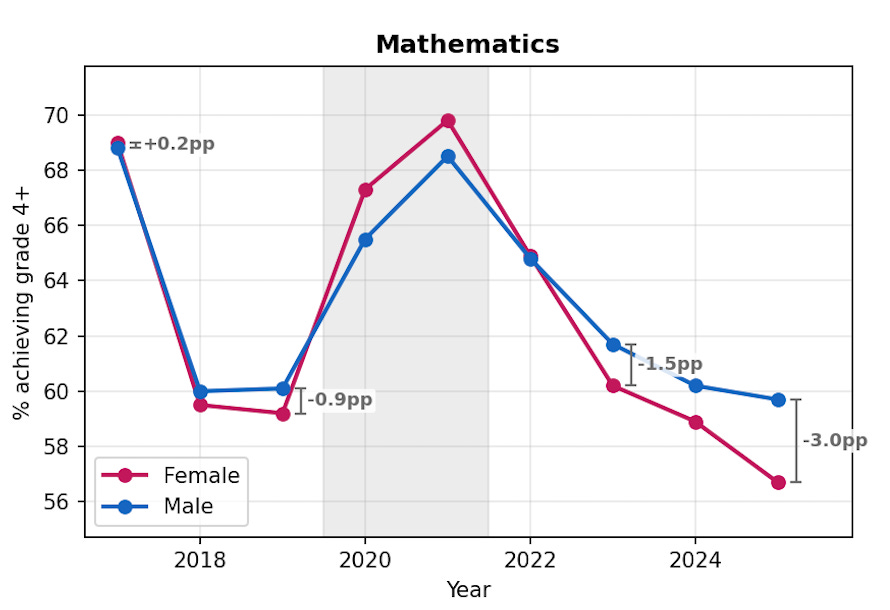
Clearly, something wasn’t quite right with Ofqual’s grade boundary calculations when the new exams were introduced in 2017, and it wouldn’t be fair to use those initial grade boundaries, so we’ll take 2018’s figures as our benchmark.
Since then, the number of boys passing GCSE maths has barely changed (a fall of 0.3 percentage points). It’s a different story for girls, with their pass rates plunging from 59.5% in 2018 to 56.7% in 2025. Across the more than 400,000 papers girls sat in 2025, it meant more than 10,000 more failed than would have done under the 2018 pass rate.
In English, girls have long outpaced boys, but that’s been changing. And, because of some innovative research, we can see that failing to pass English can also be costly – and not simply because you lack the basic skills but because you lack the certificate.
GCSE marking has some inherent noise near grade boundaries, meaning researchers can compare students who end up just above or just below the pass mark in English. These students had near-identical exam performance – any small marking fluctuation could have tipped them across the boundary. Machin, McNally and Ruiz-Valenzuela found that those who landed just below the line were significantly less likely to progress to a good sixth-form course or start university, and more likely to be NEET at 18 – all stemming from tiny statistical differences at 16.
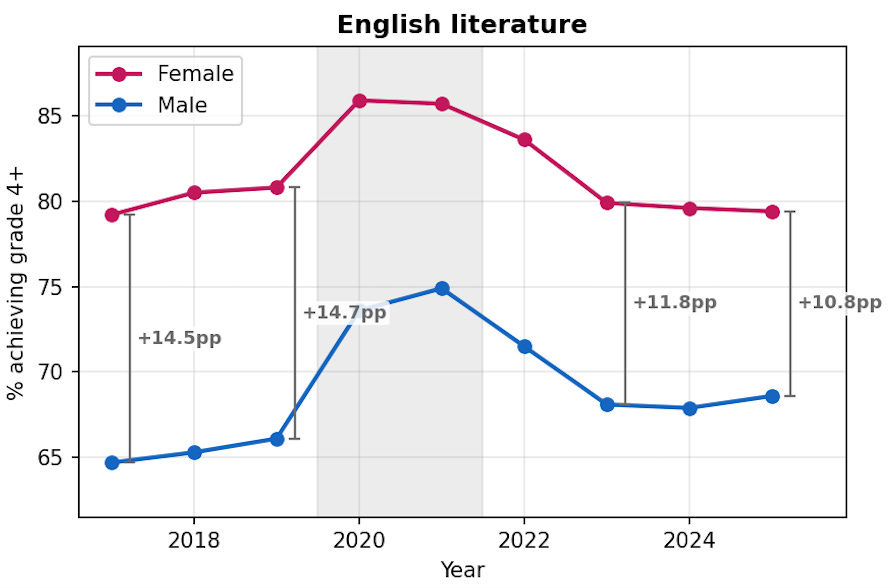
For English literature, the picture is a more positive one, with girls’ scores largely flat but boys’ scores consistently improving:
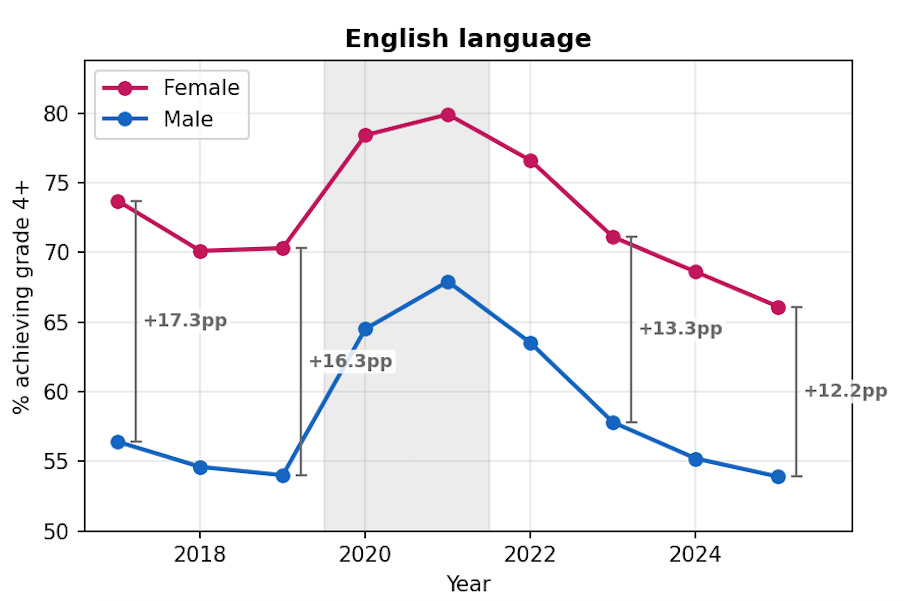
English language is a different story, though. While boys’ pass rates have fallen between 2017 and 2025, girls’ pass rates have dropped off a cliff:
What sound like tiny differences can bring huge costs – and we can do some back-of-the-envelope calculations to quantify them.
Let’s look at 16-year-olds only, to exclude retakers, whose data isn’t captured as well by the longer-term earnings calculations. In 2017, 78.2% of 16-year-old girls achieved at least a grade 4 in English language; by 2025 that had fallen to 75.9%, a drop of 2.3 percentage points. Applied to that year’s 307,270 papers, that’s roughly seven thousand more girls missing a pass than would have under 2017’s rate.
According to government figures, the boost in earnings for those who scraped a pass rather than failing their English language GCSE was around £18k in 2019 money.2 Multiplying the extra fails by the loss of lifetime earnings gives you an estimated £127 million in lost future earnings. So, that’s one subject – and we haven’t even added on seven years’ worth of interest.
Which gap are we closing?
Something has happened in England. We’ve been focusing on closing one gap – the socioeconomic disadvantage gap – at the expense of all others. Still, the gender gap has been closing, which is no bad thing in itself. Why say the gender gap is the ‘natural’ consequence of girls’ or boys’ ability or learning disposition if we wouldn’t say the same for disadvantage – or any other important outcome disparity?
But closing the gender attainment gap hasn’t been cost-free. It’s come at the expense of girls’ attainment, costing them and the economy many millions, by any estimate. It’s like dragging down the GCSE results of wealthier students and claiming we’d narrowed the gap between them and their disadvantaged peers. Few people, surely, would count this as a victory.
It’s likely there are many factors at play. But this doesn’t mean a shrug of the shoulders and back to business as usual. Before we continue, though, a note on gender: The data sources cited in this post treat gender as a binary. We lack robust, large-scale data for outcomes of students who identify, for example, as non-binary, and, while this gap should be addressed, it’s not something we can examine here due to these limitations.
What happens if you isolate and educate by gender?
To tell whether school environment makes a difference to boys’ or girls’ exam outcomes, we can perform a natural experiment, comparing students in mixed environments to the 10% in single-sex schools. And there’s a clear winner – students in single-sex schools do a lot better, getting almost grade 6 on average across their eight most important GCSE subjects. In mixed environments, the average is 4.6.
But there’s an issue. Single-sex schools are more likely to be selective or grammar schools, meaning students have higher prior attainment. They’re more often located in wealthier parts of the country, especially London, and have fewer disadvantaged students. Take all the measurable differences into account, as statistician Natasha Plaister did for her FFT Data Lab post, and the difference shrinks to almost nothing.
Not quite nothing, though, and the difference is important. After controlling for all the differences she could, Plaister found that boys make, on average, no extra progress in single-sex schools, but girls make one month’s extra progress – a small but meaningful difference. Girls’ scores may, therefore, be more sensitive to school environment than boys’, as evidenced by their larger pass grade fluctuations.
What’s changed in England’s schools?
If we’re interested in how England’s schools have changed in the last decade and a half, we need look no further than the educational policy changes brought about by the Conservative government in the early 2010s – not least the new exams discussed above. These changes have survived several changes in administration, including a Labour government, mostly intact. I’ve discussed a few of them in recent posts:
Moves towards mandated teaching techniques, as if they are fully evidence-based – a practice I’ve called ‘total instruction’.
Decreases in teacher autonomy and wellbeing.
A curriculum which proclaims high standards whilst allowing low pass marks.
We cannot pin any change, causally, to the fluctuations in girls’ pass rates, but it is worth considering whether there might be some underlying trend affecting girls. Perhaps girls’ wider school experiences are affecting their attainment.
The World Health Organisation conduct an international survey of adolescent health and wellbeing every 4 years. They ask thousands of 11-, 13- and 15-year-olds from around the globe about their health and wellbeing, plus school-related questions regarding relationships with teachers, classmates, and general experience of school. If we compare the most recent results, from 2022, to those of 2014, we can see how school-related wellbeing has changed since these Conservative-led changes began.
Daisy Christodoulou used the data to argue that the Conservative-led changes (for which she used the umbrella term ‘knowledge-rich curriculum’) had not harmed children’s mental health. I posted a reply, in which I raised doubts about the conclusion.
Here’s attitude to school, to begin with:
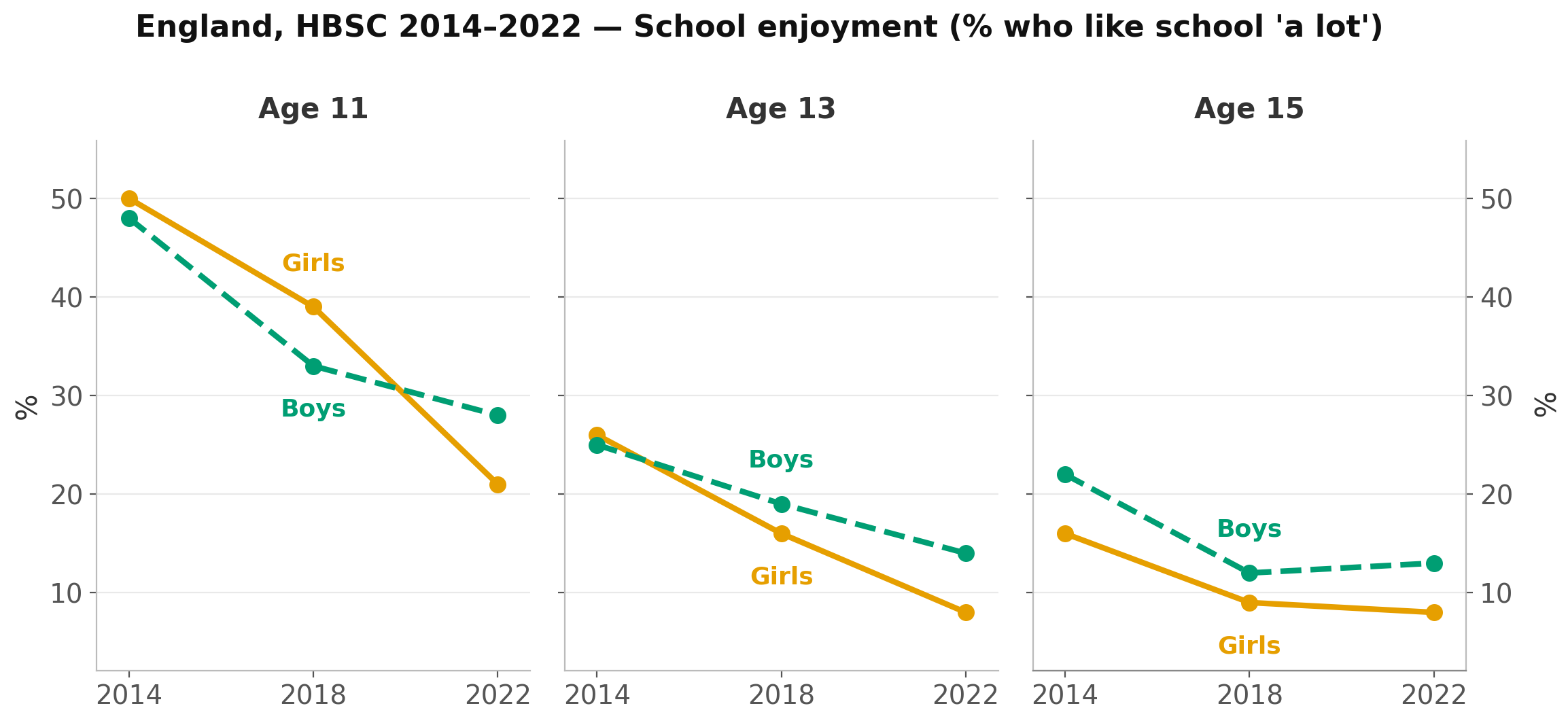
What we’re interested in here is not whether students’ attitude to school has suffered as a whole – although it has clearly crashed since 2014 and was plummeting even before the pandemic. More relevant are the gender disparities. At age 11, for example, girls liked school more – until recently. Similarly, at age 13, girls and boys shared a starting point, but their attitudes have diverged.
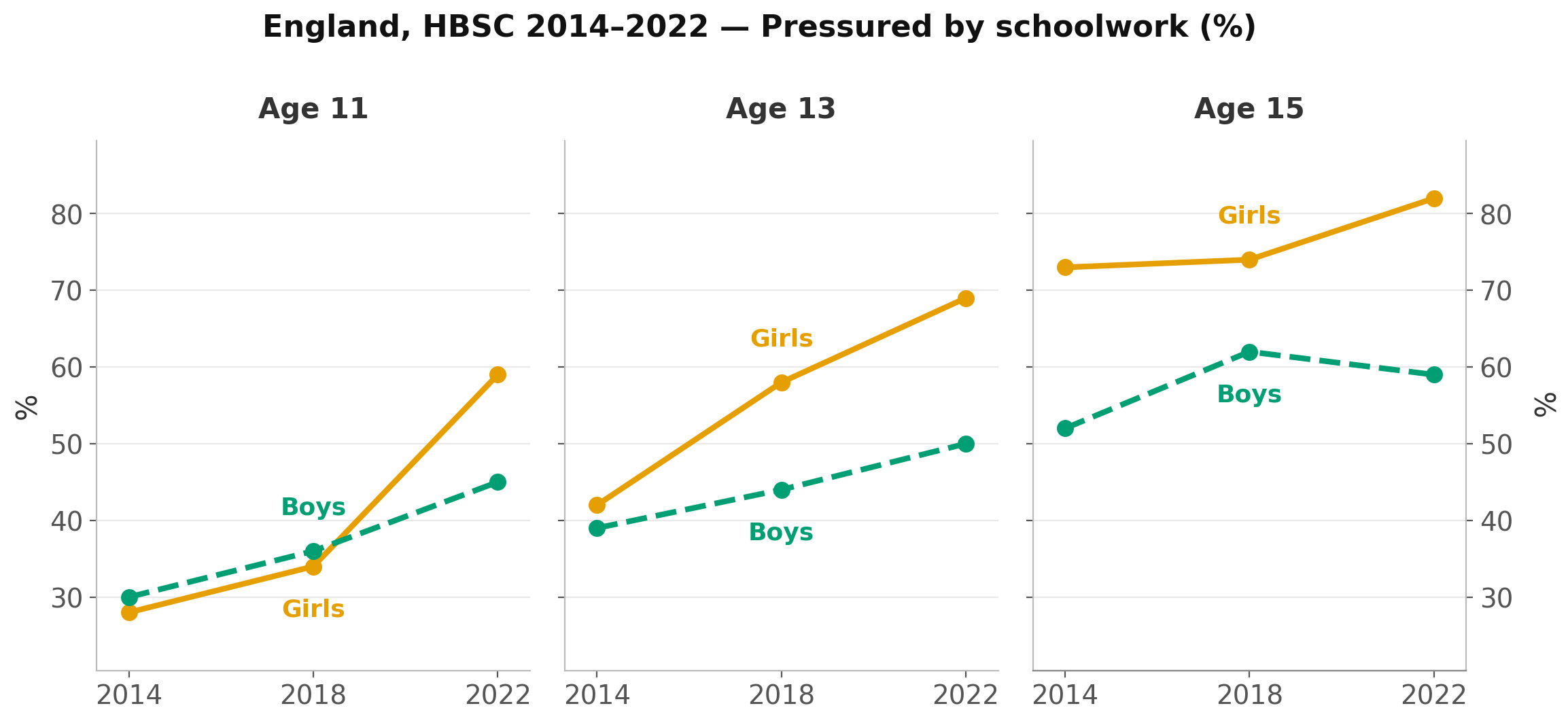
If anything, the deviation is even clearer in terms of students’ perceptions of pressure due to schoolwork. Perceived pressure has certainly increased overall. The trends at ages 11 and 13 leave no doubt around the fact that this is a gendered story too:
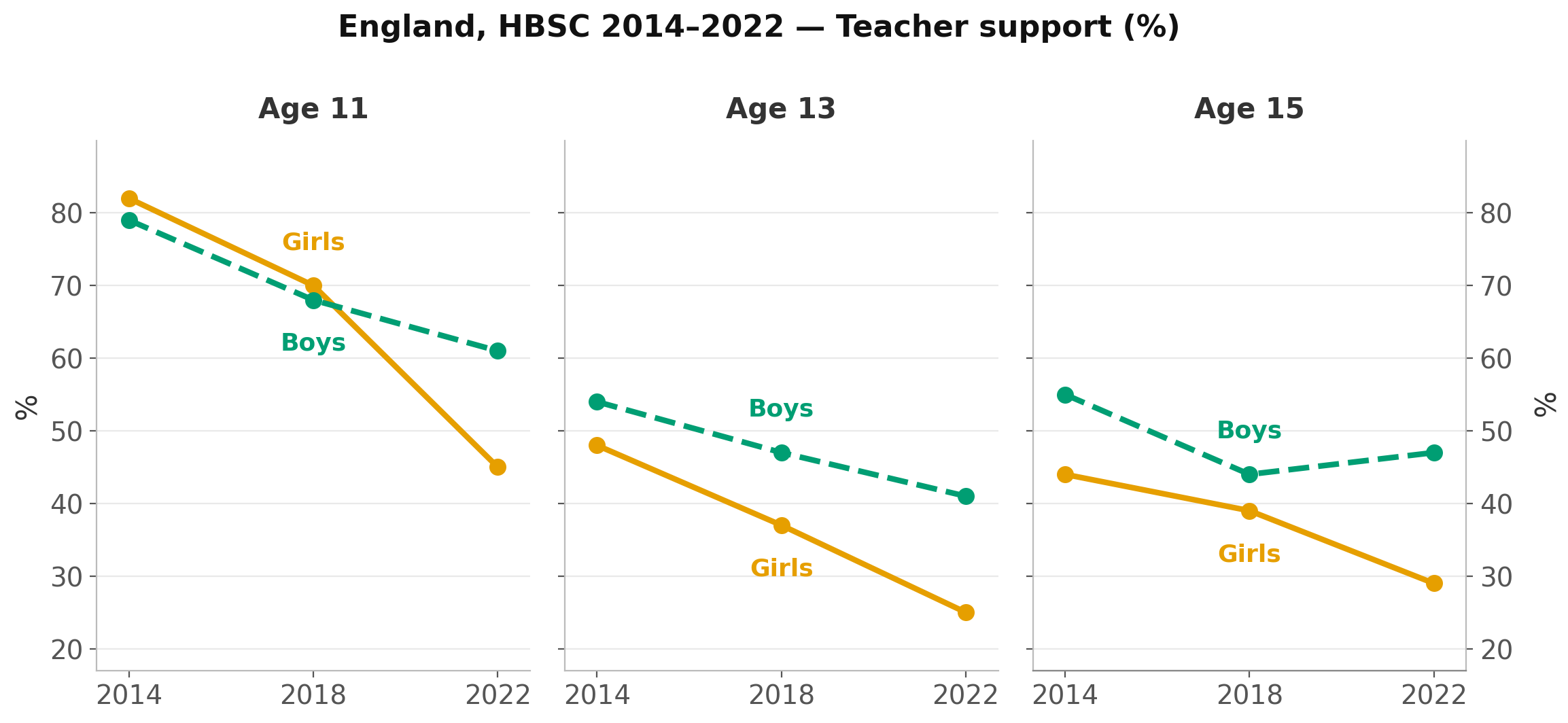
Finally, perceptions of teacher support have tumbled – and fallen considerably more steeply for girls than boys. As with schoolwork pressure, at age 11, the genders have once more flipped.
Opening the envelope
In some ways, it makes little sense to call the English curriculum knowledge rich. On some papers, a student can get a ‘good pass’ with marks a little over 20%. The disadvantage gap – the one the curriculum was meant to close – remains stubbornly high, and the gender gap has fallen, but largely at girls’ expense.
This could all, perhaps, be defensible if it had resulted in more enjoyment of school or a greater sense of support. Every HBSC indicator of school wellbeing decreased between 2014 and 2022. This is not simply a case of pandemic-related worldwide collapse; the fall was in several cases steepest from 2014 to 2018 and nearly all represent collapses in England’s standing relative to the 40-odd other nations surveyed too.
Most relevant to this post, though, is the divergence between the genders. In almost every case, boys’ and girls’ perceptions of school have diverged since 2014. Something has happened within schools that has affected children’s wellbeing – and it’s affected girls most of all.
It’s hard to pin these trends on a curriculum or changes to classroom expectations. But the patterns across all school wellbeing areas are clear and unambiguous. We’ve been asking one question again and again – ‘how do we close the disadvantage gap?’ Our answer to that needs to improve, but we need better questions, too.
Every one of the statistics we’ve seen – from the tiny changes in exam pass grades to the fall in enjoyment of school or feelings of teacher support – represents a student’s experience. Opening an envelope on results day, heart sinking as another door closes. Arriving in school for a lesson taught by mandated pedagogy rather than a teacher, responsive, understanding, ready to spark curiosity and bring the lesson to life.
Are girls being left behind in school? On the strength of this evidence, it seems so. But we also need more research. We have the evidence about exam grades and from wellbeing surveys but it’s time to widen our sense of what counts as evidence here. We need to understand their experiences, by speaking to them, listening to their answers, then doing something about it.
I’ve used GCSE grade 4+ pass data; some sources use only those for 16-year-olds, meaning cited pass rates can vary; also note that 2022’s pass grades were transitional and so still inflated above normal levels.
I’m taking the old D-C boundary (see Figure 8 in the hyperlinked doc), equivalent now to the move from grade 3 to 4; the document acknowledges these estimates are ‘upper-bounds’ and they show associations rather than causation.
Thanks for this interesting rundown. I'm wondering whether any possible changes in assessment features and procedures may have contributed to the changing achievement patterns. I'd need to look back, but can remember research from 30 years or so ago - here in Australia, and maybe more generally - which showed that girls do better in assessment regimes which favour more coursework. As against boys, who generally do better in a more knowledge/'fact'-based and exam driven system. Just a thought.