

There was jubilation in certain corners of the Substackosphere – if, indeed, a sphere can have corners – when the PISA 2025 results came out. England victorious. A certain model of education, vindicated. Then came confusion, or at least a semblance of it. Why couldn’t everyone else see what they could?
‘They’ being Daisy Christodoulou, but also others named in her recent round-up of education writers, Greg Ashman among them, who have celebrated England’s results and are wondering why nobody else is setting off the fireworks.
Here’s what Christodoulou wrote back in October:
The whole world is worrying about their kids getting dumber. England appear to have the policy solution. And yet the government in England seem to want to reverse those policies. Why is this happening?! To be totally honest, I don’t really know why! But I will have a go at answering it in a future post.
I consider myself as patient as anyone else writing in the edu-Substackosphere, but a month on, she’s still baffled, so I’ve decided to give it a go here.
A very English revolution
A quick history lesson: since 2010, England has overhauled its curriculum and exams and, through inspection, teacher-training frameworks, and research-led innovation such as the use of synthetic phonics, how teachers teach. This explains, these commentators argue, why England has done so well.
While other countries look on, wondering how to copy England, England’s own Department for Education is busy taking the thing apart. Or so the story goes.
Medals at last (just don’t ask about the colour)
Christodoulou et al. (2026) are right about one thing: the numbers tell a compelling story.
PISA is the OECD’s test of 15-year-olds, held every few years – the World Cup of international education testing. And England has had a good tournament. In 2012, by Christodoulou’s reckoning, England ranked somewhere around 20th to 25th. In 2025 it’s 8th in the world for science and, as she points out, one of only two countries outside East Asia (Estonia is the other) in the top ten for reading, maths and science. From going home in the group stages to getting knocked out by familiar foes at the business end of the tournament in just over a decade – not bad, as progress goes.
In truth, England’s scores haven’t actually risen much. Science (516) is about where it was in 2015 (512). Same story in maths (492 now, 493 then) and reading (497 now, 500 then). England’s climb up the ranking is mostly down to holding steady while much of the developed world went backwards. Christodoulou would probably say that holding steady through a pandemic and a global slump is the achievement, just as reaching the semis of the World Cup is still an achievement even though favourites like Germany had a schocker and crashed out early. A win is a win, after all.
It would be easy to cite the experts who’ve argued some of this is down to which pupils ended up taking the test, or when they took it. But it would be a stretch to claim England’s success is all a statistical artefact. After all, other international tests give similar clues. In TIMSS 2023, the international maths and science test, England came 5th in the world for science at both Year 5 and Year 9, and 6th for Year 9 maths.
It is, however, only half the story. Straight after the two-hour test, the same 15-year-olds fill in a questionnaire about their lives, their schools and their teachers. The results make for interesting reading.
An auld rivalry – and new developments
Christodoulou’s favourite comparison is Scotland: ‘a similar country which had basically the same PISA scores as England in 2012’. Since then, they’ve been on different educational journeys. South of Hadrian’s Wall, a knowledge-rich curriculum. North of the border, Curriculum for Excellence, built around four broad ‘capacities’ (successful learners, confident individuals, responsible citizens and effective contributors), with more emphasis on skills and cross-subject learning.
Is the experiment as neat as she makes out? Not really. Curriculum isn’t the only thing that differs. Scotland has no academies and no official league tables, it sits different exams (National 5s rather than GCSEs), its pupils usually take fewer subjects to exam level, and it inspects schools differently.
Let’s park all that though and follow Christodoulou up the A1(M). Before PISA 2025 came out, she was already claiming that England was ahead academically, and – using another dataset – that England’s kids were no more miserable than those in Scotland and Wales. She repeated the claim on BBC radio recently. As I argued in April, her own dataset tells a different story at 11 and 13: liking school and pressure from schoolwork have moved much further in England than in Scotland or Wales.
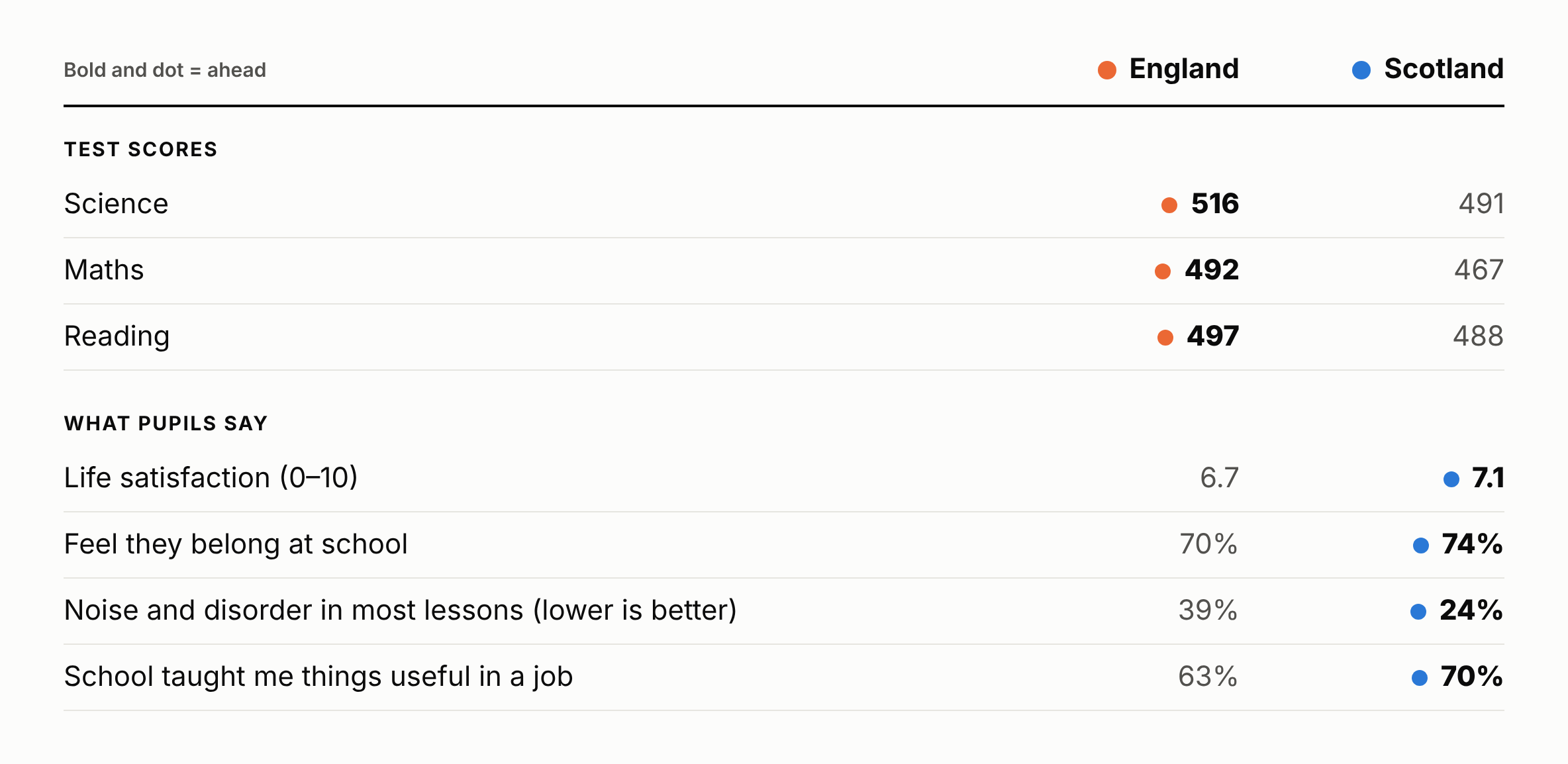
What’s changed since the 2025 results came out? Well, she’s still right about PISA. On the tests, England is ahead in every subject: 516 to 491 in science, 492 to 467 in maths and 497 to 488 in reading. Scotland’s above the OECD average in science and reading, but the gap is considerable, given the OECD put 20 points at around a year’s learning.
On results day she still argued (citing that same WHO data) that there ‘aren’t massive differences’ between pupils in England, Wales and Scotland, who ‘all seem to dislike school equally’. Is she right? Judge for yourself (the questionnaire gaps hold when you compare pupils from similar backgrounds with similar test scores):
There’s a caveat: English pupils sat PISA between February and May 2025, in the middle of mock exam season and during the run-up to GCSEs; Scottish pupils sat it in September and October. Psychologically, school might not have seemed at its rosiest to those English kids sitting in extra revision classes, whereas the Scottish kids might have felt fresh as daisies when they took it. Comparatively. But it means English pupils also had a few extra months of teaching before taking their test.
If you were starting from scratch and had to choose – the Scottish way or the English? Maybe it’s not quite as clear cut as Christodoulou makes out.
Top of the class, bottom of the table
Once you dig into the questionnaire data, the picture gets even murkier. Here’s England’s PISA scorecard in full, ranked against the 38 OECD countries:1
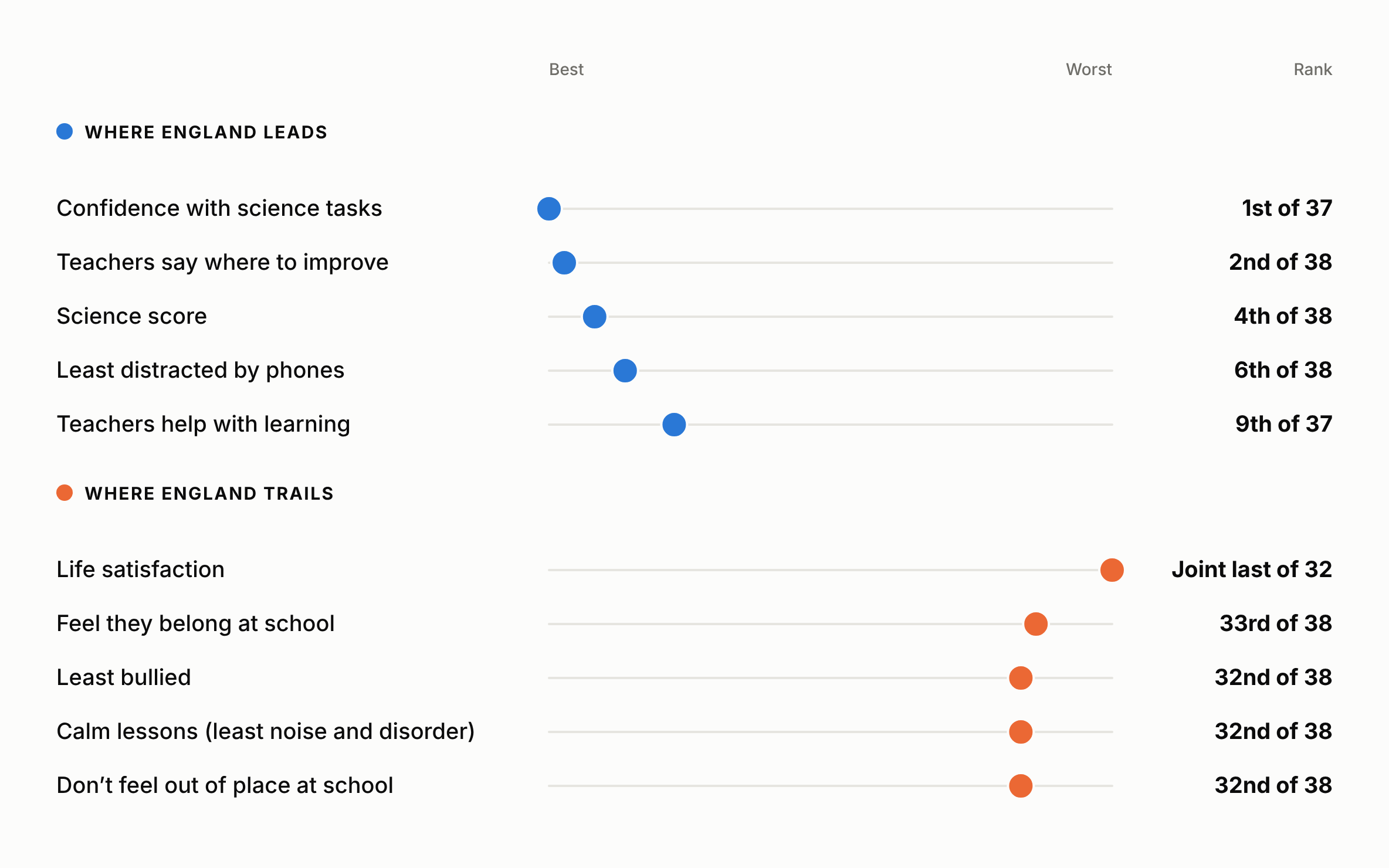
Pedagogically, something seems to be going well. English students are academically confident and get targeted help and feedback from teachers.
Alongside that, though, English 15-year-olds rate their life satisfaction at 6.7 out of 10, against an OECD average of 7.3. That puts England joint last of the 32 OECD countries that asked. Fewer than a quarter of English teenagers rate their life 9 or 10, against more than a third across the OECD. Nearly one in five rate it 4 or below, against 13%.
These are just numbers, so it helps me to picture my Year 11 class: Thirty kids. On average, six of them rate their life satisfaction at 4 or below. What does that actually feel like? What is happening in their lives to rate it that low?
Sure, life satisfaction has many causes, and it has fallen across rich countries. But this isn’t simply the global slide in teenage wellbeing that Christodoulou points to. Many of these indicators are school-specific.
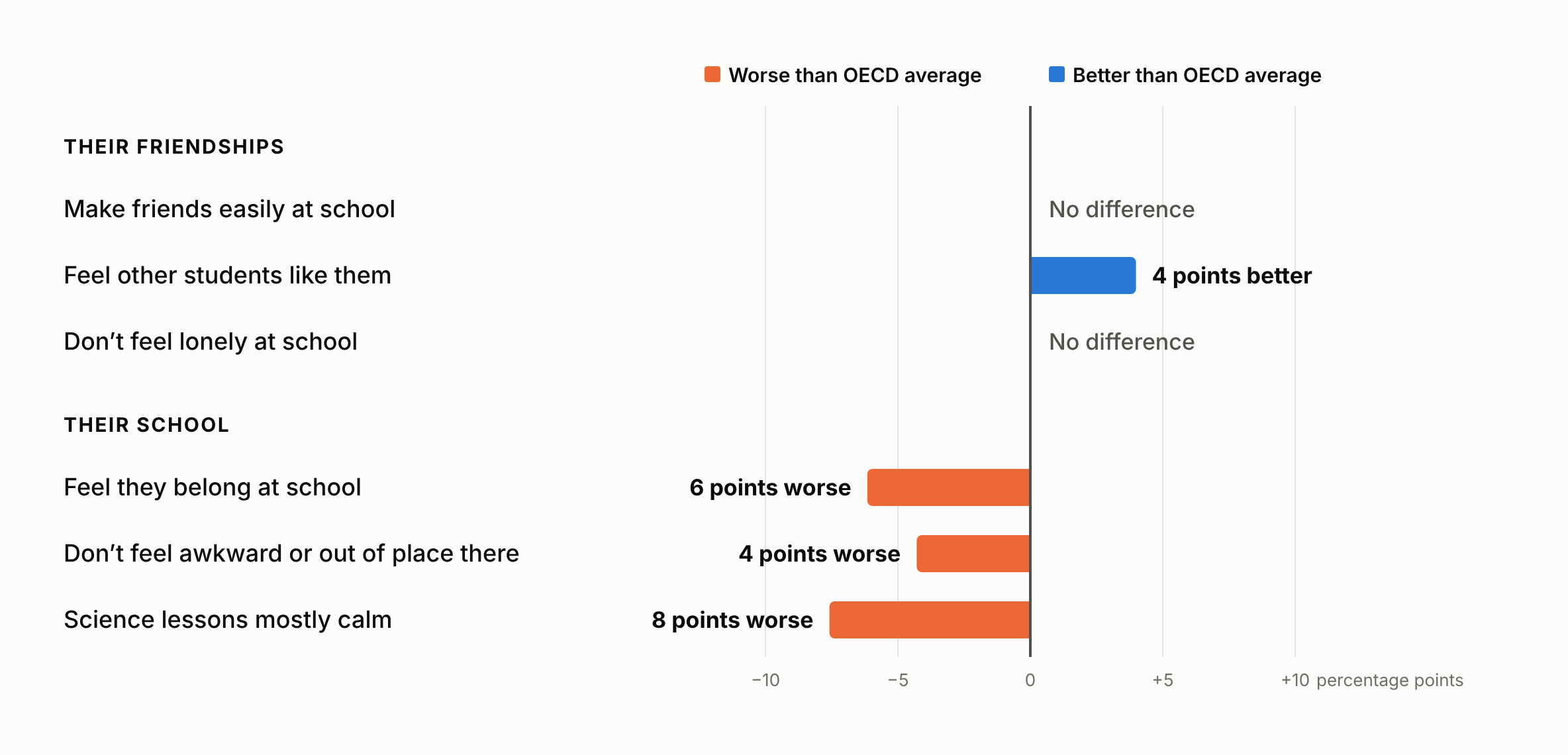
Only 70% feel they belong at school, against an OECD average of 76%: 33rd of 38. Bullying is more common than in most OECD countries: where 1st is least bullied, England is 32nd of 38, based on how often pupils say they’ve been made fun of, threatened, hit or pushed, had nasty rumours spread about them or had upsetting things posted about them online in the past year.2
If ‘top ten for science’ tells us something meaningful about the impact of England’s educational changes then so does ‘bottom ten for belonging’.
It’s not their mates. It’s the school.
The problem isn’t the kids, on these stats at least: English teenagers make friends as easily as teenagers anywhere (80%, exactly the OECD average), they’re no lonelier than the average and they’re more likely than most to say other students seem to like them (87% against 83%). What’s different is how they feel about school itself: fewer feel they belong, and more feel ‘awkward and out of place in my school’ (23% against 19%).
Despite media tales of England’s super-strict schools, that emphasis on order and compliance doesn’t come through in the results: 39% of English pupils report noise and disorder in most science lessons, against 31% across the OECD.
The relationships are there; the connection to school isn’t. And I’ve seen it play out, day after day, year after year. Those kids who just drop off the radar. The only place you see them is on the register.
We aren’t Finnished yet
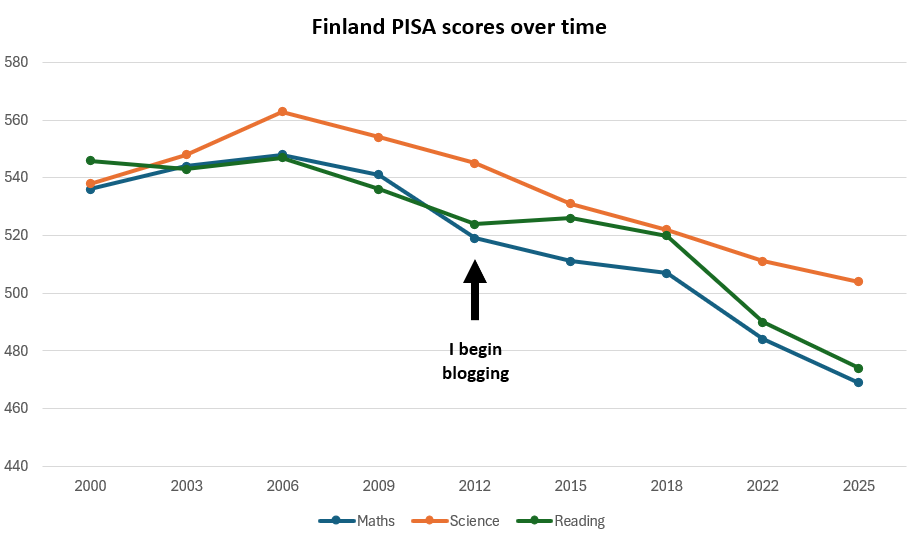
Finland, once the darling of educational progressives across Europe and beyond, has slid down the rankings, as Greg Ashman has pointed out. He even posted a graph showing that Finland’s fall began before – rather than being a consequence of – his decision to start blogging:
It isn’t the only Finland graph worth looking at, though. Plot PISA science scores – the focus of this round – against life satisfaction, and the picture changes:
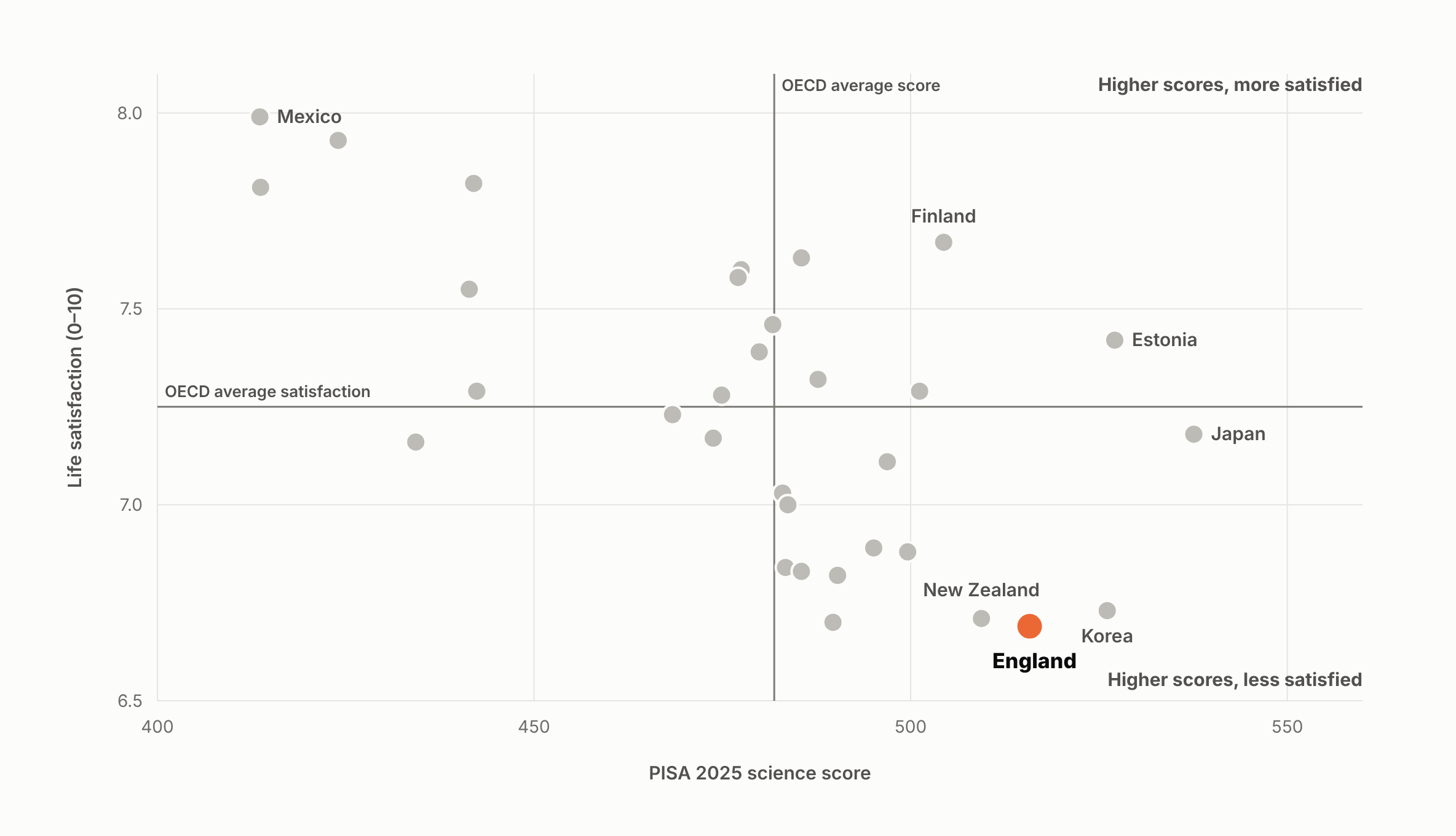
Finland’s scores have fallen, but at 504 it’s still above the OECD average for science, and its teenagers are among the most satisfied in the OECD (7.7 out of 10). England sits in the bottom-right corner, next to Korea: high scores, low satisfaction. Comparing happiness across countries raises cultural comparability questions – Mexico and Costa Rica sit top of the table – but the pattern is hard to ignore.
Do you have to trade attainment for satisfied pupils? Estonia suggests not. It beats England on science (527 to 516), life satisfaction (7.4 to 6.7), belonging (80% to 70%) and calm lessons (24% report regular noise and disorder, against 39%). Is Estonia doing something that England can do more of?
The questions we should be asking
Whether it’s the knowledge-rich curriculum, the teacher training framework or the mandating of particular teaching techniques, I’ve been critical of much of what’s happened in English education. Was I wrong to be?
Yes, in part.
England’s academic success is hard to deny without picking at statistical threads. PISA isn’t just a test of memorisation – it’s designed to see whether pupils can apply what they know. Something is working, and the reforms probably deserve some of the credit.
When the results came out, I should have been celebrating. Instead, I was ambivalent. Deep down, I didn’t believe the changes had been positive, and yet the scores were complicating the picture I held. I liked the inflated stats explanation, which is an awkward thing to admit when I teach in England and care about how my students do.
I was narrow-minded, but I don’t think I was the only one. Part of the joy of writing online is to be challenged – directly and indirectly – by those who hold different views. But the debate only moves forward by bringing the camps together, not driving them further apart.
To do that, we need to ask two questions:
1. What has actually driven England’s PISA success?
2. How do we preserve the gains while making school somewhere young people feel they belong?
Because two things are becoming clear. In England, something is working: policy reforms might well hold the clues. And in England, something is going badly wrong. We need to fix the second without undoing the first.
We can do that. But only if we stop celebrating the goals we’ve scored while ignoring those we’ve conceded.
Figures from my analysis of the OECD’s PISA 2025 student data, using the OECD’s weights; rankings among the 38 OECD countries with England in place of the UK.
Not every country asked every question, so the number of countries in each ranking varies.